$6M Affordable Housing Experiment Helps Spur $248M in Development
Share News:


An experiment using $6 million in taxpayer money to attract private investment and philanthropic contributions for affordable housing is showing some real scale in Dallas.
The Dallas Housing Opportunity Fund has supported the construction of 858 affordable multifamily units across 10 investments since its launch in 2022, according to a new three-year impact report by LISC Fund Management. The fund invested $39.8 million into projects representing $248.3 million in total development costs.
Boosters already declared the fund “wildly successful” last year after its first eight deals. At that point, it had supported 553 units, including 200 targeted toward households earning between 30% and 50% of area median income.
DHOF pools city money with private and philanthropic capital and then invests in developers rather than owning housing itself. The fund targets households earning between 30% and 120% of AMI, with an emphasis on those at or below 80%. It is managed by LISC Fund Management in partnership with Dallas-based TREC Community Investors.
“In a short period, DHOF has demonstrated how aligned, mission-driven capital can deliver tangible results — expanding access to quality, affordable housing for Dallas residents while strengthening neighborhoods across the city,” said TREC president and CEO Jamee Jolly. “These early outcomes highlight the strength of collaboration between the private sector, the City of Dallas, and community-focused investors.”
The approach is different from other mechanisms used by Dallas officials to encourage the construction of affordable housing. A number of projects have been supported by the Dallas Housing Finance Corporation and Dallas Public Facility Corporation. Such arrangements can have the city taking legal ownership of the development, removing it from the tax rolls.
“I am a big fan of LISC and have routinely touted their success in funding projects across Dallas, addressing affordability gaps in areas that other Dallas tools have been unable to fill,” Council Member Chad West (District 1) said in a newsletter, touting the fund’s progress over the last three years.
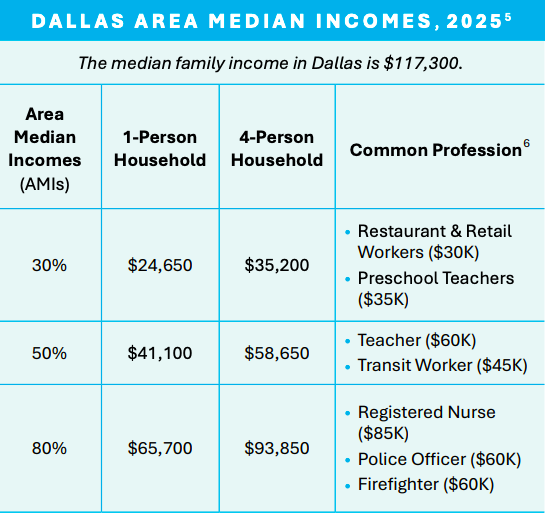
LISC’s report estimates that 59% of Dallas’ roughly 304,000 renter households earn less than 80% AMI, while half are cost-burdened, meaning they spend more than 30% of their income on housing. Households below 30% AMI spend more than 75% of their income on housing. Dallas also has only about 60 affordable units for every 100 extremely low-income renters.
Those findings track with an earlier analysis by city officials and housing advocates who said Dallas has a shortage of roughly 46,000 units affordable to households earning 50% AMI or less. While the region has produced a good amount of multifamily housing, much of it has been market-rate or luxury product rather than workforce housing. LISC’s report projected that the affordable housing shortage for 50% AMI and below could reach 84,000 units by 2030.
Fund managers said their approach can chip away at that deficit while also avoiding a longstanding pitfall of Dallas affordable housing policy: where subsidized units get built. DHOF prioritizes high-opportunity neighborhoods and distributes investments across different parts of the city rather than concentrating affordable housing in a handful of lower-income areas.
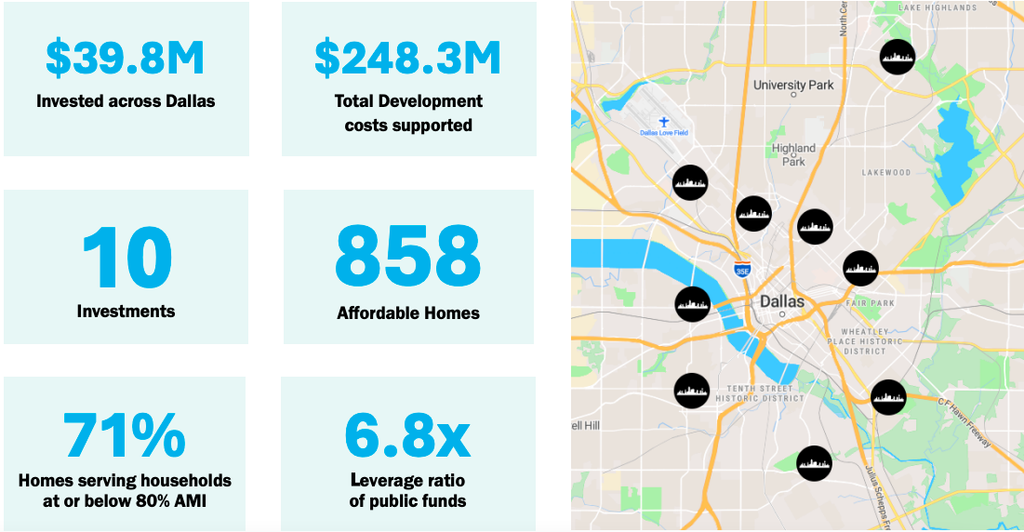
Its portfolio reflects a fairly broad range of projects:
Oak Lawn Place includes 84 apartments, all affordable to households earning less than 60% AMI. It’s billed as North Texas’ first LGBTQIA+-affirming affordable senior housing development. Rawlins Chateau provides 54 affordable units, including 22 reserved for people with disabilities who have experienced chronic homelessness. The Culbreath in Southeast Dallas is by far the largest project, with 364 units, including 327 affordable to households below 80% AMI.
In Old East Dallas, the 71-unit Jaipur Lofts is entirely affordable and represents $27.8 million in development costs. CandysDirt.com reported when the development opened that it was the neighborhood’s first tax-credit housing project in more than two decades. Nearby Kiva East includes 87 units, 71 of them affordable below 80% AMI, along with a tuition-free Montessori-inspired Bezos Academy preschool serving 40 children onsite.
“These outcomes represent more than numbers,” said LISC Fund Management president Tiffany Durr. “They reflect long-overdue reinvestment and real progress for Dallas residents, families, seniors, and working households seeking stability, opportunity, and community.”
DHOF relies on a mix of local developers and financial partners to put that capital to work. Developer partners listed in the report include Dallas City Homes, Exodus Development Group, Launch Capital, Metrocare, O-SDA Industries, Saigebrook Development, Texas Inter-Faith Housing, The Resource Center, and Volunteers of America National Services.
Altogether, 71% of homes supported by DHOF serve households at or below 80% AMI, and developments financed by the fund are required to remain affordable for at least 15 years.