
D-FW Hotels’ World Cup Win Came More From Higher Rates Than Higher Occupancy
Share News:


Numbers are still being tabulated, but early data suggest D-FW hotels outperformed most other U.S. host markets during the FIFA World Cup.
AT&T Stadium in Arlington, rebranded as Dallas Stadium for the tournament, hosted a tournament-high nine matches, positioning the Metroplex to capture a significant share of World Cup visitors. While it seems increasingly unlikely that the total economic impact will reach the lofty expectations touted last year, preliminary figures suggest hotels made the most of the event by charging premium rates.
Bookings in downtown Dallas, for instance, jumped nearly 70% opening weekend, with room revenue spiking roughly 170% compared to the same period last year, according to the Hotel Association of North Texas. Now, that’s just one weekend in one high-profile submarket, but the metrics are illustrative:
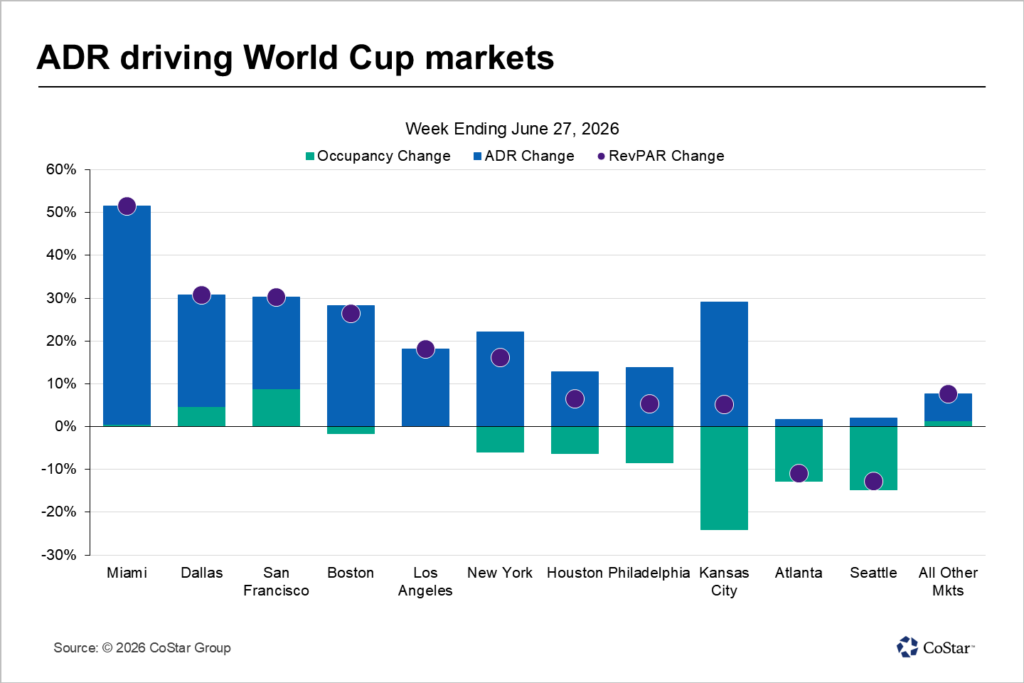
Higher room rates, rather than dramatically fuller hotels, drove the gains.
Of course, it will take some weeks to get a complete picture of hotel occupancy and spending across the June 11-July 19 tournament, but early national data through June indicated occupancy saw a very modest bump among host city markets. — less than 3%, per an analysis by CoStar.
For the week ending June 27, Dallas and San Francisco were the only host markets to record year-over-year occupancy increases, according to CoStar data. Occupancy in other host markets was flat or went down from last year.
That performance came after warning signs emerged when FIFA started canceling blocks of reserved hotel rooms in April and May.
Unimpressive occupancy, however, does not tell the entire story when hotels can command significantly higher rates. Revenue per available room, or RevPAR, measures the combined effects of occupancy and average room rates and is considered a key gauge of hotel performance. U.S. hotels nearly hit a 10% increase in the weeks ending on June 20 and June 27.
D-FW hotels performed even better, posting a RevPAR spike of just over 30% for the week ending on June 27, according to CoStar.

Hotel Association of North Texas Executive Director Traci Mayer struck an optimistic note in a statement to CandysDirt.com.
“Our hotels saw full houses around match days, guests from all over the world, and concierge teams working nonstop to serve our visitors,” she said. “What our members keep coming back to is how welcome their guests felt. They came for soccer and left loving Dallas, and that impression will pay off for this region long after the tournament.”
Arlington officials had reason to celebrate early. The city beat its previous monthly record ($23.6 million) for combined hotel and short-term rental revenue, hitting $31 million in June alone.
One piece of the World Cup’s economic impact that has already come into focus is short-term rentals. According to AirDNA, D-FW generated $93.3 million in STR revenue between June 10 and July 19, a 39% year-over-year increase and a $26 million gain over the same period in 2025. The Metroplex ranked second nationally for demand growth and third for revenue growth, with a surge in new listings helping absorb the influx of visitors.
Higher nightly rates played a big part in those gains, as did international travelers. According to HANTX, international flight bookings into D/FW International Airport and Dallas Love Field were up 78% during the early stretch of the tournament. The group said international guests stayed around two-and-a-half nights on average.
It’ll be interesting to see the final breakdown between traditional hotels and STRs, with the latter part of the lodging industry now basically fully matured — though still hampered by a patchwork of local bans and regulations.







I’d love to see the numbers for Texas Live. How did they keep that placed stocked with alcohol? (Serious question.)