
Residential Building Permits Fall as Recession Risk Climbs to 40%, Economist Says
Share News:

The economy is still growing, but the margin for error is shrinking fast. That’s according to Moody’s Analytics chief economist Mark Zandi, who said his latest modeling puts the chance of a recession over the next year at about 40%, well above the typical baseline.
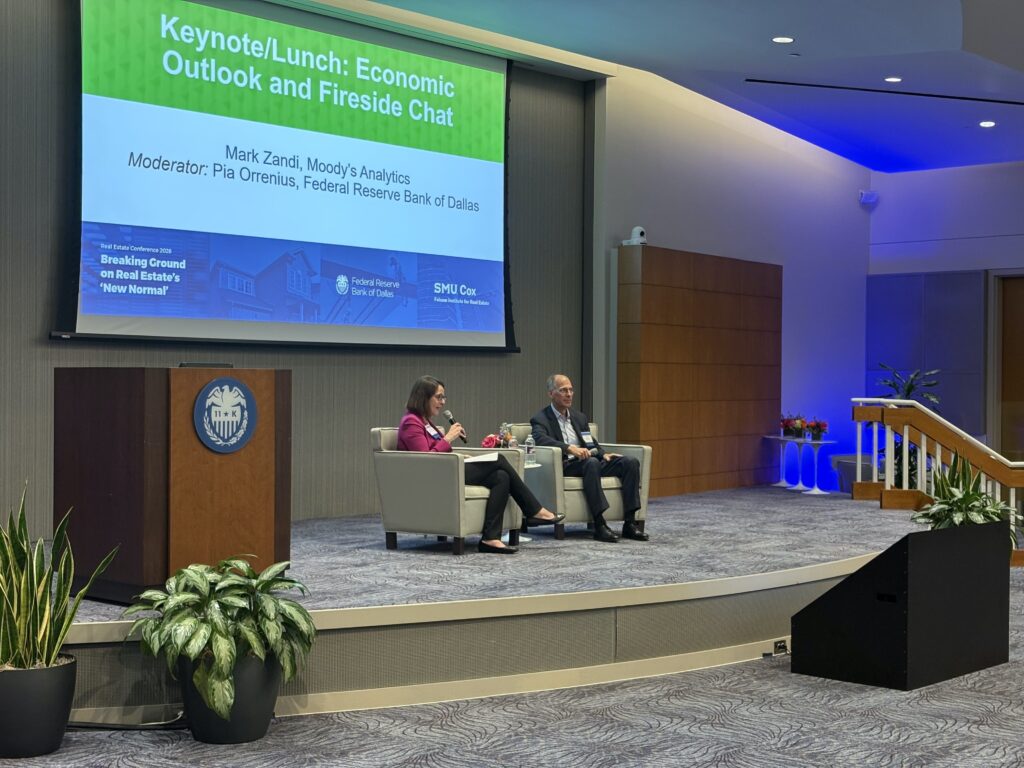
“I expect in the most likely baseline scenario going forward for it to continue to grow, but it’s a fragile growth, and recession risks are very high,” Zandi told attendees at the Federal Reserve Bank of Dallas’ Breaking Ground on Real Estate’s “New Normal” conference held Wednesday.
The typical probability of a recession is closer to 15-20%. One of the most reliable early indicators, Zandi said, is the housing market — particularly residential building permits.
“It always goes down before a recession,” he said.
National data shows permits dropped more than 5% month-to-month and year-over-year in January. And this was already after months of cooling over the fall as builders became more cautious amid affordability and financing concerns. Federal trade (tariffs) and immigration (deportation) policy under the Trump administration has added quite a bit of uncertainty.
Both single-family and multifamily markets, Zandi said, are among the softest parts of the economy right now, reflecting the broader drag from elevated interest rates and reduced affordability.
“So, are we going to suffer a downturn or not? I don’t think so,” Zandi said. “I think we’ll be able to navigate through it, but it’s going to feel a bit uncomfortable.”
According to Zandi, a few big factors loom over the trajectory of the economy: the war in Iran and its corresponding impact on oil prices; the job market; and the Federal Reserve.
Higher energy costs due to the war are already weighing on consumers and could tip the economy into recession if prices spike further. A sustained surge could push gasoline prices back toward $5 per gallon nationally, he said, eroding purchasing power and dampening demand. But even if the Strait of Hormuz was opened tomorrow, the new geopolitical reality in the region would make transporting oil out of the strait prohibitive because of insurance costs.
“We’re not going back to the sub $3 a gallon for [regular],” Zandi said, noting, however, that the economy should be able to navigate that new reality. “I know you pay less for that here in Texas, but in the rest of the country you pay about three bucks. We’re not going back to that.”
Further deployment of AI in the workplace could also tip things over at some point. Labor market conditions are already weaker than data suggests, with growth largely concentrated in healthcare and construction. Businesses have avoided widespread layoffs over the past year, instead pulling back on hiring and hours, which Zandi described as a firewall.
“The firewall comes down and we are in a recession,” he said.
All the while, the Federal Reserve will be trying to navigate competing pressures. Prospective homebuyers, sellers, realtors, and builders (really everyone in the industry) have anxiously been waiting for mortgage rates to chase after the central bank’s benchmark interest rate downward. It’s looking like they’re going to have to wait longer.
“The key here to whether the Fed starts jacking up rates and whether long-term interest rates start to rise is inflation expectations,” Zandi said, calling higher long-term rates “fodder for recession.”
Beyond near-term risks, Zandi highlighted artificial intelligence as both a powerful tailwind and a potential source of disruption. Investment tied to AI — particularly in data centers — along with surging tech valuations, is helping sustain the economy’s growth. But a rapid acceleration in productivity and deployment in the workplace could also lead to job displacement, creating a new pathway to recession.
For now, though, as precarious as things may seem, nothing is set in stone.
“I’ve seen a lot of business cycles through a lot of business models, and there are only a handful of other times in that period when I’ve been as uncertain about the economic outlook as today,” Zandi said. “So, it’s really important to keep that in mind.”