
Is Saving Dallas City Hall at Odds With Saving Downtown?
Share News:

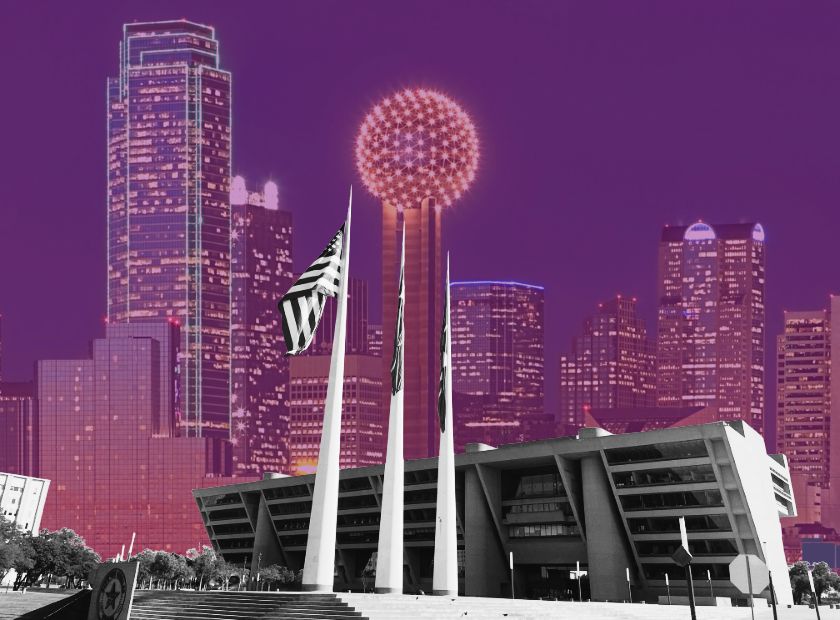
A battle for the hearts, minds, and identity of Dallas is underway as officials prepare to make one of the most consequential decisions of their careers: keep the seat of municipal government at 1500 Marilla St. or relocate City Hall operations somewhere else downtown.
Over the last few months, the debate over the fate of the Brutalist edifice has become more than just disagreement over costs, historic preservation, and functionality. Rather, partisans in the fight are framing the issue as an inflection point that could determine the future of the central business district and perhaps the character of the city as a whole. If all that seems dramatic, you haven’t been paying attention to the discourse.
“If we’re honest, it’s an open question whether anything is sacred in Dallas,” said Seemee Ali, director of the Dallas Institute for Humanities and Culture (DIHC), lamenting the neglect that has befallen City Hall and other historic buildings.
DIHC and the Dallas Architecture Forum held an event on Thursday at J. Erik Jonsson Central Library, where Ali and other guest speakers shared their perspectives on the significance of 1500 Marilla St. to Dallas history and the city’s identity. More than 140 people turned out, almost all seemingly in the Save City Hall camp.
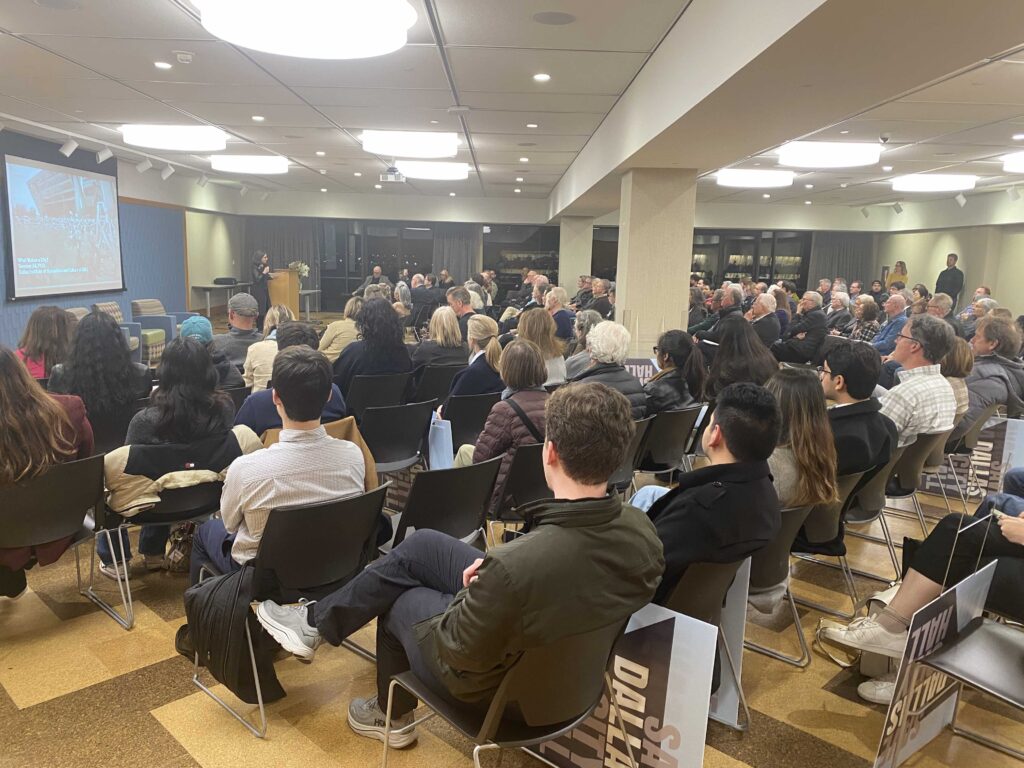
“It challenges people,” Ali said. “It’s one of the buildings that makes Dallas Dallas.”
1500 Marilla St.’s inception was bound up in the local rebranding effort that followed the assassination of President John F. Kennedy. Civic leaders wanted to shed the “City of Hate” moniker, enlisting renowned architect I.M. Pei to design the iconic building.
Now, another rebranding effort by way of real estate is afoot, with some developers, boosters, and officials arguing that downtown revitalization is at stake. Proponents of offloading City Hall to the Dallas Mavericks or some other interested buyer claim the transaction would spur further development at a critical point in the neighborhood’s history.
The central business district is in a state of transition as office towers give way to residential and officials grapple with the spike in crime and homelessness that followed the COVID-19 pandemic. Meanwhile, other parts of town (cough, cough, Uptown) are outshining the historic city center with new construction.
Recently, The Dallas Morning News announced it was launching a series of editorials and columns dubbed “Saving Downtown,” citing the debate over City Hall as the impetus.
“Every important decision comes with cost and opportunity, and we believe this one will set the direction for our city, and by extension the region, for many years to come,” wrote the editorial board.
One of the inaugural pieces was by local developer Ray Washburne, a stakeholder with real estate holdings downtown near City Hall. He envisioned a tax-revenue-generating, walkable, connected neighborhood transformed by redesigned streets and dense, mixed-use projects, with a new Mavericks arena at 1500 Marilla St. as the catalyst. He also proposed relocating city operations to Founders Square, which he owns.
Washburne isn’t alone. Multiple developers, former city officials, and downtown stakeholders have argued that unlocking the real estate there would stimulate significant investment and transform the southern part of the central business district.
“I believe in this vision because I believe in Dallas. We can make our city beautiful, prosperous, and an envy of the world. We just need to see what it can be and make it happen,” he wrote.
While there are no doubt some who wish (in vain) that the central business district could be restored to its former glory as the mecca for city office space, many share Washburne’s hopes for downtown — they just don’t think demolishing City Hall is necessary.
At Thursday’s event, economist J.H. Cullum Clark of the George W. Bush Institute painted a similar picture of a “vibrant live-work-play-learn environment” based on continued residential population growth, cultural projects like new higher education facilities, and interesting design and architecture.
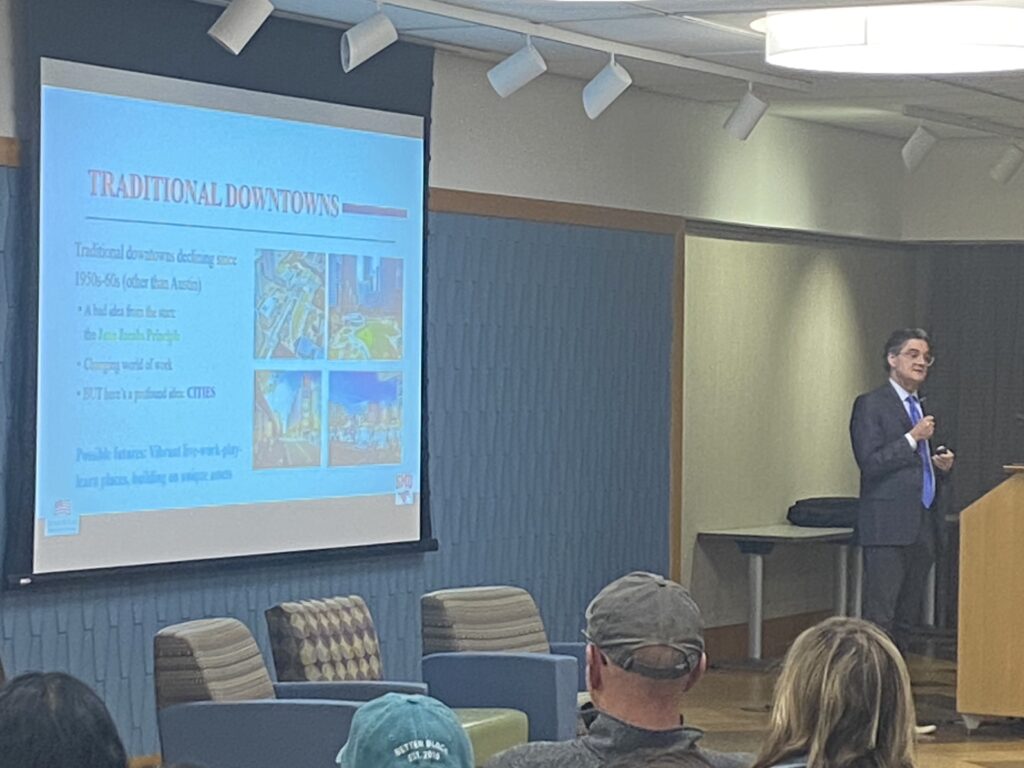
Improved public safety is also important, he said, cautioning against projects that could have undesirable spillover effects. He specifically referenced casinos in his presentation.
“Casinos do in fact create spillovers in the form of binge drinking outside, drug use, prostitution. All of these things do tend to go up in that immediate facility proximity,” Cullum said.
Even though casino gaming is not legal in Texas, supporters of keeping City Hall at 1500 Marilla St. have speculated that if the Mavericks’ casino magnate majority owner Miriam Adelson buys the property, she would plant a casino in the development at the first opportunity.
Her company has already been trying to set the stage for casino gaming at the local level in Irving, and the industry has been lobbying the Texas Legislature hard in recent years. Some feel it may not be a case of if it becomes legal, but when.
Cullum said officials should instead seek to make City Hall more engaging to the public by leveraging the first floor and plaza outside, pointing to the Dallas Federal Reserve’s museum as an example.
“We have the occasional exhibit, but imagine really doing it right,” he said.
No one doubts something needs to be done about City Hall. Setting aside the activation potential, many years of deferred maintenance have left the building in need of a laundry list of repairs. But local preservationists and industry professionals dispute the figures being quoted by city staff, which at last check have surpassed half a billion dollars over 10 years.
Architect Robert Meckfessel, FAIA of DSGN Associates, called the push to consider relocating municipal operations a “coordinated sneak attack” by some officials and outside interests.
“We’re going to the development community and saying ‘what do you think we ought to have for our city hall?’ We’re not asking the citizens what we want for our city hall,” he said, echoing criticism that’s been percolating since a quick series of committee-level meetings led to City Manager Kimberly Tolbert being tasked with having the building assessed while simultaneously exploring relocation options.
“I have nothing against developers,” Meckfessel said. “My clients are mostly developers. We can’t build a city without developers. But they’re not the only people playing in this game.”
Thursday’s event ended with a call to action, with organizers and guest speakers imploring attendees to lobby their council members and keep an eye open for more events spotlighting the issue.
So, what next? Before long, the city-commissioned report on the condition of the building will be made public. The Finance Committee will likely be briefed on its contents the last week of February. A decision one way or the other may very well be made this spring, at least if there’s any truth to the Mavericks speculation.
The team needs to make a decision soon, with CEO Rick Welts saying he hopes they can announce a site selection around July 1. He also said the franchise has narrowed down its preferred options to the former Valley View Center mall and an unidentified space downtown, which many assume to be City Hall.






Not at all. But if you must tear it down, which they seem intent on doing, make sure that what you replace it with is better.
Penn Station NYC before and after serves as a cautionary tale:
https://www.facebook.com/thevintagenews/posts/penn-station-nyc-then-now/947002474123845/
It’s always been about the dollars in Dallas
Capitalism at it’s worst and finest
As the late David Dillon described North Texas
As “The Mess on the Prairie “
Save City Hall by supporting the Valley View location for the Mavericks!
Victory View!
Dallas City Hall was built to last forever. Demolishing it will be the equivalent of taking out the entire city of, say, Arlington. Build the Maverick arena on the Valley View. property. Fix City Hall. Improve the neighborhood. Listen to the citizens, not the developers. They are salivating at the possibility of all that property to develop.
Oh a developer who just so happens to be well positioned to profit from the scheme claims it’s critical? Groundbreaking.
Save City Hall. City Hall belongs exactly where it is and no where else. When one stands to develop over the citizens of Dallas. That is a scary thought.
Question: Why aren’t Lobbyist searching for ways to create affordable housing for those without a place to live?
Casinos in Dallas are a very scary thought. People will lose their homes and families.
Have we as the City of Dallas looked at exactly, what is the City Hall land deeded for? What are the deed restrictions for the Manilla property? I hope there are.
Keep City Hall where it is.