
New Year Comes With Some New State Laws
Share News:


The New Year’s Day after a Texas legislative session means some new laws in the Lone Star State, with more than a couple dozen going into effect.
While most of what lawmakers passed last session related to housing and real estate came into force in September (we paid a good deal of attention to this bill), there are several on deck that are getting ringed in on Thursday.
Here’s what Texans have to look forward to going forward:
Senate Bill 1502
The single biggest individual property tax bill a Texas homeowner sees is the one issued from their local independent school district. With valuations being what they are today, an ISD property tax hike can be a bitter pill to swallow.
Currently, state law has measures in place to limit how much an ISD can increase its property tax rate. ISDs are supposed to hold an election if their school board members want to bump the rate above the voter-approval tax rate, which is calculated every year.
However, there have purportedly been instances where ISDs used disaster exemptions to hike rates despite voters rejecting an increase in a taxpayer ratification election. Under SB 1502, if voters vote down a proposed rate, the school board may not adopt a rate above the voter-approval threshold for the rest of that tax year without holding another election with results in the affirmative.
Senate Bill 38
It is about to become easier for a landlord to evict a tenant following the enactment of SB 38. The law streamlines a process that property owners have claimed is slow, inefficient, and fails to safeguard against instances of squatting.
Housing and tenant rights advocates, however, argued that instances of actual squatting are few and far between and rather than targeting squatters, every tenant would become more vulnerable to eviction under such a law.
Stakeholders on both sides of the issue negotiated some of the stipulations in what became SB 38. The law requires courts to act within 10-21 days of an eviction filing; streamlines eviction notice delivery; allows tenants to respond via phone, email, or in person; limits appeals to stall evictions; limits summary disposition evictions to squatting cases; and requires law enforcement to execute visible writs or serve citations in squatting cases.
While housing activists aren’t thrilled with the new law, there was some acknowledgement of the mitigation.
“I’m celebrating the fact that a significantly worse bill could have passed and didn’t,” said Dallas attorney Mark Melton, who heads up the Dallas Eviction Advocacy Center, according to The Texas Tribune.
Senate Bill 1968
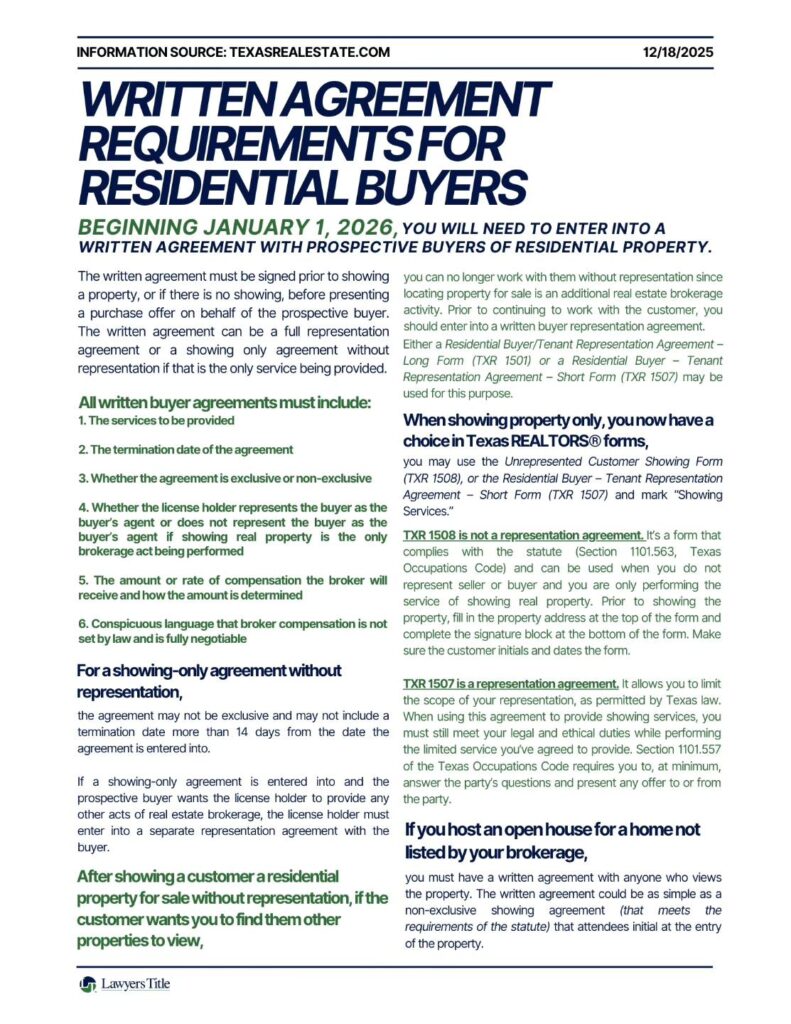
This is an important one for all our Realtors out there. In addition to expanding the Texas Real Estate Commission’s oversight, SB 1968 requires brokers to complete a responsibility course as part of licensing or renewal.
Seller agents must also enter into a written agreement before performing most brokerage services, including showing property or advising on offers. Here’s a helpful compliance notice by Lawyers Title:
House Bill 2067
Here’s one that might be of interest to those who have ever been given a hard time by a homeowner’s insurance provider.
HB 2067 requires insurance companies to provide a written explanation whenever they decline an application, cancel a policy, or refuse to renew coverage without you having to ask for one. It also requires providers to submit quarterly reports to the Texas Department of Insurance covering the reasons why they won’t insure a customer.
The law is intended to increase transparency and help regulators and consumers better understand insurance market trends, particularly amid rising insurance costs.
House Bill 2525
This one expands the charitable property tax exemption by updating the eligibility criteria for organizations that provide housing and related services to people 62 and older. Previously, only properties used to provide housing without regard to the resident’s ability to pay qualified for the exemption. Under HB 2525, the exemption can also apply if the organization provides charitable housing and services equal to at least 4 % of its net resident revenue.
The bill defines “charitable housing and services” to include housing and services designed to meet the unique needs of seniors, such as social, health, educational, or ministerial services. To qualify under the new provisions, the organization must be 20 years old or affiliated with a group that’s been around that long.
House Bill 30
Apparently, disaster exemptions were being used by more taxing entities than just ISDs to bypass voter-approval tax rate elections. HB 30 aims to change how local governments calculate and adopt post-disaster tax rates by creating a “disaster debris rate” based on documented disaster-relief costs like debris removal and recovery efforts.
The new law also limits how long and under what circumstances disaster-related tax rate adjustments can be adopted by officials. It also prevents taxing entities from repeatedly using the same disaster declaration to hike rates in future years.
Senate Bill 1023
On the transparency front, anyone who is interested in whether local property tax rates are being calculated properly can rest a little easier (if for whatever reason that’s the kind of thing that keeps you up at night).
SB 1023 requires that the electronic forms used to calculate rates like the no-new-revenue and voter-approval tax rates be altered so that supporting documentation by local officials can be attached. The law also ensures that certain adjustments to taxable values, such as in reinvestment zones, for instance, are calculated and reported separately for each zone. The idea is that this will make it easier for taxpayers to verify rates and harder for taxing entities to obscure or err in their calculations.