
DART Light Rail Stations Delivering Rent Premiums, Development Wins
Share News:

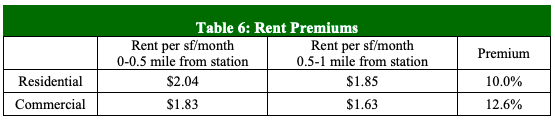
Owning property near a DART light rail station appears to have significant benefits, with a recent study suggesting landlords reap a double-digit premium in commercial and residential rents when a building is within half a mile of a stop.
While only a part of the regional public transit network, Dallas Area Rapid Transit’s (DART) light rail system has had a multi-billion-dollar economic impact over the past couple of decades and now runs roughly 93 miles in and around the Big D.
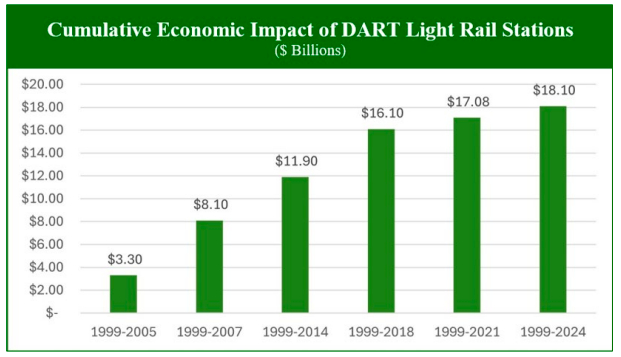
Part of that, although in an indirect manner, is the increased revenues landlords can apparently realize, according to the University of North Texas Economic Research Group, which periodically assesses the economics surrounding DART light rail stations.
Looking at rents within a mile of several light rail stations, researchers found a 10% and 12.6% differential in residential and commercial rents, respectively, between properties within 0.5 miles of a station and properties 0.5-1.0 miles away from a station.
They examined rents from 2022-2024 around the following light rail stations: Addison, Arapaho Center, Bachman, Downtown Carrollton, Downtown Garland, Downtown Plano, Farmers Branch, Forest/Jupiter, Lovers Lane, North Carrollton/Frankford, Park Lane, Parker Road, Trinity Mills, and Walnut Hill.

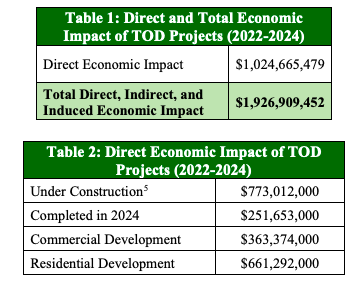
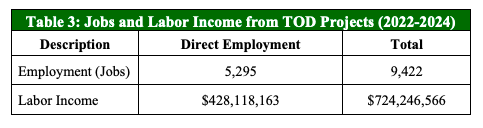
Stations have also been a driver of development. Some 37 projects were identified within one quarter mile of a DART light rail station during the three-year period (not counting downtown Dallas), comprising over $1.02 billion in direct impact and $1.93 billion in overall economic impact across the D-FW. That windfall included nearly 5,300 in direct employment and just over 9,400 jobs in total employment creation with $724 million in wages.
“When we talk about the role DART plays in the local economy, we mean that in a very literal sense, beyond just moving people to and from their jobs,” DART president and CEO Nadine Lee said in a press release. “Every dollar generated by and within development around our light rail stations has the ability to improve our cities, provide economic mobility and stability to our residents, and grow opportunity for North Texas.”
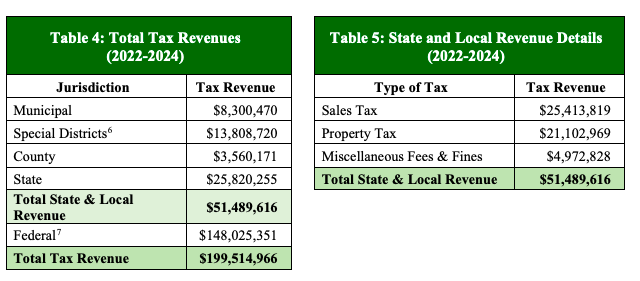
Local and state tax coffers also got theirs, with construction around light rail stations generating $51.5 million in revenues, including sales tax, property tax, fees, and fines in 2022-2024.
Transit-oriented development has been a watchword of Dallas’ update to its comprehensive land use plan — ForwardDallas 2.0 — which seeks to provide guidance on where and how the city should grow. Earlier this year, the city council authorized $14.5 million in incentives for a project that will see underutilized surface parking at the Buckner station turned into more than 300 mixed-income apartment units.
“The findings are not surprising because we know over the past 25 years of study that transit-oriented development around DART light rail stations results in commerce, tax revenue, and jobs,” said Michael Carroll, director of UNT’s Economic Research Group. “When we center sustainable transportation in development, the result is beneficial in nearly every way.”
Unfortunately for DART, not everyone feels the same way lately. The transit network is experiencing quite the suburban revolt, with multiple cities (Farmers Branch, Highland Park, Irving, and Plano) putting withdrawal from the system on the ballot in May 2026. Critics of remaining a part of DART have argued that their contributions far exceed the services they receive.
If a city approves withdrawal, DART services will end that month, however, the jurisdiction would still be on the hook for DART-related debt.
1 Comment
Leave a Comment







I think Plano and the other cities are being short-sighted. Having reliable public transportation is very important (especially for those who have no other transportation option) and we need to consider the community, as a whole. Do they not understand how DFW, which is already riddled with too much traffic, will experience so much more traffic congestion if they pull out of DART? I use DART a lot because I like the convenience (I live in Carrollton, which was a final consideration to why I moved there). I hope these cities look beyond money and consider what a service DART provides.