
‘Retail Follows Rooftops’ as D-FW Sees a Healthy Surge in Construction and Demand
Share News:


Retail construction is surging in North Texas, lending truth to the old real estate adage that retail follows rooftops.
CRE firm Partners Real Estate recently published its quarterly market report on the retail sector in D-FW, and the Metroplex saw a hell of a bump in Q2 in terms of square footage delivered and its under-construction pipeline.
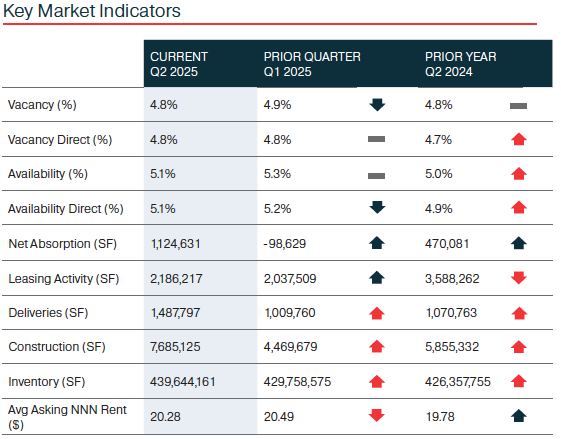
Nearly 1.5 million square feet of retail space went up in Q2 of this year, marking a roughly 50% increase over both Q1 2025 and Q2 2024. Projects in the pipeline shot up by even more, hitting about 7.7 million square feet. Partners clocked around 4.5 million square feet in Q1 2025 and some 5.8 million square feet in Q2 2024 for increases of 71% and 32%, respectively.
Partners senior vice president of research and market forecasting Steve Triolet told CandysDirt.com that certain market segments were driving the spike in deliverables (think new Costcos and H-E-B’s entry into the D-FW), but underlying it all is still the region’s growing population and its northbound trajectory.

“Municipal standouts include Celina, which has seen its population soar from 8,000 to 54,000 in a decade, drawing retailers like H-E-B to capitalize on this growth,” Triolet said, also mentioning Anna, Aubrey, and Melissa — the “sister cities” of the northern suburbs.
“Frisco and Plano continue to thrive as mixed-use hubs, with developments like Legacy West integrating retail with office and residential components. These areas benefit from corporate relocations, such as JPMorgan Chase and Toyota, boosting local economies and retail demand,” he added.
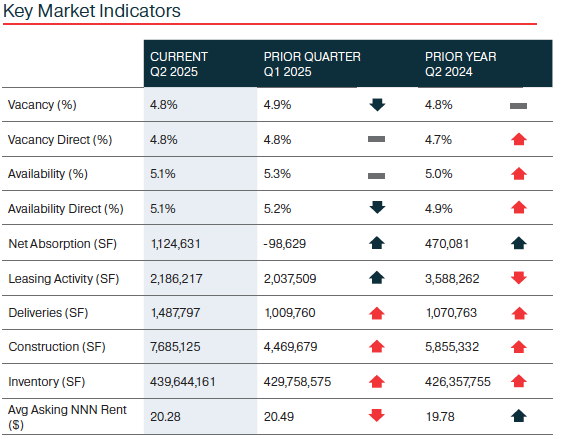
On top of the new growth, the D-FW’s retail sector also maintained a strong vacancy rate of 4.8%, about the same year-over-year and the previous quarter. Net absorption also accelerated from -98,629 square feet in Q1 2025 and 470,081 square feet in Q2 2024 to more than 1.1 million square feet this past quarter.
“Anywhere below 5% vacancy is a very healthy number,” Triolet said.
While some retailers like Joann’s and Party City, which required relatively large spaces to operate, have shuttered due to poor sales and high rents, gyms like Crunch Fitness and various “retail-tainment” (think pickleball) businesses are picking up the slack.
“Those are attractive for landlords because typically they’re going into big blocks of space, which are generally a little harder to backfill,” Triolet said. “A lot of the power center-type tenants, they’ve shrunken their footprint a little bit. “Think of the Best Buys of the world. They’re still around, but they trimmed how much square footage they generally take.”
Even with the economic uncertainty prompted by President Donald Trump’s tariff-fueled trade policy, which is expected to impact stores that rely on imported goods (furniture, tools, car dealerships, appliances, etc) Triolet doesn’t expect any seismic shifts on the retail front in North Texas anytime soon — especially if the region’s demographics continue to grow.
“We’re talking about below 5% vacancy. That’s super healthy. There’s no alarm bells indicating something’s going to shift dramatically in the near term, and by near term I mean the next year or two,” he said.






Noticed that no retail was added in Southern Dallas, a whole lot of apartments have been built though, and developers keep adding more. Retail isn’t following rooftops in certain parts of town.