
Commission Adjusts Lakewood Conservation District Boundaries, Next Stop City Council
Share News:


Following a years-long battle to expand the Lakewood Conservation District, the Dallas Plan Commission unanimously agreed Thursday to remove a large chunk of the proposed expansion area and move the case forward to the Dallas City Council.
The decision wasn’t taken lightly and drew opposition from about half the residents in the affected area, according to more than 200 comment cards submitted to City Hall. About 18 neighborhood meetings have been held since the effort to expand the boundaries of an existing Lakewood Conservation District began in earnest in late 2021.
The original Lakewood Conservation District, formed in 1988, starts at Abrams Road and does not extend east of Brendenwood or Copperfield drives. Hundreds of the original homes on Lakewood, Lakeshore, Avalon, Tokalon, and Westlake are not protected, according to the Lakewood Conservation District Facebook page.
“Unprotected” means to Lakewood residents like Summer Loveland that those homes — including architecturally significant showpieces designed by Clifford Hutsell — could be bulldozed and replaced with structures that are incompatible with the rest of the neighborhood.
“We’ve begun to see a trend in ill-fitting and oversized development, which changes the character of our neighborhood,” Loveland said Thursday. “Our homes are similar in style and period as the existing conservation district and just as deserving of protection.”
Loveland added that the opposition mobilized after 15 ordinance meetings were held, and in response, the pro-district group recommended that a revised map be considered to “remove the areas that are opposed and limit the connecting blocks to development standards only.” Because the process was already in motion, the revised map had to come from the CPC.
The revised expansion map, approved for recommendation to the Dallas City Council, is displayed below. The black dotted line represents the areas removed from the proposed expansion district.
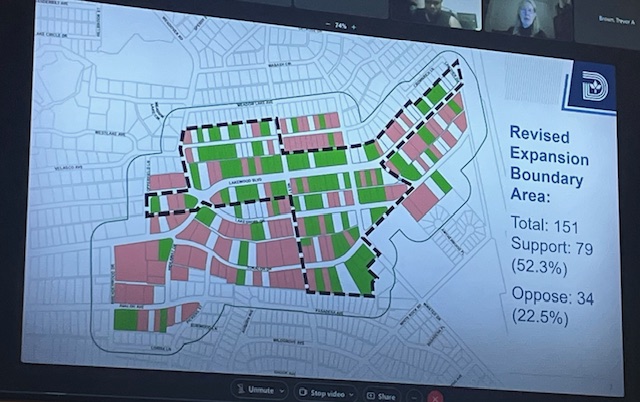
As applause broke out on Marilla Street after amendments were made and a final, unanimous vote was taken, Loveland told Candysdirt.com she was “over the moon.”
Those opposed to the conservation district expansion said Thursday they have a right to do whatever they want with the homes they purchased and pay taxes on. They formed the group “NotoCD2” and refused to even call the initiative an “expansion,” suggesting that proper protocols were not followed when hosting informational meetings.
Tokalon Drive resident Samantha Crispin opposed the expansion and said she tore down her 1970s home to rebuild a better one.
“It was the ugliest house in the neighborhood,” she said of her former home. “We tore that down, and we put something in place that looks a heck of a lot like the rest of the houses in the neighborhood … Let’s not assume that in the absence of regulations, people are going to build monstrosities.
“People love Lakewood, and they’re going to do the right thing.”
There appeared to be an almost 50-50 division among the pros and the cons on the matter. By our unofficial count, at least 25 residents spoke in favor of the conservation district and about 25 spoke against it at the CPC meeting.
After the vote, the opposition said they, too, were pleased that their beloved homes were removed from the expansion area. The vote was taken around 8:30 p.m. after a long day at the horseshoe. It was unclear at press time how many homes are included in the expansion area and which ones are designated historic.
Read the staff case report, view the draft ordinance, or watch the video from the Nov. 21 CPC meeting. The City Plan Commission only makes recommendations; the ultimate authority to expand the conservation district lies with the Dallas City Council.
Lakewood Conservation District
A conservation district allows neighborhoods to establish exterior design criteria and other standards to preserve the character of an area. An ordinance is established for each conservation district that details the regulations homeowners must follow in any renovations or new construction and must ultimately be approved by the Dallas City Council.
Five architectural styles are approved within the Lakewood Conservation District: Spanish Eclectic/Revival, French Eclectic, Neoclassical, Tudor, and Colonial Revival.
The expansion boundaries, as written in the proposed ordinance are alleys between Westlake Avenue and Meadow Lake Avenue and between Lakewood Boulevard and Westlake Avenue on the north, Lawther Drive on the east, Tokalon Drive and the alleys between Tokalon Drive and both Pasadena Avenue and Avalon Avenue and the alley between Lorna Lane and Avalon Avenue on the south, and Brendenwood Drive, Copperfield Lane and the alley south of Westlake, and Wendover Road on the west.
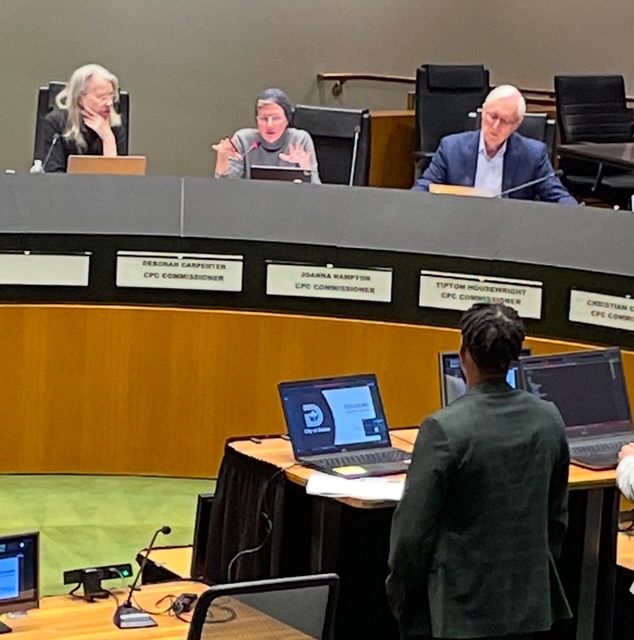
At Thursday’s meeting, the City Plan Commission gave the go-ahead to District 9 Commissioner Neal Sleeper’s proposed changes, which include the removal of the following areas:
- City Block K/2825 described as the “half” along the northern side of Lakeshore between Windover Road and Copperfield;
- The area west of Westshore Drive and south of the north portion of City Block F/2821 fronting Lakeshore Drive and south of the north portion of City Block E/2820 fronting Lakewood Boulevard;
- The area lots fronting on either side of Westlake Drive east of Westshore Drive;
- The area southeast of Lakewood Boulevard and north of Heath Street;
- The area along the southeast line of Tokalon Drive northeast of Winstead Drive
“I know it’s been a very taxing project on everyone, and that’s unfortunate,” Sleeper said. “I don’t see any rights or wrongs in this group. They’re all people who want to do the right thing, do a good thing, with just a difference of opinion on how to get there.”
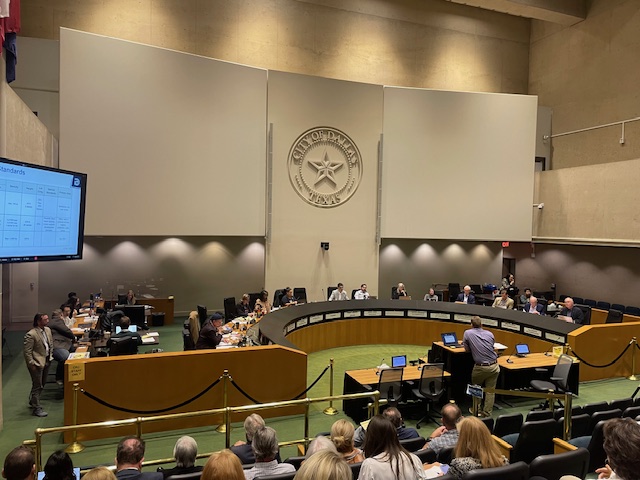
Dallas has 18 conservation districts, some of which have been in place since the late 1980s. Commissioners on Thursday thanked Chief Planner Trevor Brown and his team for shepherding the process, noting it was not a simple one. CPC Chair Tony Shidid complimented Sleeper’s devotion to the project.
“You were handed a live grenade, and you didn’t take a step back,” Shidid said. “You were curious and you were calm, which was frankly the most important thing. I appreciate your hard work.”
A date has not yet been set for the Lakewood Conservation District to go before the Dallas City Council.





For many months, it has been evident that the majority of residents within the original expansion area do not affirmatively support expansion. Response forms submitted in advance of the CPC meeting validated this. The CPC approved a revised expansion map in order to remove blocks where there was significant demonstrated opposition to expansion since overall public support for the project is a gating item. Had efforts to remove areas where opposition was strong been implemented in a fair, consistent and reasonable way, my home and the homes of my neighbors in the 6800 block of Lakeshore Drive would also have been removed from the new expansion area.
There are 7 homes on the 6800 block of Lakeshore Drive. Six of them (over 85%) have been publicly opposed to expansion of CD for many months. The 6800 block of Lakeshore has only one home that falls within a category of contributing styles the CD was originally intended to protect. There is almost no other single block within the entire original expansion boundary that has either: (1) fewer homes with a contributing style; or (2) a higher percentage of public opposition to expansion. If there was any consistent criteria applied to determine whether a block should be removed from expansion efforts, the 6800 block would have been removed.
But instead of removing the 6800 block entirely, the CPC chose to remove only the south facing side of the street, where all 3 residents opposed expansion. The CPC chose to leave in the district the 4 north-facing homes on that block, 3 of which (75%) oppose expansion. And further, the CPC chose to bolt onto that block face a single house with a Lakewood Blvd address that backs up to Lakeshore Drive but that is owned by one the the original expansion applicants, while removing the remainder of that block of Lakewood Blvd (where there are several homes with contributing styles) entirely from the redrawn expansion area. This is completely counter to the CD’s goal of protecting homes with contributing styles.
Why was this done? Because in order to satisfy the requirements of an “expansion” of an existing CD, the expansion area must be contiguous with the existing district it seeks to expand. If you look at the revised map, there is overwhelming opposition to expansion on all of the blocks that are contiguous with the existing CD. Yet my house, and the homes of my neighbors on 6800 Lakeshore, are now proposed to be included in the CD, while our homes face houses and live across the alley from houses just like ours that are not subject to the CD. Of what benefit is it to us to live within a CD when nobody around us is subject to the same restrictive rules that apply to us?
It is not transparent or in furtherance of the goals of a CD to gerrymander expansion boundaries to remove those opposed to expansion so you can falsely claim that CD expansion has support of the community at large. It is not in furtherance of those goals to exclude blocks of houses with contributing styles because there is opposition, while including other blocks where there are almost no such homes. It is not reasonable to remove half of my block from the district in order to try to claim that there is support on my block for expansion when my block overwhelmingly opposes expansion and has for months. What the maps make very clear is that there is support for a CD in a very small subsection of the original expansion boundary, and that subsection is not even close to being contiguous with the existing CD it is asking to be an expansion of.
Notably, even after all these CPC machinations, there is still nowhere near the level of public support for expansion within the revised boundaries that we have been told is required to move forward with expansion, though there is much conflicting information being distributed on this point. I am hopeful that city officials will take the time and effort to evaluate what has transpired and to get a clear picture of how residents feel about this project. If they do that, I believe they will conclude this project should not move forward.