
Green Light: Tax Credit Housing Projects Will Continue Despite Bylaw Scrutiny
Share News:


Dallas leaders agree that two corporations responsible for financing affordable housing need diligent oversight. But a City Council Housing Committee majority agreed last week that instead of pausing the programs, projects should move forward while bylaw revisions are made.
Public Facility Corporations (PFCs) and Housing Financing Corporations (HFCs) like the ones discussed at last week’s Housing and Homelessness Solutions Committee can incentivize developers to build more affordable housing in underinvested areas. Since its inception in June 2020, the Dallas Public Facility Corp. has brought in $3.8 million and the Housing Finance Corp. has revenues totaling $23.6 million. Those dollars will ultimately be funneled toward affordable housing needs in Dallas.
“The reason we’re here today is to make sure we’re using HFCs and PFCs to the best of their abilities, making sure they are reflecting the priorities of our city council and the City of Dallas, making sure we are using those revenues to reinvest back into our priorities,” HHS Chair Jesse Moreno said.
Greater Oversight
City Councilwoman Cara Mendelsohn, who has routinely voted against PFC projects, has been critical of PFC projects because they are taken off the tax rolls, often for up to 75 years, and has questioned whether the affordable units they provide are actually in the income bracket where housing is most needed. She asked to review the PFC board’s bylaws in August.
“I’m concerned that there is not enough oversight of this board,” she said at the August meeting.
The Dallas PFC seeks to develop and preserve mixed-income workforce housing communities to serve residents earning at or below 80% of the Area Median Income (AMI) as well as provide non-income restricted units. Critics say the affordable units are in the higher AMI categories, thus not providing “deeply affordable” housing that is most in demand.
“What we already know and has been repeatedly shown to us is that we have 80% Area Median Income housing available,” Mendelsohn said. “In my district, there are literally hundreds and hundreds of available units of 60% Area Median Income [units] available for taxpaying entities … What I would hope is that both corporations would be focused on what’s not available.”
The Dallas HFC provides tax-exempt mortgage revenue bonds and other support for the acquisition, construction, or substantial rehabilitation of multifamily housing. The Dallas HFC has created 7,206 units, more than 5,000 of which are Low Income Housing Tax Credit units rented to tenants who earn an average of 60% of the Area Median Income, according to last week’s presentation.
Watch the Oct. 29 Housing and Homelessness Solutions Committee meeting or view the slide presentation here.
Green Light
During last week’s presentation, Director of Housing and Community Development Cynthia Rogers-Ellickson offered the committee options on how to proceed: Continue evaluating projects while the bylaws are rewritten, halt new applications, or stop the process altogether until new policies are in place.
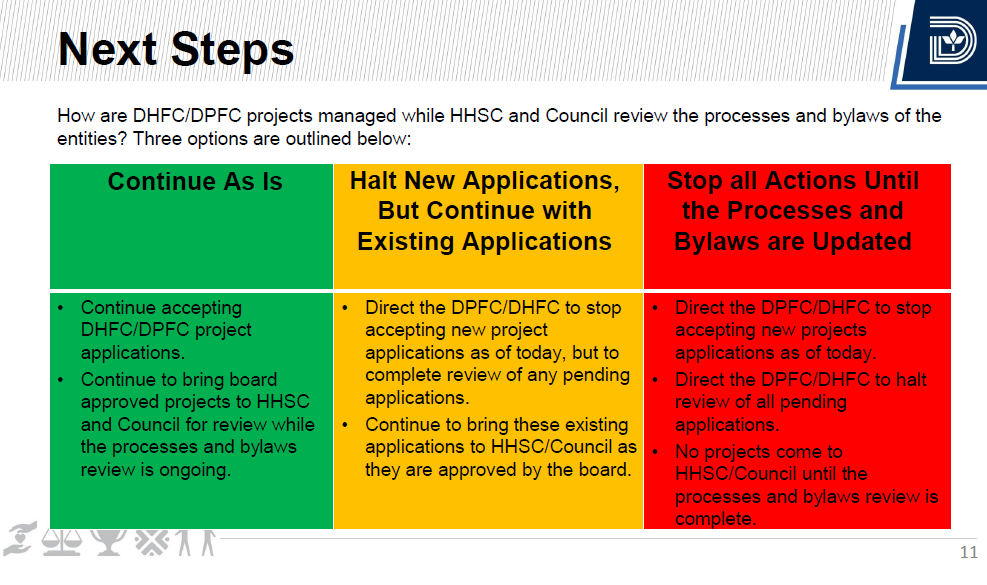
The housing director suggested that committee members provide feedback by the end of November so new bylaws could be presented to the corporation boards in December and to the housing committee in January, with council adoption in February. Committee members said that the timeline may be unrealistic.
“There are things we need more information on and need to thoroughly go through, not try to cram it in before Thanksgiving,” Mendelsohn said. “But I appreciate how ambitious it is because usually we are slow.”
Katie O’Brien, a partner with local consulting firm Trinity Public Affairs LLC, pointed out during the HHS meeting that Dallas could miss out on an entire year of Low Income Housing Tax Credit deals if the HFC program is put on hold while the bylaws are in development.
Dallas Housing Finance Corporation member Marcy Helfand suggested that it would make more sense to determine how state legislation could impact affordable housing programs before deep-diving into bylaw revisions. The Texas Legislative session begins in mid-January.
“I don’t think you want to go through this process, amend our bylaws, and then find out that something in the legislation requires you to amend them again,” Helfand said.
Politics Versus Policy
Councilman Chad West, who represents an area of North Oak Cliff where several PFCs have been approved, said the projects are among the most important and impactful tools Dallas has to enable and preserve affordable housing.
“We’ve got to make sure these programs are working,” he said.
The boards want more autonomy and flexibility and staff wants more control, West said.
“I think the one time-sensitive question that we’ve got to answer is … how we continue operations of these boards while we work through the bylaws situation,” he said. “I don’t see a need to stop accepting [or] processing new projects while we work through the differences. I think it sends a terrible message to developers and the development community that we are not a stable place to do business.”
Mendelsohn said the projects should be paused.
“There are these gaping financial risks because we don’t have the proper controls in place,” she said. “I truly appreciate the service of all our volunteers. I am in no way trying to cast any kind of aspersions on anybody, but providing a lack of controls welcomes misuse.”
Councilman Zarin Gracey, who represents Southwest Dallas, served on the PFC Board in its infancy and said he’s a fan of the projects but would like to give more consideration to locations where they’re approved.
“[I am] looking for a way to ensure … that they’re strategically being located in areas where they’ll get the best benefit,” he said.
Mendelsohn encouraged Rogers-Ellickson to make policy recommendations as the city’s housing expert, rather than get in the middle of a political debate among council members.
“As it turns out, I believe since I’ve been on council, every single project, 100% of them have been approved by the City Council,” Mendelsohn said. “At some point, you have to wonder if it’s getting the scrutiny it should, if every single project is approved. I would put it back on the policy side. That’s where it needs to be evaluated for the value. It’s too easy for politicians to say, ‘I support affordable housing, therefore, no matter what it is, no matter what the cost is, regardless of how few units are going to be added that do what we need i to do, I’m going to for or against it,’ because it becomes a political statement as opposed to a policy statement.”