Dallas Council Members West, Mendelsohn Agree to Disagree on Public Facility Corporation
Share News:

Editor’s Note: This story was updated Aug. 29 to include a statement from Child Poverty Action Lab Chief of Housing Ashley Flores.
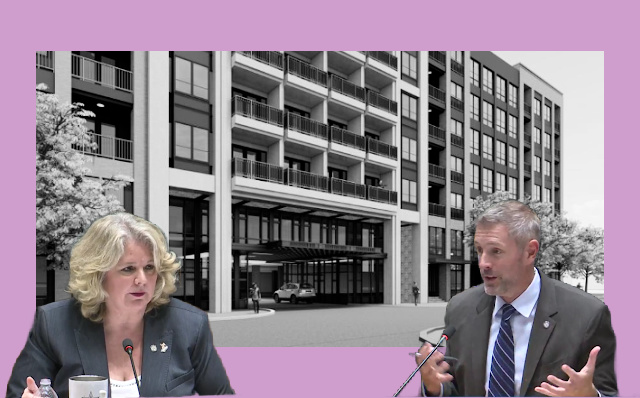
If District 1 Dallas City Councilman Chad West was hoping for full support of Public Facility Corporation projects as a mechanism for providing much-needed multifamily workforce housing, he is probably disappointed.
Several months ago, West called for a PFC projects briefing on these government-created entities to get hard numbers on how the projects add value to Dallas — even though they’re taken off the property tax rolls for up to 75 years in exchange for affordable units. The briefing was held Monday before the Housing and Homelessness Solutions Committee. West didn’t get his “kumbaya” moment, but let’s be honest. He knew that wasn’t going to happen.
The PFC figures were provided, but the presentation was met with scrutiny from Far North Dallas Councilwoman Cara Mendelsohn, who alleged a lack of oversight around the city’s PFC Corporation board of directors. Additionally, Southern Dallas Councilman Zarin Gracey, who served as the first PFC board president, asked why there was so much focus on rental units and not an effort to create more for-sale housing.
View Monday’s presentation or watch the meeting online.
By the Numbers
The Dallas Public Facility Corporation was created in June 2020 and is governed by a board of directors appointed by the City Council.
According to city documents, the corporation seeks to develop mixed-income workforce housing communities to serve residents earning at or below 80 percent of the area median income (AMI) as well as provide market-rate units.
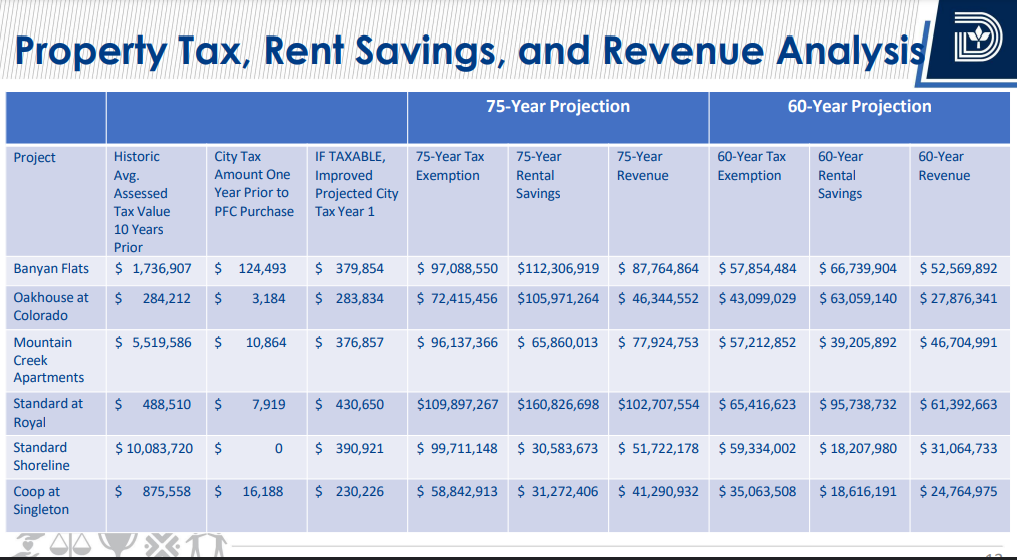
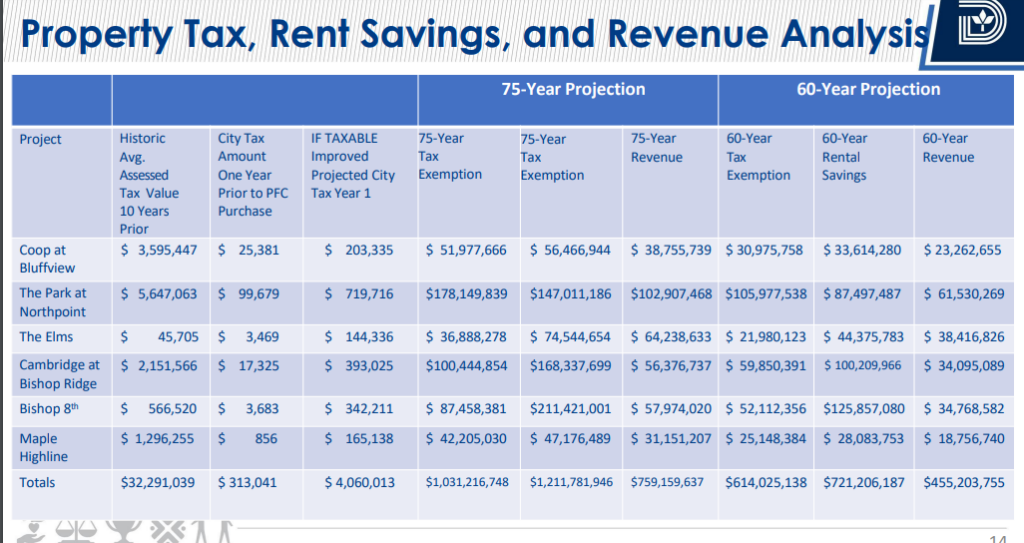
To receive the exemption, a private apartment developer transfers land to the PFC, which then leases the land and any buildings on it (including those built in the future) back to a limited partnership controlled by the developer.
PFC board president Keith Pomykal said Monday that Dallas PFCs reserve 10 percent of the units for families at or below 60 percent of the AMI, 40 percent for families at or below 80 percent of the AMI, and 50 percent at market rate.
“Without PFC assistance in this time of increasing construction costs and high interest rates, these projects would not have been financially feasible. If not for this program, citizens across Dallas would not have these units to call home. It’s expensive to live in this city. We believe this shows it’s good for our fellow citizens of Dallas. Though we do give a tax abatement, you can see over the 60 years of rental savings, this is a benefit for the citizens of Dallas.”
Keith Pomykal, Dallas PFC Board President
At least 20 projects have been approved by the Dallas City Council but some have not gone forward, city officials explained. About a dozen are underway now, with three preleasing and seven under construction. The first PFC completed, Oakhouse, developed by Mintwood Real Estate, has successfully leased two floors of its six-story, 219-unit project in North Oak Cliff.
The total project cost of the PFCs in development is about $689.5 million. The average project cost is $57.5 million. About 3,000 PFC units have been provided since the corporation was formed in 2020. The average project size is 250 units, and the total number of affordable units provided to date is 1,518 (about 51%).
Backlash on PFC Projects
West frequently references a Child Poverty Action Lab report as the best data to inform Dallas’ affordable housing decisions. The CPAL data from 2023 indicates that there is an “OK” housing supply for residents living at 60% of the AMI and above, and if nothing changes, a massive gap will be created by 2030 in the 60% to 80% AMI categories, West said. The PFC structure isn’t addressing housing for those with severely low incomes, city officials acknowledged.
“What this revealed to me — and correct me if I’m wrong — is that the PFC program is really meant to address that 61% and above AMI levels,” West said. “As we get down to where the real need is, in the 30% to 60%, we’ve got to find other tools for that.”
Housing and Neighborhood Revitalization Director Cynthia Rogers-Ellickson agreed that PFC projects are designed for workforce housing.
“This offers a mixed-income opportunity so we can spread some of that cost across the entire building,” she said.
Real estate economist Adam Perdue told CandysDirt.com that D-FW’s 80% AMI is about $88,250. The local median renter household income is $58,132, Perdue said.
“The ‘affordability’ requirement really isn’t for the people that the housing will serve,” he said.
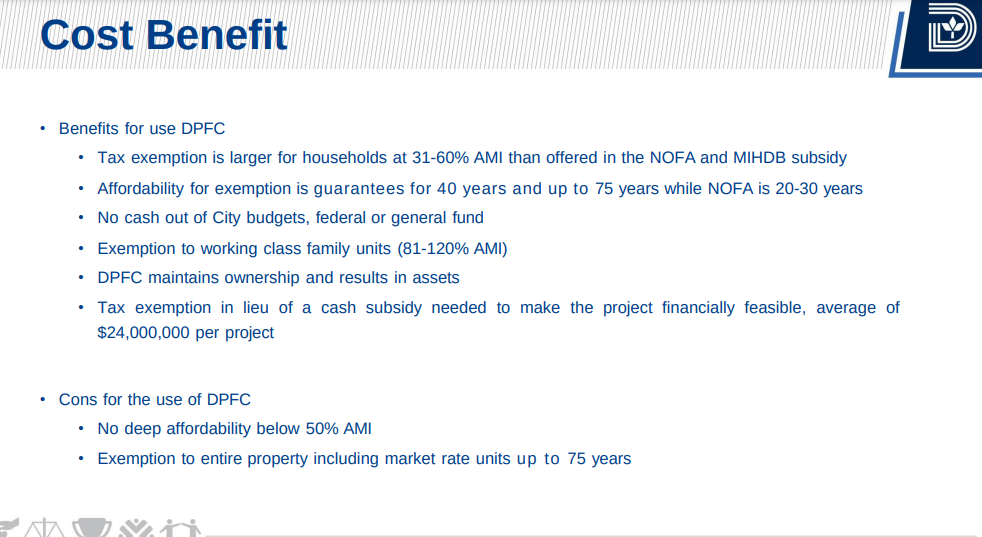
Preston Hollow Councilwoman Gay Donnell Willis suggested that the cost-benefit analysis presented in Monday’s meeting did not account for a loss from tax exemptions. The statute changed in the last legislative session so tax exemptions can only go up to 60 years, not 75 years, as has been widely reported, Dallas PFC board vice president Ken Montgomery clarified. Leases remain in place for 75 years.
Mendelsohn has routinely voted against PFC projects and has questioned whether they add value and whether the affordable units they provide are actually in the AMI category where housing is most needed.
The councilwoman said Monday it was unusual that the board president and vice president were presenting the briefing rather than the staff members assigned to oversee PFC projects.
“I’m concerned that there is not enough oversight of this board. I’m just going to flat-out say it like that,” she said.
Mendelsohn expressed interest in changing the PFC board’s bylaws and asked for the city auditor to evaluate potential risks created by PFC projects.
“My understanding is there may be some other issues with executive board members making decisions that haven’t gone to the full board, but other changes that might limit the risk to the city might need to be considered,” she said.
Mendelsohn further added that residents at 30 to 60% of the AMI population are often “hard-working and barely making it.” That’s where the government should step in, she said.
“We have people who truly cannot pay their rent every month and we’re squandering the dollars we actually have available for the wrong population, the population that didn’t need our assistance,” Mendelsohn said. “The population that truly is at risk, this 30 to 60%, they are the people at risk of becoming homeless.”
CPAL is a credible organization but the report referenced by West has two fatal flaws, Mendelsohn said. One is that it vacillates between the City of Dallas and Dallas County. It also discounts properties built before a certain date.
“That is almost every property in District 12,” she said. “When you only look at it from … I think it was 1980 forward, well, there were a lot of things built in the ‘70s. [There are] thousands and thousands of units in District 12 that are very appropriate for people at the 60% AMI. The picture is skewed.”
CPAL Chief of Housing Ashley Flores released the following statement after this story was published:
“The rental market supply gaps in the assessment (e.g., the 34K shortage at or below 50% AMI) were calculated just for the City of Dallas. We do include Dallas County and larger metro data throughout the report, usually as a point of comparison for the City of Dallas, but the core supply/demand calculations are just for the City of Dallas. Regarding properties built before a certain date, the assessment includes all rental units we can capture, regardless of the year they were built. I’m not sure where the misconception came from about properties only included after a certain date. I’ve asked for clarification on this particular comment to try and understand how the misconception originated.”
ASHLEY FLORES, CHILD POVERTY ACTION LAB
Proposed Amendments to PFC Structure
In response to a question from Councilman Gracey, Rogers-Ellickson said about 5% of the city’s housing funding goes toward for-sale initiatives.
“Is there a way we can potentially use some of the revenue toward home ownership?” Gracey asked. “Everything related to housing seems to be around rental units. It’s hard to hear about the housing crisis, but there is no talk of home ownership in all these discussions. I consistently see developers going to all of the suburbs. If we could use some of this to incentivize them to stay in Dallas and build neighborhoods like they once were, that is a recommendation, a strong recommendation.”
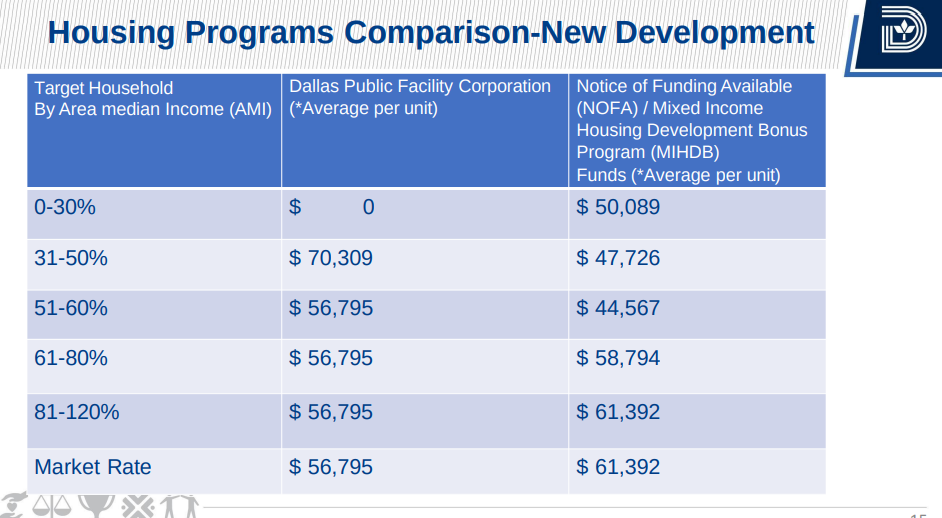
A change of bylaws would be necessary but that can be done, Pomykal said.
Councilman Jesse Moreno, who chairs the HHS Committee, said he supports mixed-income housing but wants to have caps on the number of units built in certain geographical areas.
“I want to be able to preserve affordable housing for future generations, but I want to make sure it’s not saturated in one particular area,” Moreno said.
Mendelsohn also pushed back on a statement from PFC board members that the projects benefit all Dallas citizens.
“In what way do you think removing items from a tax roll that would be paying for police and roads and libraries and parks would benefit them to be able to subsidize somebody else’s rent through this method?” she asked.
Montgomery, the board VP, said the City Council decided unanimously that the affordable units provided through the PFC were a public good. Retail follows rooftops and the projects can be catalysts for new development, he said.
“Taxpayers benefit from that,” he said. “It’s not as tangible as filling a pothole. I’ve known for a long time that affordable housing is a little more esoteric for the average person. We as a city decided that affordable housing is a public good.”