Housing, Mixed-Use Could Be on the Horizon for Hampton-Clarendon Corridor in North Oak Cliff
Share News:


When the West Oak Cliff Area Plan — a plan to give displacement-vulnerable residents more control over new development in their neighborhood — was unanimously approved in September 2022, it was clear that change was coming and not everyone would embrace it.
Slowly but surely, the public meetings in an authorized hearing area that includes what is now being referred to as the Hampton-Clarendon Corridor (it’s not a trolley stop) have become a little less hostile and a lot more informative. Unlike before, no one appears to be in a hurry and no one is talking about bulldozing properties or shuttering small businesses. This is what the people of North Oak Cliff asked for, and the Dallas planning staff appears prepared to engage them every step of the way.
An authorized hearing is a city-initiated rezoning, which sounds a little daunting, but again, the public engagement process has been massive over a period of years. The Hampton-Clarendon authorized hearing is one of several that will occur as a result of WOCAP. Another neighborhood, Elmwood, recently went through the authorized hearing process and can now have coffee shops in the area, which were previously hindered by parking requirements, District 1 Councilman Chad West said. Other neighborhoods like Jimtown and North Cliff have authorized hearings pending.
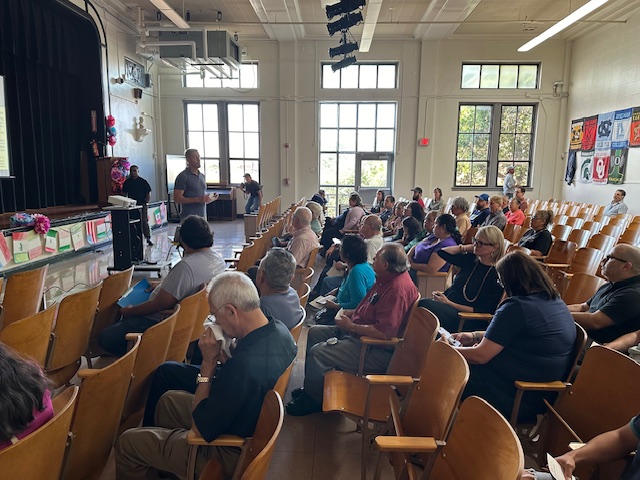
A meeting was held last week at Lida Hooe Elementary School, the third in a series on the Hampton-Clarendon Corridor. West said the magic words every neighbor in an authorized hearing area wants to hear: “There’s no rush to get this done. We can keep having meetings.”
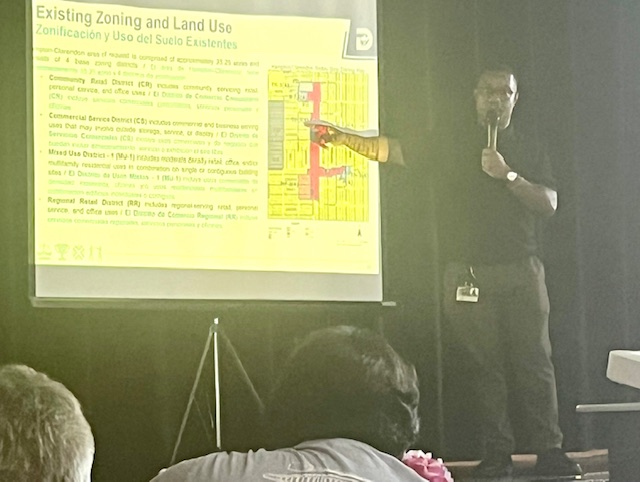
City planner Jalyn “J.P.” Porchay also may have made some new friends when he promised no one was “getting kicked out.”
“We’re not proposing any zoning changes for the residential areas,” Porchay said. “I’ve assessed every property. All of the uses will be allowed to stay. No one is getting kicked out. This is just to increase design standards so if anyone decides to redevelop in this area they’re going to abide by the development standards that the community is comfortable with.”
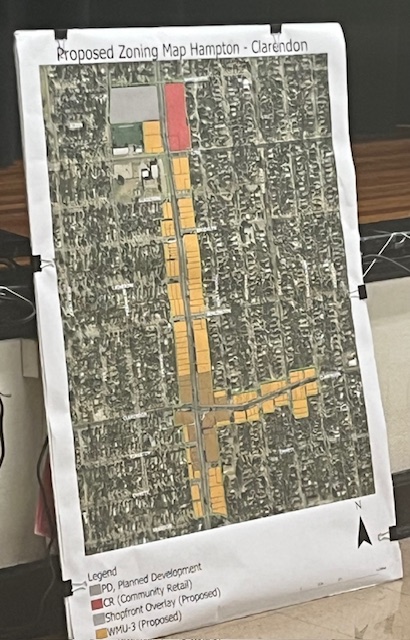
In fact, the 35-acre zone is likely to benefit many along the corridor and protect against gentrification and displacement.
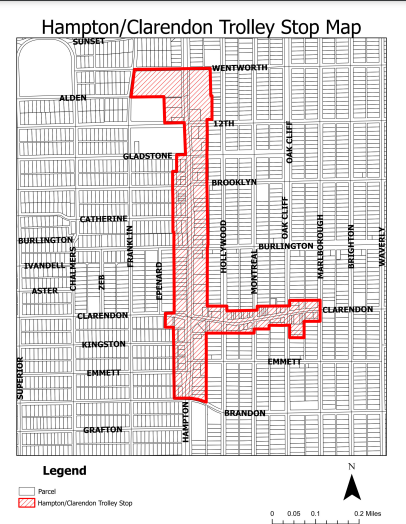
Neighborhood landmarks within the Hampton-Clarendon Corridor include 7-Eleven, La Guadalupana Meat Market, Tom Thumb grocery store, Hampton Food Market, and J&E Express Auto Service.
Why Hampton-Clarendon Needs a Plan
West frequently references his first day as a city plan commissioner in 2017 when the news broke that developers purchased the beloved El Corazon del Tejas to tear it down and build a drugstore.
“If you have no plan, you end up with a building like El Corazon being torn down and having a CVS built in its place,” he said. “I believe in having a plan versus no plan.”
The councilman emphasized that the future of the neighborhood is in the hands of its residents.
“If we want wider sidewalks, if we want shorter roads, if we want trees along the sidewalks, those kinds of things seem like they should be easy to do, but if you don’t know how your buildings are zoned and how far they have to set back from the road, you can’t do that,” West said. “We’ve got to figure out the zoning that we want as a community, and if you want it to stay the way it is, that’s an answer too. We’ve got to figure out what that is so we can move forward and actually get the infrastructure and do the planning.”
The Plan
A majority of neighborhood leaders in Sunset Hill, Hampton Hills, Jimtown, Kessler Plaza, and North Cliff have agreed on the proposal presented by staff last week, West said.
“The purpose of an authorized hearing is usually to determine the most appropriate zoning for an area,” according to the city webpage devoted to Hampton-Clarendon. “It typically considers zoning, development standards, and other appropriate regulations to ensure land uses and development standards that are compatible with existing and future development in an area.”
Apartments are proposed but they will be small structures, limited to 12 units, with height restrictions. Porchay said the multifamily development is proposed only for designated areas such as the southern end of the corridor adjacent to Jimtown. Eleven buildings and 32 lots in the area are vacant.
The corridor encompasses “a pivotal commercial node” flanking both sides of Hampton and Clarendon roads and is home to a diverse array of small, locally owned businesses, including numerous auto-repair shops, restaurants, gas stations, and strip centers.
“Despite its potential for a vibrant urban streetscape, traffic calming measures and pedestrian enhancements are needed to address safety concerns, evidenced by the unsuccessful attempt of a temporary road diet in 2020,” city officials said on the Hampton-Clarendon webpage. “Hampton Road, a bustling thoroughfare, poses challenges to pedestrian connectivity, dividing surrounding neighborhoods while boasting historic commercial structures. In contrast, Clarendon Road offers a more neighborhood-oriented commercial corridor, albeit with issues like sidewalk disrepair and lacking bike lanes, reflecting community aspirations for enhanced connectivity and walkability. Although this area has existing commercial uses, many have numerous vacancies as well as barriers such as zoning which make current redevelopment or reinvestment difficult.”
The objective of the authorized hearing is to explore implementing the following recommendations of WOCAP:
- Amend existing zoning (CR, MU-1, CS, and P(A)) to allow for mixed-use development along Hampton Road (between Wentworth and Brandon) and Clarendon Road (between Hampton and Marlborough).
- Explore form-based zoning districts for walkable urban form, including activated facades and wide sidewalks.
- Promote pedestrian-oriented design, minimizing vehicular-pedestrian conflict points, curb cuts, and parking locations. Explore prohibiting new drive-thru establishments.
- Implement citywide parking code reform, including reductions for existing commercial structures and shared parking use agreements with surrounding properties.
- Ensure proposed rezoning considers residential proximity slopes, setbacks, and landscaping to minimize impact on adjacent single-family properties.
- Permit small multifamily developments (12 units or smaller) and townhomes within the designated areas.