
Former Plan Commissioner Says ForwardDallas Focuses Too Much on Housing, Ignores Economic Development Opportunities
Share News:


Jasmond Anderson, like many Dallas residents, has been closely following discussions about the city’s comprehensive land use plan. At one time in the not-so-distant past, he was seated at the horseshoe during those discussions.
Anderson, CEO of a design-build development company, was the District 4 plan commissioner when ForwardDallas 2.0 first came under review in 2021. Anderson said he was “booted” off the commission for lack of attendance but he also served briefly on the Comprehensive Land Use Plan Committee (CLUP) tasked with updating the 2006 original version of ForwardDallas.
Anderson told CandysDirt.com that he is concerned about the plan’s emphasis on housing, focus on “placetypes” — generic land uses for different geographic areas of the city — and what appears to be the dismissal of the years-long work that’s been poured into smaller plans such as the West Oak Cliff Area Plan and South Dallas Fair Park Area Plan.
“I began to ask why we were not relating to any of the area plans that the city has spent so much time and effort on,” he said. “I felt like the discussion should have been led by the planning staff offering good examples and guidance for opportunities for sustainable and economic development. Things like streets, transportation access, economic opportunities, healthcare, and retail are considered in overlay districts but were not included in the ForwardDallas placetypes. It seems like it was out there on its own. We’re doing ForwardDallas while all these areas are doing their own area plans.”
Anderson said his neighbors in South Oak Cliff like their large lots and would rather see a business park than another playground. Every neighborhood is different, which speaks to the need for area plans rather than a one-size-fits-all approach, he said.
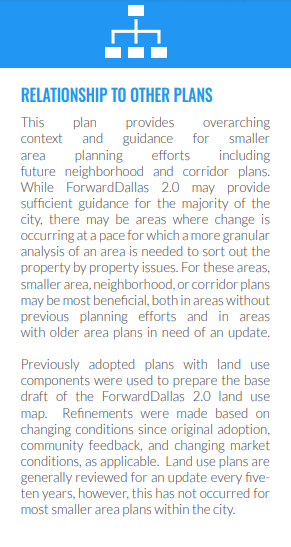
Area plans with land use components were considered in the base draft of ForwardDallas 2.0, according to the latest version of the document. Additionally, city officials have explained that area plan updates should follow ForwardDallas.
CLUP and CPC members have said that Anderson had an opportunity to raise his concerns and steer the discussion of ForwardDallas’ economic development component while he was serving on those panels, but he missed a lot of meetings. Anderson is now “Monday morning quarterbacking,” said one source.
North Dallas and South Dallas
In a Sept. 6 interview with CandysDirt.com, Anderson referenced something that is commonly alluded to by elected and appointed officials: the “tale of two cities” that divides the northern and southern sectors.
“We have North Dallas and South Dallas, this Mason-Dixon line, whether you like it or not,” he said. “Common development practices in urban planning involve sustainable development that happens by bringing in economic forces, businesses, and things like that, and also developing toward retail and amenities, healthcare, and banking. That results in housing because of course the influx of people needs housing, kind of similar to what’s happening in North Dallas.”
There was a “well-orchestrated playbook” that allowed North Dallas to flourish, Anderson said.
“That was proper urban planning. That’s the way you do it,” he said. “That’s how our communities were founded.”
Initially during the ForwardDallas discussions, healthcare and economic drivers in the southern sector were identified as priorities. Anderson said he wanted to use common urban design practices to facilitate an educational corridor at Camp Wisdom Road and a healthcare corridor along South Lancaster Road. Those areas are already developing, with college campuses and a Veterans Administration hospital, respectively, but Anderson wanted those goals to be documented in the plan.
“There is a healthcare desert in the southern sector,” he said. “We began to promote where healthcare institutions should go. The best way to influence that conversation is land use, suggesting that this corridor could potentially be used for these kinds of activities.”
The former plan commissioner said he does not believe city staff has been dishonest or is pushing a particular agenda for personal gain. He just thinks some of the original priorities got lost in the shuffle when the conversation turned to housing.
“So … it’s about housing,” Anderson wrote on LinkedIn last week. “Not economic development or sustainable communities. This is the biggest missed opportunity.”
Southern Dallas has the opportunity to outshine northern Dallas in the next 20 years if developed properly, Anderson said.
“If we don’t [develop it properly], you will build housing communities and no one will tear down one single house to build anything that’s an economic driver,” he said. “So then we’ve pigeonholed ourselves with housing and all of our comps are low-income because you can’t build a house with federal funds without them being low-income, so now every house in the area is under $250,000.”
The Focus on Housing Distracts From Other Needs
Once Anderson left the CPC and was replaced by D4 Commissioner Tom Forsyth, the conversation around healthcare, educational institutions, and economic development had already shifted to housing. CPC meetings dragged until the wee hours of the morning as officials debated definitions, primary and secondary placetypes, and whether multiplexes, cottage courts, and accessory dwelling units should be encouraged near single-family neighborhoods.
Anderson said he watched the meetings online and observed “a pitch for housing in the southern sector.”

“Why are they promoting affordable housing when the southern sector is already affordable?” he said. “The plan benefits the more prosperous areas. In the southern sector, it has more housing. There are no economic corridors or any of the things we’d been talking about.”
Had he been on the CPC during the July 25 meeting at which the plan was approved and passed on to City Council, Anderson said he would have voted with Commissioner Joanna Hampton, who suggested more review and public input was needed.
“I’m all for various housing types in single-family communities,” Anderson said. “It needs to make sense. What’s missing in underrepresented areas is design consideration. There’s no master planning. There’s no forward thinking. I was asking if they could give some consideration to not only South Oak Cliff but South Dallas, Pleasant Grove, and West Dallas. I’m really a southern sector guy who is well-trained to help figure this out.”
The latest version of the plan, which includes some “compromise language” to address the concerns of single-family neighborhood residents, also has a heavy emphasis on design standards.
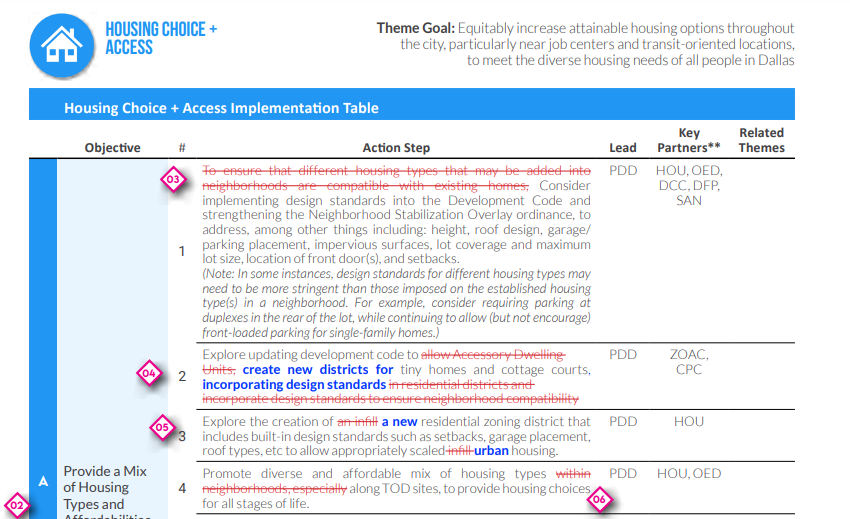
It’s up to staff to present facts and options, Anderson said. The plan commission should be steering the plan, he added, but they’re not always well-versed in all the technicalities.
“They do a great job,” he said of the appointed officials. “They are heroes at the horseshoe. At the same time, staff members are degreed professionals. In academia, you start from the bottom. You come up with available land, you do overlays, and you study all the different elements. I know all of them have that experience. The commission does not.”
Plan commissioners were thinking more about where they could add housing rather than how to generate economic development, Anderson added.
“The major developers want to take advantage of federal money that is allocated toward housing, and we need larger investments in order to make the investment pools happy,” he said. “They want to use the developable land in the southern sector to take advantage of those funds.”
A public hearing is set before the Dallas City Council on Sept. 25, at which time the plan could be adopted, changed, or deferred to a later date to allow more review.




Simple answer: the active nimby folks are anti development, could care less of the future of the city bc they’re bitter and old and just want to selfishly protect what they have, obviously. they dont represent the mass but have the louder voice bc they have time to waste …bc of the above reasons. their voice is moot and not what the future of dallas represents. they are the past. what held the city back. but we can now use those things to help propel us forward 360 degrees. and yes, theres TONS of affordable housing all over dallas, including the south, east and way west. we do NOT need to add to the center, highest value real estate where actual tax payers want to live. we move affordability to where its abundant. how lucky dallas has so many of these and isnt like nyc or Austin centrally built outward cities like most – but we have these deep pockets of affordability. there should be no affordable non market driven housing in the core and surrounding 2-3 miles unless we build for the projects or like hunts thing for service and public sector. enough! may those old weak feeble folk get steamrolled and understand its all evolving bc u cant stop evolution. either now or when they all die in next 10 -15 years, its changing. for the future and betterment of the city and the children. their POVs must be considered 2nd hand to actual issues. they had their chance and its done.
Concentrating low income and affordable apartments and housing concentrates poverty, low performig schools and crime. Nice jobs, stores and restaurants don’t want to open around them. This type of housing needs to be added all over Dallas County. I live in Southern Dallas and keep seeing more and more low income and affordable apartments added even though we have lots of affordable housing here now, and have seen if for myself. A lot of us that live here would like to see Dallas focus on economic development, but it seems like all they care about if more low income housing.
Concentrating low income and affordable apartments and housing concentrates poverty, low income schools and crime. Nice jobs, stores and restaurants don’t want to open around them. This type of housing needs to be added all over Dallas County. I live in Southern Dallas and keep seeing more and more low income and affordable apartments added even though we have lots of affordable housing here now, and have seen if for myself. A lot of us that live here would like to see Dallas focus on economic development, but it seems like all they care about if more low income housing.