Dallas Housing Committee to be Briefed Monday on Public Facility Corporations
Share News:

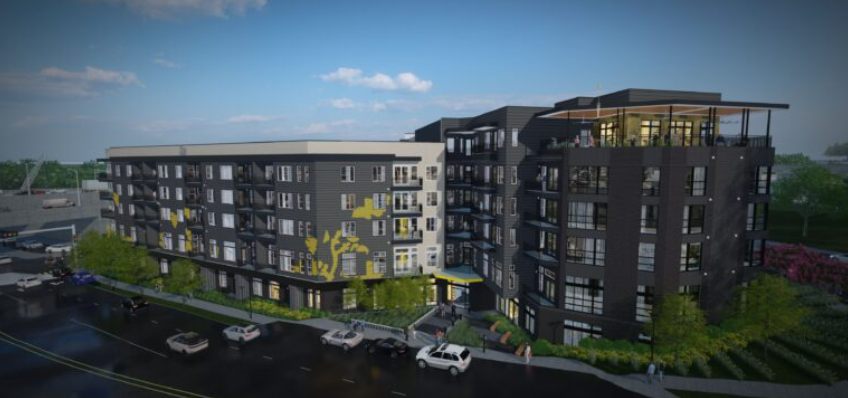
A long-awaited briefing on Public Facility Corporation projects is scheduled Monday at 9 a.m. before the Dallas City Council’s Housing and Homeless Solutions Committee.
The presentation has been postponed several times leaving many in the dark about whether the mixed-income housing projects add value to city coffers and housing stock.
“Months ago, I asked staff to pull together information on the PFC program, including long-term financial implications to the city pertaining to waiving property taxes on PFC-funded properties in exchange for construction and management of affordable housing units in these properties,” said North Oak Cliff Councilman Chad West. “Many others on Council supported this request. On any given Council Wednesday, when a PFC project is up for a vote, you’ll likely see [Council Member Cara] Mendelsohn and I battle back and forth on the viability of the project. Both of us have expressed a desire to dig into the numbers with staff.”
Those who oppose the PFC financing structure don’t like that the projects are taken off the tax rolls, in some cases for up to 75 years, in exchange for providing affordable housing. Those who support PFCs say they’re necessary to provide affordable housing. Developers can’t make a deal pencil without an incentive, PFC proponents say.
There’s also been confusion about whether some of the council-approved PFCs will actually provide a significant number of units for those living at or below 80% of the Area Median Income.
While experts say Dallas has done PFCs legally and properly, it doesn’t help that other Texas cities have run the projects through allegedly corrupt housing authorities and not kept their promises to provide a percentage of affordable units.
House Bill 2071, a PFC reform bill, was approved by the Texas Legislature in 2023 at the urging of Sen. Paul Bettencourt. Bettencourt said at the time that Dallas is not the problem; Houston and San Antonio are the worst offenders.
View Monday’s Housing and Homelessness Solutions Committee agenda.
What is a PFC Project?
The Dallas PFC was created in 2020 to assist the city in financing, refinancing, or providing “public facilities” as defined by the Texas Local Government Code.
“In general, the DPFC seeks to develop and preserve mixed-income workforce housing communities to serve residents earning at or below 80 percent of the area median income (AMI) as well as provide non-income restricted units,” according to the Dallas PFC webpage.
To receive the exemption, a private apartment developer transfers land to a PFC set up by a local government entity, which then leases the land and any buildings on the land (including those built in the future) back to a limited partnership controlled by the developer.
CandysDirt.com reported in May that about 20 PFC projects had been approved or are pending in Dallas.
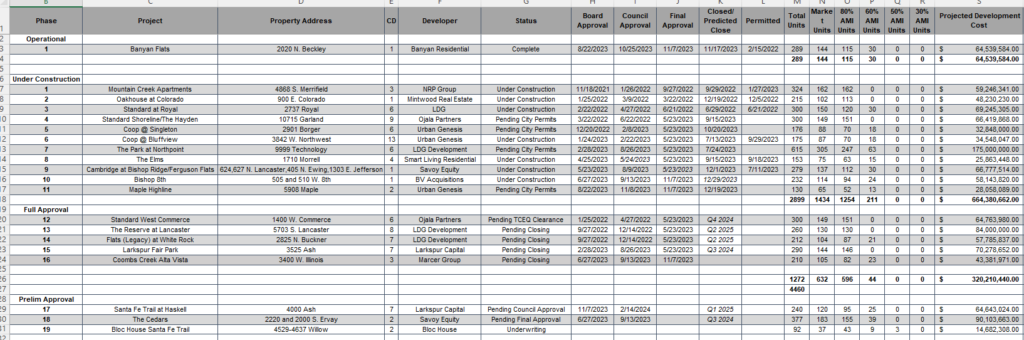
Darryl Baker, a former city planner who lives in southern Dallas, has said he suspects that dozens of PFC projects were left off the city’s inventory but appear on the Dallas Central Appraisal District website.
We’re hopeful that the Dallas Housing and Neighborhood Revitalization Department will provide some clarity in Monday’s meeting about the actual number of projects.
How Are Dallas PFCs Performing?
PFC projects do in fact offer a financial benefit to the municipalities in which they are built, Larkspur Capital development associate Cole Wade told us in May.
“You’re not technically collecting property taxes, but … you are getting the land for free,” Wade said. “You’re getting affordable units. You’re getting a large annual fee. You’re getting a percentage of every single sale of the property. When you add all that up, the actual dollar value to the City of Dallas is higher than it would have been as a market rate deal collecting property taxes.”

Councilman West said the PFC program has leapfrogged the Low Income Housing Tax Credit program as “the most impactful tool in the city’s toolbox to enable the construction of more affordable housing.”
“I’m cautiously optimistic that it will also prove to be a sound financial tool into the near and far future for the city, providing both revenue and housing development,” West said.
One of the first PFC projects — Oakhouse developed by Mintwood Real Estate — is in West’s district. The six-story, 219-unit mixed-income property at 900 E. Colorado Blvd., features half of its units at an affordable rate for residents at or below 80% of the AMI.
Mintwood co-founder Katy Slade told CandysDirt.com on Friday that Oakhouse opened last month and is already seeing significant leasing success.
“Today, we have residents on two floors of the building and are opening the next floors of our elevated, high-design living environment over the coming months,” Slade said. “As the first Dallas Public Facility Corporation development completed, Oakhouse provides 110 units of essential housing for residents making 80% of the area’s median income.”
The PFC program provides “future-proofing” in the neighborhood to protect housing options for essential workers as housing values rise and demand increases to be in a highly accessible area,” Slade added.
“We were drawn to Oak Cliff because of its close proximity to many employment centers, as well as its adjacency to the restaurants and shops in the Bishop Arts District and Jefferson corridor,” she said.
WDG Architecture was the architect on the Oakhouse project. Swoon was the interior design firm, and Gables Residential is leasing and managing Oakhouse.