
Proposed Rule Change Could Lower Hurdle for Dallas City Hall Relocation
Share News:

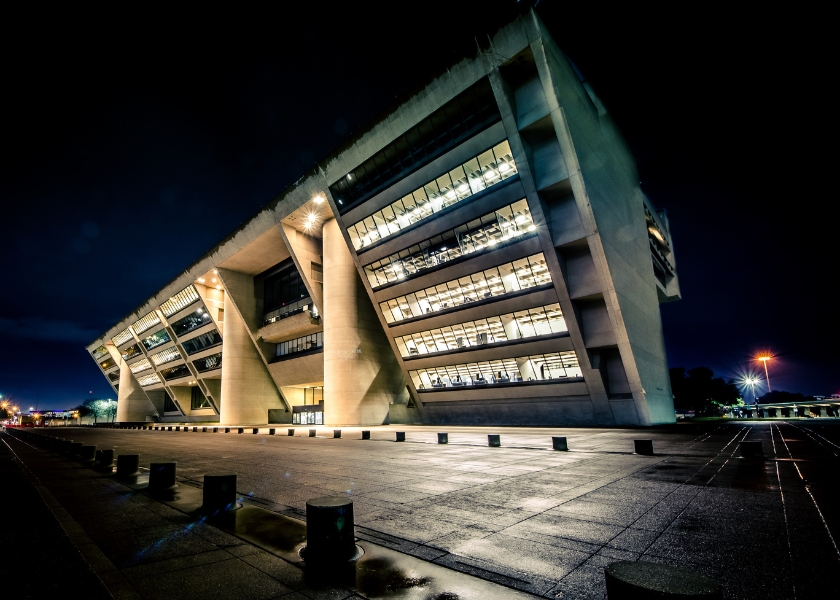
Council members on the Finance Committee will discuss a potential rule change on Monday that would make it easier for officials to authorize the reopening of Dallas City Hall operations in a building other than 1500 Marilla St.
Dallas’ Financial Management Performance Criteria, which are the rules governing the city’s financial planning, currently require an undefined supermajority of the city council to authorize “each new or reopened facility/building.” In addition to other reforms of the FMPC, staff is proposing to strike the supermajority requirement in favor of a simple majority and rewrite the rule to apply to any “added, replacement, or reopened facility/building.”
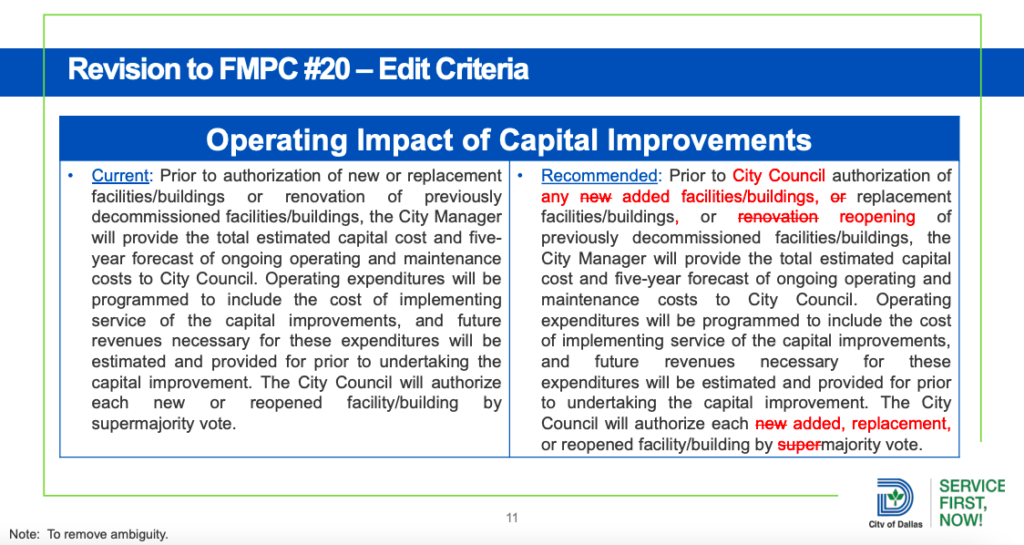
Staff noted that the proposed revision is intended to “remove ambiguity.”
The supermajority provision has hovered over City Hall relocation debates this year, with votes often breaking 9-6 in favor of advancing exploratory work to identify alternative sites and entertain redevelopment opportunities for the historic acreage.
According to Council Member Chad West (District 1), who chairs the Finance Committee, City Manager Kimberly Tolbert asked for the FMPC item to be tacked onto Monday’s special called committee meeting agenda.
“I think it is appropriate to have a discussion on this matter in our committee, but I have let the city manager know I am not comfortable calling a vote on this matter in committee and it would be more appropriate to bring this to a vote of the full city council without a recommendation from the committee,” West told KERA News.
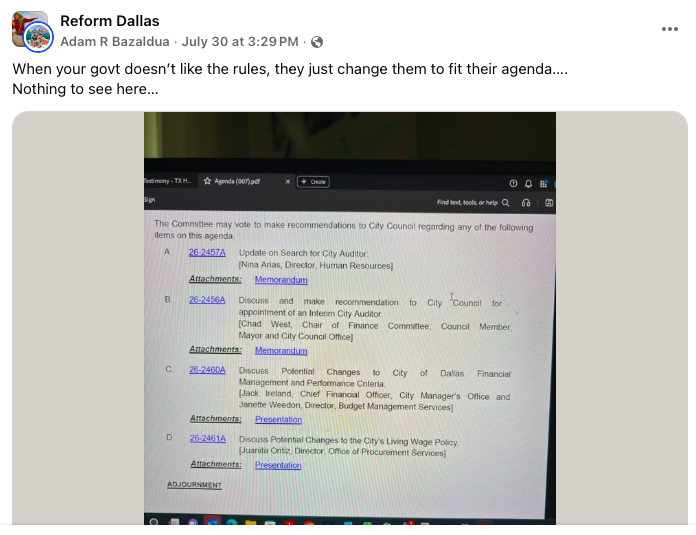
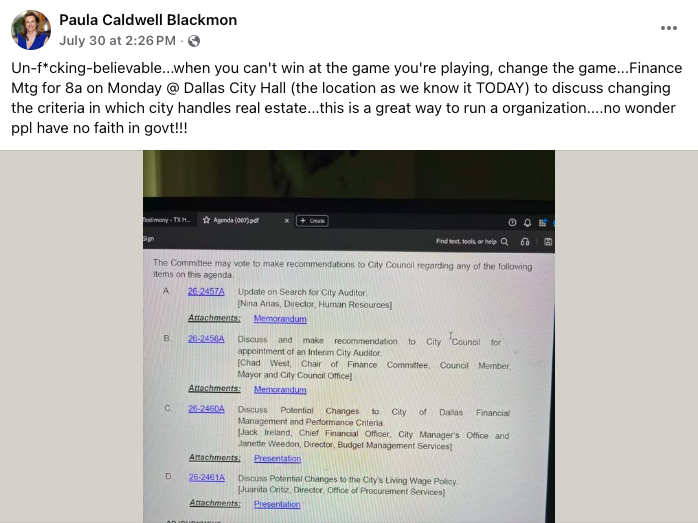
The agenda item, which lacked specifics at the time of posting on Thursday, drew rebuke from Council Members Adam Bazaldua (District 7) and Paula Blackmon (District 9), who have opposed any moves to facilitate relocation from City Hall.
Officials are at odds with one another over the ultimate fate of 1500 Marilla St., with six council members — including Bazaldua and Blackmon — insisting on maintaining operations at the I.M. Pei-designed building in spite of multiple city-commissioned assessments that put the cost of repairing the facility in the hundreds of millions of dollars. Some estimates, when accounting for temporary relocation, interior renovations, and financing, surpass the $1 billion mark.
Preservationists and others have criticized those projections, accusing consultants and staff of inflating costs and pursuing an expanded scope of work that goes beyond necessary repairs.
A majority of the city council, however, has expressed openness to relocating, arguing that taxpayers would be better served by unlocking the real estate at 1500 Marilla St. to spur revitalization in downtown’s southern sector. The nine council members voted in June to shelve a phased repair program for the building, arguing officials should first be briefed on the costs associated with specific relocation options.
Tolbert was directed to come back to the city council by August 26 with relocation options and redevelopment opportunities. Relocation would involve moving City Hall functions and emergency operations (currently housed in the basement) into separate buildings.
A recent city solicitation reportedly tipped Tolbert’s scouting effort, identifying the city-owned former IBM office building at 1000 Belleview St. in the Cedars as the preferred site for 911 dispatch and emergency operations. The site would need to be “special hardened and weather-proof” in order to keep with best practices. The city’s solicitation is for a development agent. It further indicates the property would undergo a conversion.
Last month, reporting indicated three office towers had emerged as leading contenders for City Hall after staff and select council members on the Finance Committee toured at least 15 properties: Bryan Tower at 2001 Bryan St., The Epic in Deep Ellum, and Comerica Bank Tower at 1717 Main St., according to The Dallas Morning News.
Officials have suggested a decision on City Hall’s fate, one way or the other, would need to be made before council members vote to adopt a budget and property tax rate for FY 2026-2027 on September 16.
Beyond the change to the supermajority requirement, staff proposes eliminating the requirement for the city manager to prepare a no-new-revenue tax rate budget scenario, modifying the property tax revenue limit to better align with state law, including an employee benefits reserve in the General Fund’s unassigned fund balance while increasing the minimum reserve target from 50 to 55 days, and establishing a new policy governing how proceeds from the sale of city-owned real estate are used, among other revisions.
The Finance Committee’s special called meeting is scheduled for 8 a.m. on Monday, August 3.