
Dallas City Council Shelves Repair Plan, Continues Relocation Search
Share News:

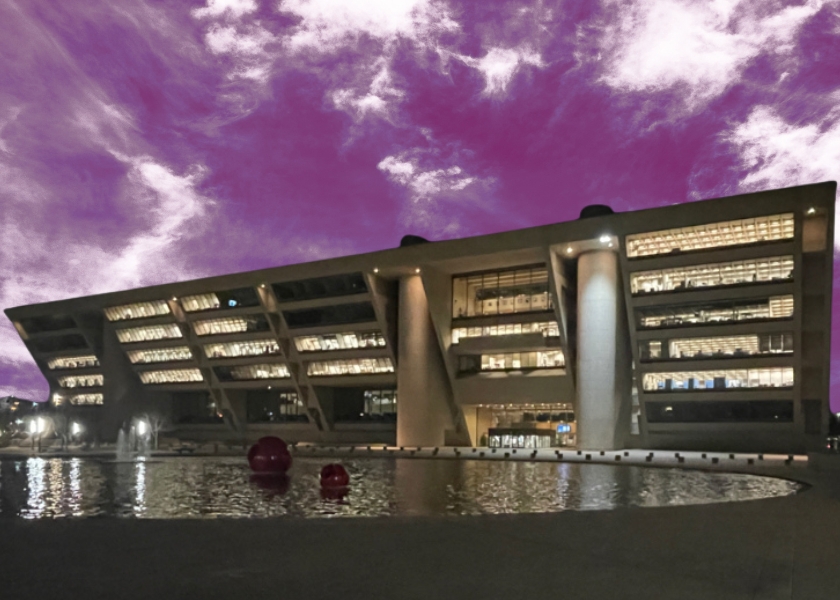
Dallas City Council voted Wednesday evening not to advance a proposed phased repair strategy for City Hall, instead directing the city manager to continue exploring relocation and redevelopment options.
The motion was made by Council Member Chad West (District 1) after hours of impassioned public comment, closed session discussions about potential City Hall relocation sites, and sometimes tense exchanges between officials.
It passed 9-6, with Council Members Laura Cadena (District 6), Adam Bazaldua (District 7), Paula Blackmon (District 9), Bill Roth (District 11), Cara Mendelsohn (District 12), and Paul Ridley (District 14) voting against.
In a statement, West said his motion “pauses moving forward with a repair strategy” for the time being and directs City Manager Kimberly Tolbert to continue on previously authorized work from a March resolution tasking her with finding potential relocation sites for City Hall and emergency dispatch functions and exploring redevelopment options for 1500 Marilla St.
Council members voted after a state district judge issued a temporary restraining order preventing the city from proceeding with voting items in the special called meeting’s agenda related to relocation and redevelopment of City Hall. The restraining order was initially sought by Bazaldua, Blackmon, and Mendelsohn, but Mendelsohn subsequently pulled her name from the suit. The lawsuit names the city, City Manager Kimberly Tolbert, and City Secretary Bilirae Johnson as defendants.
Wednesday morning, lawyers for the opposing parties agreed that the voting item related to phased repairs could be discussed at the special-called meeting, filing a Rule 11 Agreement to amend the order.
During the meeting, City CFO Jack Ireland briefed council members on funding strategies for a potential repair of or relocation from 1500 Marilla St. While the presentation didn’t have any hard numbers for potential relocation sites to compare against the estimates for phased repair, Ireland said city staff believes relocation would ultimately cost less than repairing the I.M. Pei-designed building.
The presentation outlined how financing a phased repair across 20 years could potentially cost well over $1 billion when accounting for swing space, modernization, bond interest, and finish-out. Corrective repairs themselves are estimated to cost between $532 million and $611 million.
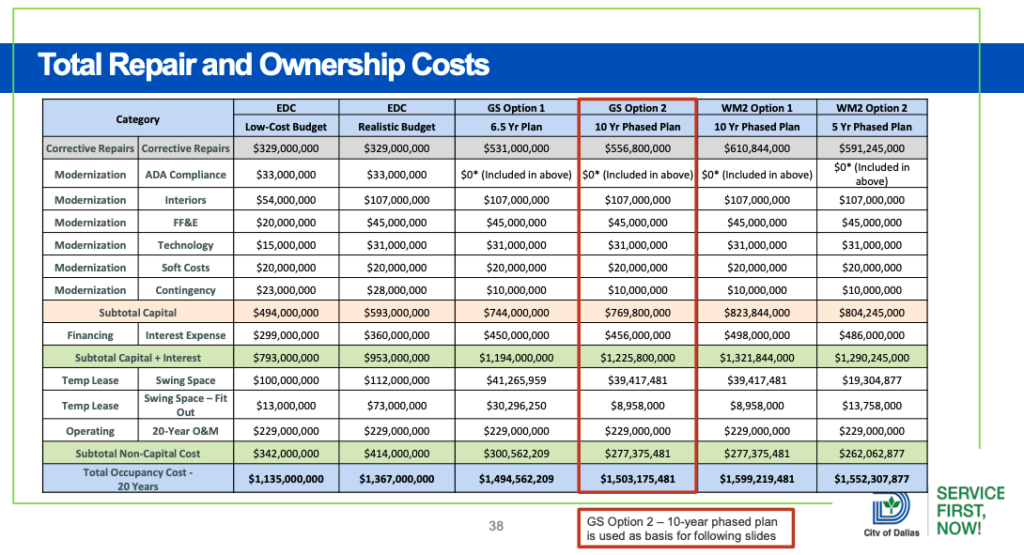
Ireland said financing would disrupt existing projects and put bond propositions totaling $1.7 billion before voters, including public safety initiatives. On paper, a pay-as-you-go approach using cash to pay for only corrective repairs and modernization ($770 million) would require either severe cuts to staff and services or a significant voter-approved property tax hike, according to the presentation.
“Any final action regarding the disposition of City Hall or temporary or permanent relocation will need to come back to City Council,” he said. “As I mentioned at the horseshoe, the TRO unfortunately prevents us from obtaining the numbers for potential relocation options so we can compare apples to apples, which is what the public has really been asking for.”
West questioned Ireland about the potential financial benefits of relocation over repair, to which the CFO and consultants pointed to a favorable downtown office market. Tolbert also said there would be an opportunity to carry out operational efficiencies by consolidating city departments currently working in other facilities.
Ireland also suggested that the city was intent on pursuing a lease-to-own option if it didn’t purchase a building outright.
“There is not anticipation that we would be a permanent tenant somewhere,” he said. “Every option that we’re looking at would be, if we did go with a lease, it would be a lease-to-own option. Our goal is to own City Hall, not to lease City Hall.”
Multiple amendments were proposed to require the city manager to come back with additional information related to demolition costs, waste disposal, and environmental impacts that would possibly result from an eventual relocation, but a majority of council members shot them down.
“Even if you wanted to knock this building down, why wouldn’t you want more information?” Mendelsohn said.
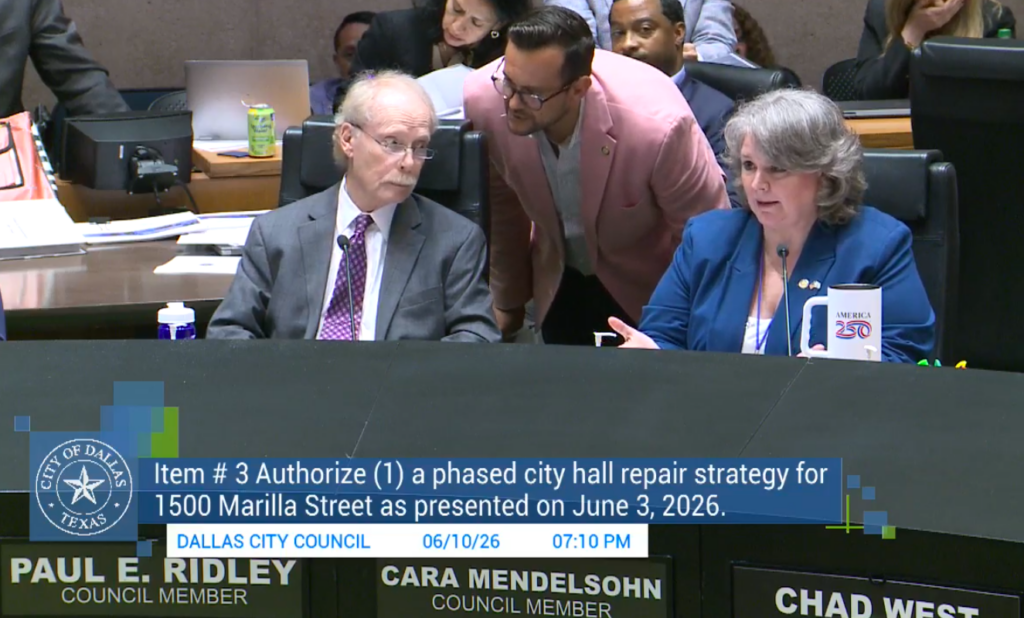
Ridley argued that the repair estimates were still unnecessarily high and fell outside the scope of a resolution calling for plans to address “critical repairs.”
“That’s something I’m quoting from that resolution,” he said. “We don’t have that yet, and I think it’s time that we insisted that we get that from the city manager, along with a reasonable financing plan for that cost.”
Consultants previously explained that the extent of the corrective repairs would likely result in a domino effect in terms of escalating costs once invasive work actually began. ADA and code compliance rules would also come into play, making certain updates to the building mandatory. Still, some preservation advocates and industry professionals have argued that repair costs could be significantly lower than the estimates presented by the city — ranges in the tens of millions rather than the hundreds.
Mayor Eric Johnson described the decision as the most fiscally responsible and best long-term option for city employees and residents, pointing to the several months of analyses by staff and outside consultants that led to bigger and bigger estimates for repair.
“Instead of delivering the Dallas taxpayers a billion-dollar invoice for a dilapidated government office building that is impeding the growth of a large section of our urban core, the City Council took an important step toward realizing my vision of a downtown teeming with life, with community, and with social and economic activity,” he said in a statement after the vote.
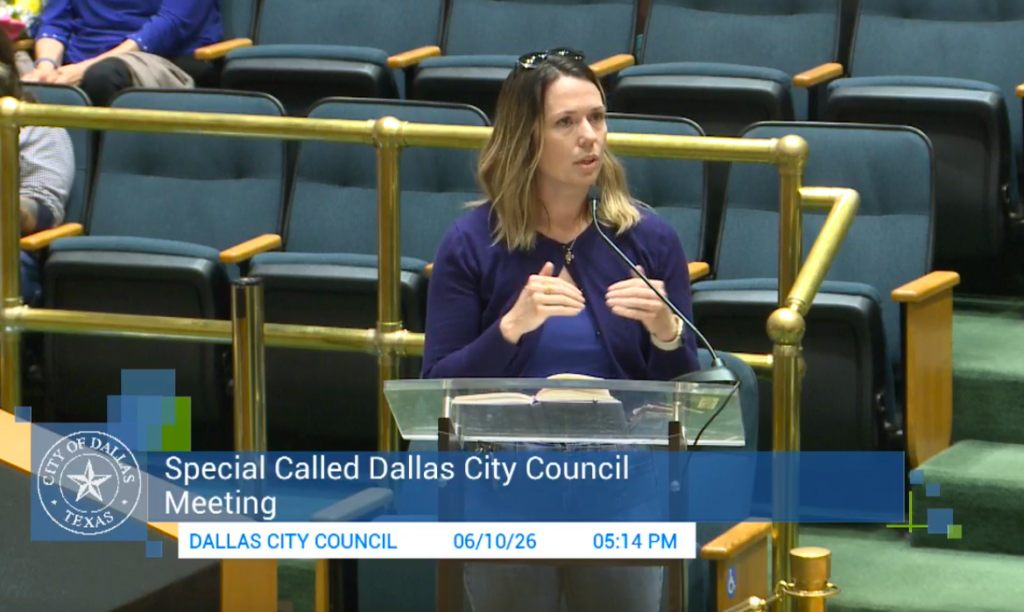
Public comment was interspersed across the day and well into the evening, with officials switching back and forth between the special-called meeting and city council’s regular Wednesday meeting. While upwards of 200 people intended to speak in person or virtually, many left or were unable to say their piece due to the uncertain timing of the day’s business.
Many speakers who opposed repairing City Hall argued that spending more than half a billion dollars to rehabilitate the aging building would be a missed opportunity to revitalize downtown. Such speakers, including business leaders, developers, former officials, and downtown advocates, argued that redevelopment would expand the tax base, attract investment, improve public safety, and support broader economic growth.
“The current City Hall site sits at the heart of an area of downtown Dallas that has faced challenges for decades and has never reached its full potential,” said TREC CEO Jamee Jolly. “Redeveloping this site presents a generational opportunity to connect the southern edge of the downtown core to southern Dallas.”
Developer Amanda Moreno-Lake, one of the co-chairs of former mayor Mike Rawlings’ Say Yes to Downtown pro-relocation campaign, argued that the city had already received sufficient information to make a decision and should seize the opportunity to redevelop City Hall, contending that continuing to invest in the facility would be a poor long-term use of taxpayer dollars compared with pursuing new economic development and investment opportunities.
“Today is an opportunity to choose growth over stagnation, opportunity over maintenance, and the future over the past,” she said.
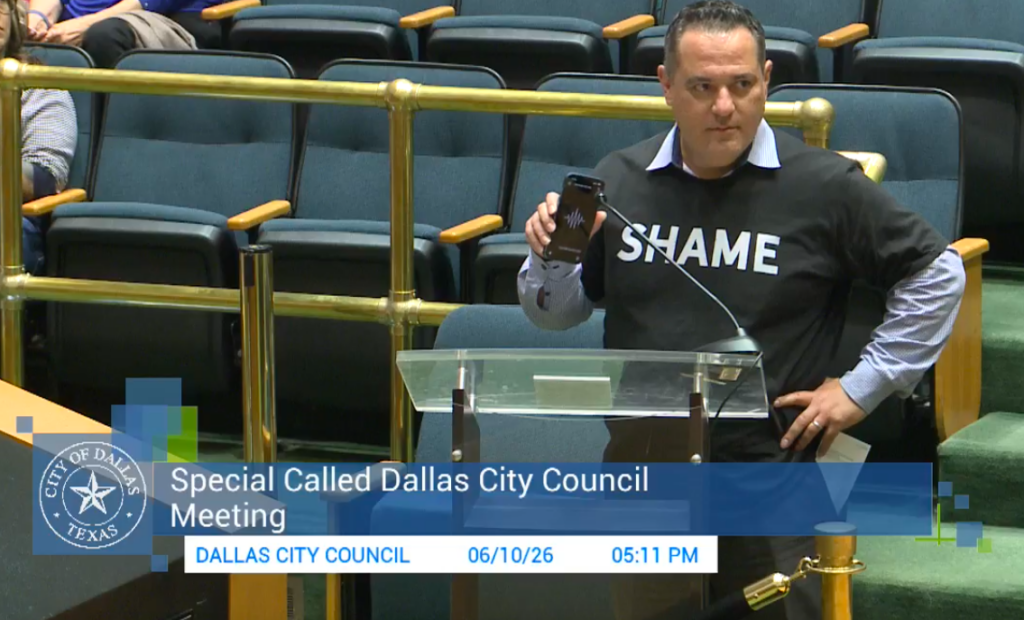
Meanwhile, supporters of repair maintained that estimates had been inflated, arguing that City Hall remains a structurally sound and historically significant public asset and that taxpayers deserve a transparent comparison of all available options before a decision is made. Several speakers framed the issue as one of stewardship, arguing that deferred maintenance by previous city leaders should not be used as justification for abandoning an iconic civic landmark.
“The plan you’re voting on today is not a repair plan. It’s a construction project that’s too extensive and too expensive,” said resident David Voss. “This building’s not broken. The way it’s being used and managed is broken, and the way it’s being presented is very broken.”
Sarah Crain, executive director of Preservation Dallas, pushed back on the notion that preserving City Hall and revitalizing downtown are mutually exclusive goals, saying Dallas has historically succeeded by blending old and new development.
“This building is neither an albatross nor a magic bullet for downtown. Saying yes to downtown redevelopment should not mean having to say no to repairing this building,” she said.
An open call for proposed concepts of what to do with the site received some serious submissions, including a wholesale transformation of the CBD’s southern district that would see City Hall preserved while siting an integrated blend of commercial, green, and venue space to the southwest.
West’s motion called for redevelopment options to be brought back to the city council no later than August 26, but more activity around the relocation question could be coming much sooner. A hearing on the temporary restraining order is scheduled for June 18.
While a final vote on the fate of City Hall has yet to be made, Bazaldua suggested, “The outcome is clear.”
“History ultimately judges decisions like this not by the promises made in the moment, but by their results,” he said in a statement after the meeting. “Years from now, Dallas residents will evaluate whether this vote served the long-term interests of the city and whether this council was a responsible steward of a civic asset entrusted to it.”
4 Comments
Leave a Comment







Why should they consider moving to a new site, when they did not take care of the property they had for all these years????? The City just keeps delaying maintenance and will continue to do the same
thing for as long as they can. It is a shame that City officials have allowed the building to get in the shape it is in. They have not been good stewards and the citizens should not keep funding bad decisions by the City Officials. There seems to be so much waste and they should get back to the basics of taking care of their employees and the property they are in and suppose to maintain. If they had done their job in years past – the conditions would not be in the shape they are in. Why give them a new place to ruin?
If IM Pei’s iconic Dallas City Hall is torn down, it will be the end of Dallas’ claim to be a “world-class” city. The current discussions are a shameful and toxic mix of disrespect for City Hall and Dallas’ architectural heritage in general plus underhanded double-dealings by certain powers-that-be who have vested interests in getting their hands on the real estate under City Hall. The alleged billion-dollar estimate is just the tip of the iceberg when it comes to the lies being told to try to justify their desired outcome.
Dallas’ City Hall is unique. There is nothing else like it in the entire world (unlike our copycat Calatrava bridges — another expensive and misguided “civic improvement” that merely mimicked what’s already been done better in Boston and elsewhere). Furthermore, Dallas’ City Hall is not only unique; it also is a historically significant masterpiece by IM Pei, a towering figure among architects from any era and certainly one of the top names of the 20th century.
If it is torn down, Dallas will be a world-class laughingstock at best, not to mention a cultural philistine. Why can we not recognize and preserve what makes this city great? The citizenry at large is not to blame.
Historically, Dallas has sheer disdain for the people who actually live and work here. Case in point: the arts. Dallas wants to be known as a city that supports the arts, but builds a performing arts center that local theatre companies can’t afford to rent. The money for the big theater building (now sponsored by AT&T) could have been better spent renovating the Kalita Humphreys Theater, (another building designed by a famous architect, Frank Lloyd Wright). A true revitalization of downtown would include affordable storefront spaces for small theatre companies and art galleries, locally owned restaurants, and grocery stores.
SHAME!