
City Hall Roundup: Veteran Housing, Library Drama, and Budget Pressures
Share News:

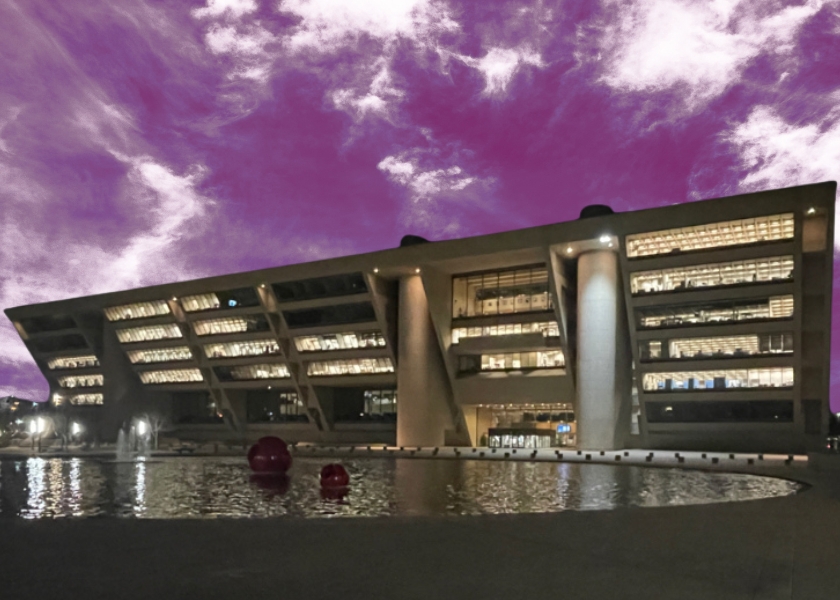
It was a difficult week in Dallas, particularly in Oak Cliff, where residents continue to support survivors of the Clyde apartment explosion while investigators search for answers. Meanwhile, individuals and organizations are stepping up to provide support for the survivors who lost their homes and belongings.
Click on the links below to see how you can help:
Mission Oak Cliff
Oak Cliff Muscle Factory
Well Grounded Coffee
Viral Foodies DFW
Now, from tiny homes to budget spreadsheets to pointed emails, here are some of the recent headlines out of Dallas City Hall that caught our attention this past week.
Officials Grant Land for Veteran Tiny Home Community Project
A long-vacant tract of city-owned land in southern Dallas is set to become a transitional housing community for veterans experiencing homelessness after the Dallas City Council unanimously approved an agreement with a national nonprofit on Wednesday.
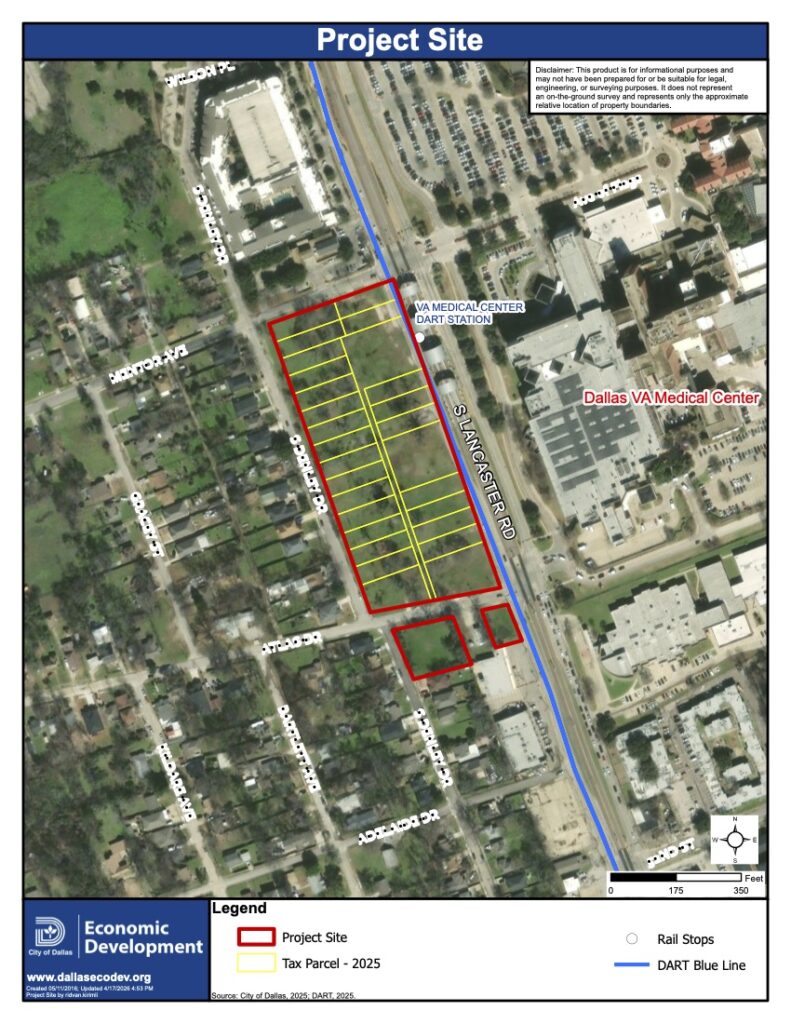
Veterans Community Project Village will be developed on roughly 7.3 acres near the Dallas VA Medical Center along South Lancaster Road. Under the agreement, Kansas City-based Veterans Community Project will receive the property and take responsibility for designing, funding, constructing, operating, and maintaining the development.
“This project represents that Dallas stepped forward and decided that Veteran homelessness was its problem to solve,” said Veterans Community Project CEO Bryan Meyer in a statement. “This Village will be more than a collection of homes; it will be a visible reminder that this community values its Veterans and is willing to invest in them.”
Plans call for 50 stand-alone tiny homes, a community center, and a variety of shared amenities intended to support veterans as they transition out of homelessness. The site was selected in part because of its proximity to the VA hospital, public transit, healthcare services, and employment opportunities.
City officials described the project as an opportunity to address veteran homelessness while putting an underutilized property to productive use. Dallas has owned the land since 2015 and previously sought private development proposals for the site, but none resulted in a completed project. Over the past several months, city staff and Council Member Maxie Johnson (District 4), who represents the area, worked to explore alternatives before identifying Veterans Community Project as a potential partner.
The nonprofit operates similar communities in several other states and focuses on providing transitional housing coupled with case management and supportive services. Veterans living in the community will not pay rent, but they will participate in programs designed to help them secure permanent housing and regain stability.
Development is expected to cost approximately $15 million. Before construction can move forward, Veterans Community Project must raise at least $4 million in funding by the end of 2027, a benchmark required under the city’s agreement.
Central Library Drama May Have Resulted in Board Casualty
On Wednesday, the Dallas City Council officially sanctioned a former member of the Municipal Library Board over an email he sent to the director of Dallas Public Library that was determined to have violated the city’s Code of Ethics.
The email stemmed from a staff announcement Library Director Manya Shorr made back in November of last year pushing back on rumors that the city wanted to sell J. Erik Jonsson Central Library. While Shorr pointed to planned investments in the property and a proposal to “reimagine” operations at the historic building, she also hedged on the final outcome.
“If the City decides to sell City Hall and the Central Library, that is not my decision,” she said. “But I also know the challenges of such a vast space created in the early 1980s, when the building was constructed — when no one fathomed what the future of libraries would be. The services we offer are incredibly valuable, as is the work you do with our community. But they are separate from the space they occupy and that’s what I ask us to focus on.”
Sam Staggs, then-board member for District 8, accused Shorr of speaking “from both sides of your mouth,” questioned the circumstances surrounding her hiring, suggested without evidence that developers and city officials had influenced the process, and criticized her leadership and professional judgment.
“It’s clear why you, and those you report to, are worried about the ‘rumors,’ especially since local news media have gotten wind of the nefarious plans that until recently seemed almost a fait accompli,” Staggs said. “And do you really think that any member of the library staff would contradict you if they were asked for the real story? Your management style is no secret. Word is out, and many plans upset. The fight is just beginning!”

In December, Council Member Lorie Blair (District 8) told Staggs she would be nominating a new Library Board member to represent her district. Debbie Austin was later installed as Staggs’ replacement.
The Office of Inspector General charged Staggs with an ethics violation:
“City officials and employees shall, when acting in the performance of their official duties, comply with the following standards of civility in their interactions with city officials, city employees, residents, and persons doing business with the city: City officials and employees shall not make comments or take actions that are abusive; belligerent; crude; derogatory; impertinent; profane; slanderous; threatening; or involve personal attacks upon the character, integrity, or motives of others.”
The ethics charge was resolved with Staggs completing one hour of ethics training in February. The settlement was approved in Wednesday’s vote on the sanction.
Highlights From Budget Memo
Staff published a memo on Friday answering a number of operational and funding-related questions asked by council members earlier this month. Those questions focused on identifying new revenue sources or reducing General Fund obligations. The memo comes as officials look to offset a projected budget shortfall for FY 2026-2027 totaling tens of millions of dollars.
Here are some interesting highlights:
School Crossing Guard Program
Council Member Maxie Johnson (District 4) previously raised the prospect of mitigating the city’s contribution to the funding of crossing guards at Dallas ISD schools. Per state law, cities of a certain size are obligated to support such safety programming. In FY 2024-2025, the program cost city taxpayers $6.28 million.
Staff said the city could appeal to the Texas Legislature to secure more revenue authority, pointing to a few specific potential revenue streams:
- Request that Dallas County and any other city or municipality remit to the City the $25 fee collected on traffic citations issued for school zone violations, directing these funds into the Child Safety Fund.
- Seek a mandate requiring Kaufman County and Rockwall County to remit the City of Dallas’ proportional share of revenue generated from vehicle registrations, as portions of the City that extends into these counties.
- Request that school districts with elementary schools located within the City of Dallas contribute a percentage of their tax-rate-generated revenues toward funding school crossing guard services.
Savings From Vacant Positions
Last month, City Manager Kimberly Tolbert implemented a hiring freeze for all non-uniform positions in General Fund departments through the end of the fiscal year (with some limited exceptions for mission-critical positions).
Staff was asked what kind of savings would be realized if the hiring freeze was extended through FY 2026-2027. According to the memo, there are currently 705 vacant non-seasonal positions impacted by the hiring freeze. If they were all to be held vacant through next fiscal year, taxpayers would save roughly $32 million.
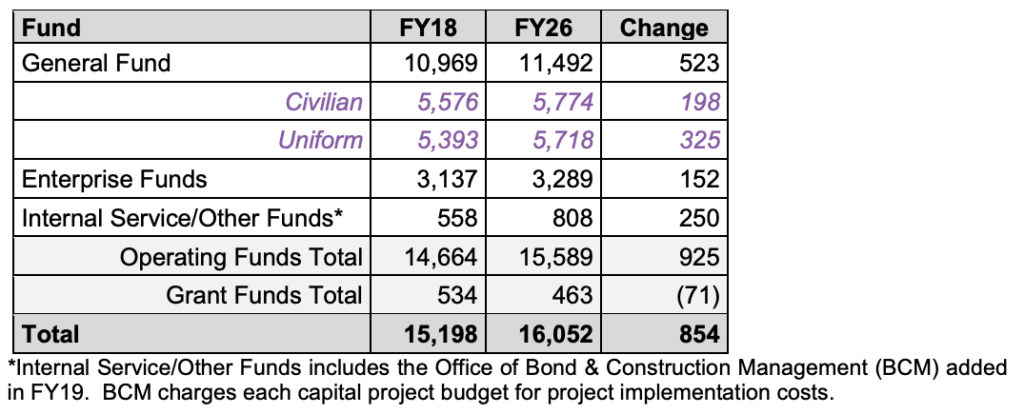
A graph was also provided comparing city position counts in FY 2017-2018 and FY 2025-2026:
Bike Lane Utility
Council Member Gay Donnell Willis (District 13) previously suggested that spending on bike lane expansion and related programming needed some investigation.
Staff pointed to data in the 2024 American Community Survey related to work commutes. Apparently, only 382 Dallas residents use a bicycle to commute.
“It’s important to note that this figure represents only work‑related bicycle trips and comes from a relatively small survey sample,” staff said. “As a result, it does not capture the full range of people who may use bike lanes for recreation, errands, school trips, or other non‑work purposes.”
Bike lane projects aren’t just supported by the city. They also get money from DART’s excess sales tax revenue, county capital improvement programs, and state and federal set-aside funding. The city does maintain a dedicated bike fund, though, and bond and TIF dollars also support such programming.