
Oak Cliff Viaduct Backlash Forces Dallas to Reconsider Dallas Convention Center Plans
Share News:

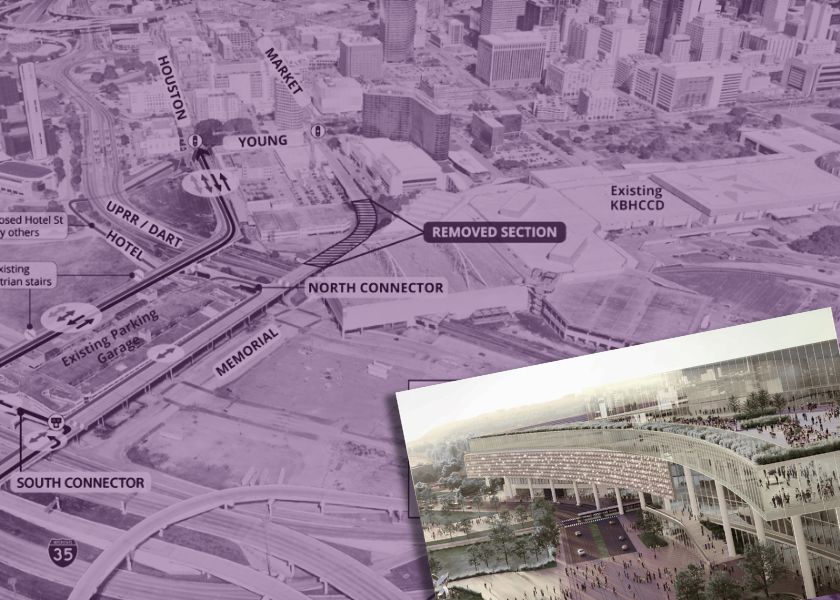
The Kay Bailey Hutchison Convention Center redevelopment is going back to Dallas City Council after the Transportation & Infrastructure Committee realized the current plan might unnecessarily inhibit the southern sector’s access to downtown.
In a 4-2 vote on Tuesday, the committee recommended to city council that the convention center project be reverted to the earlier design that would raise the building to “address problematic Jefferson Viaduct realignment.” The vote followed weeks of public outcry in North Oak Cliff, where residents and business owners have been stressing the importance of existing viaduct traffic flows to the neighborhood’s connectivity with the city center.
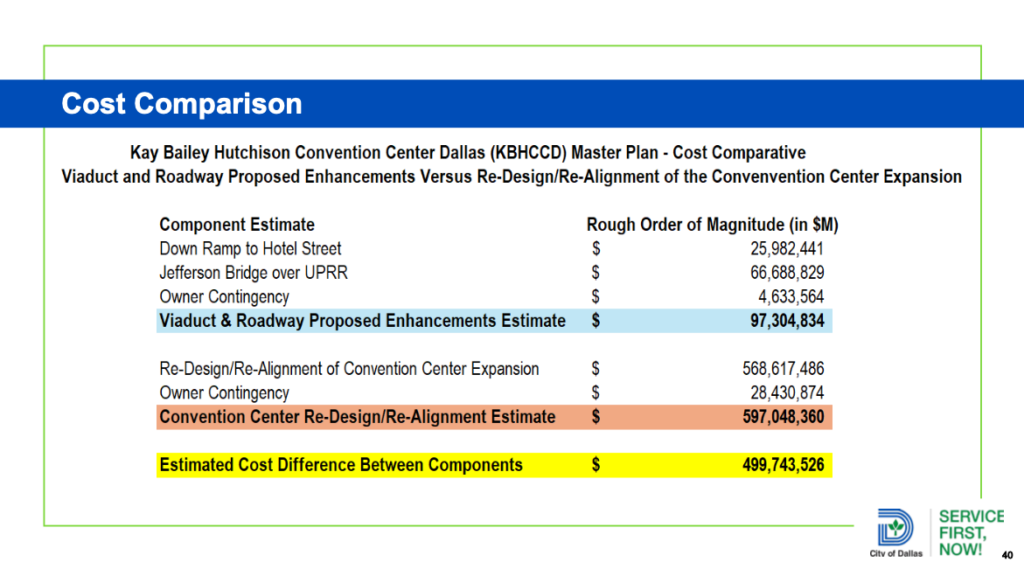
Earlier this year, staff updated the convention center design to realize roughly half a billion dollars in savings after receiving direction from council members to find ways to lower the project’s cost. Staff concluded it would be cheaper — and better for the convention center customer experience — to lower the building, foreclosing the possibility of allowing the Jefferson Boulevard Viaduct to run under the facility and into the heart of downtown as it currently does. Before the update, the price tag was estimated at between $3.5 billion and $3.7 billion.
Committee members received a briefing on staff’s latest proposal for how to accommodate the convention center’s encroachment on the viaduct. The conceptual plan was previewed at a community meeting last week, but officials gave a more thorough explanation on Tuesday, detailing what viaduct traffic would look like during convention center construction, at the facility’s opening, and in the years after.
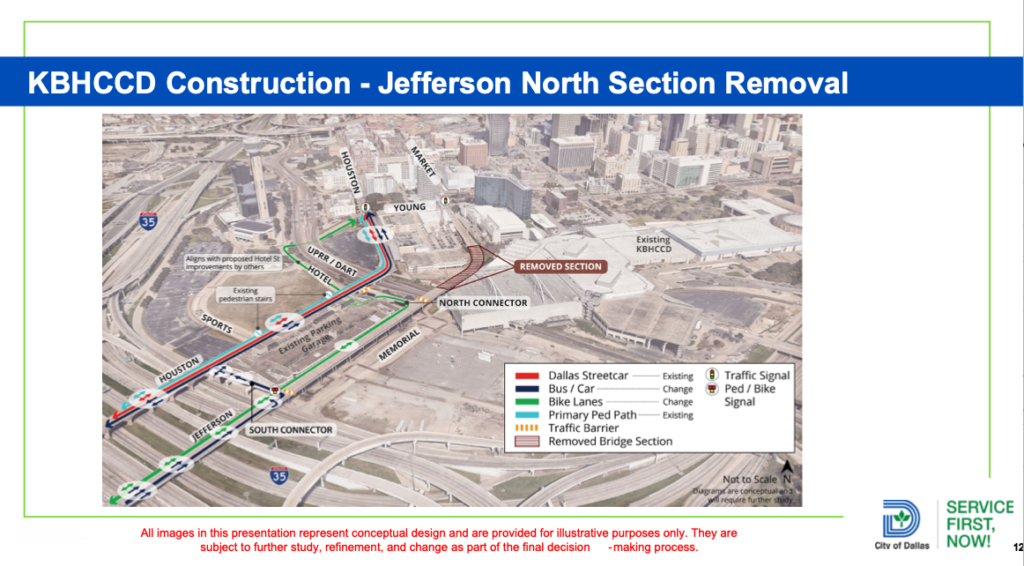
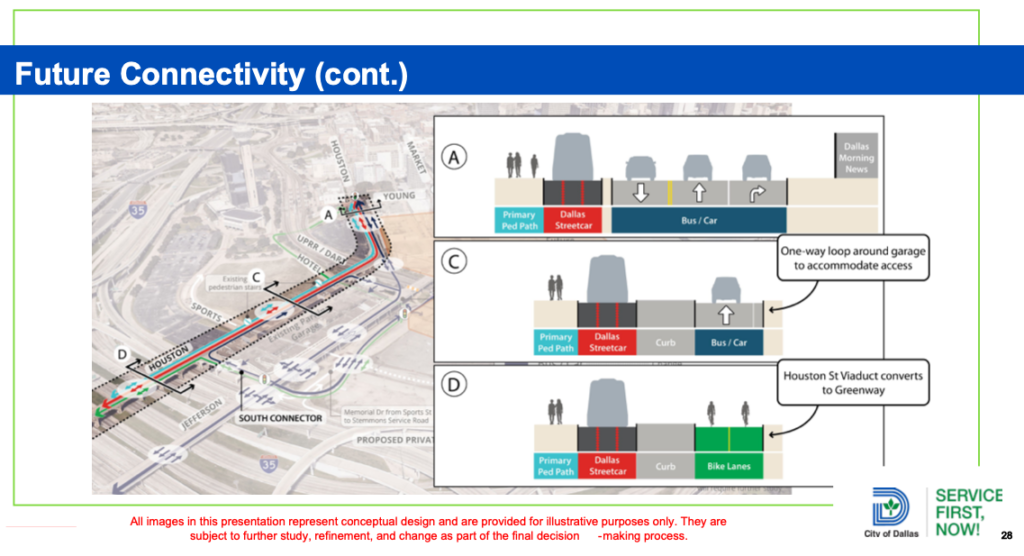
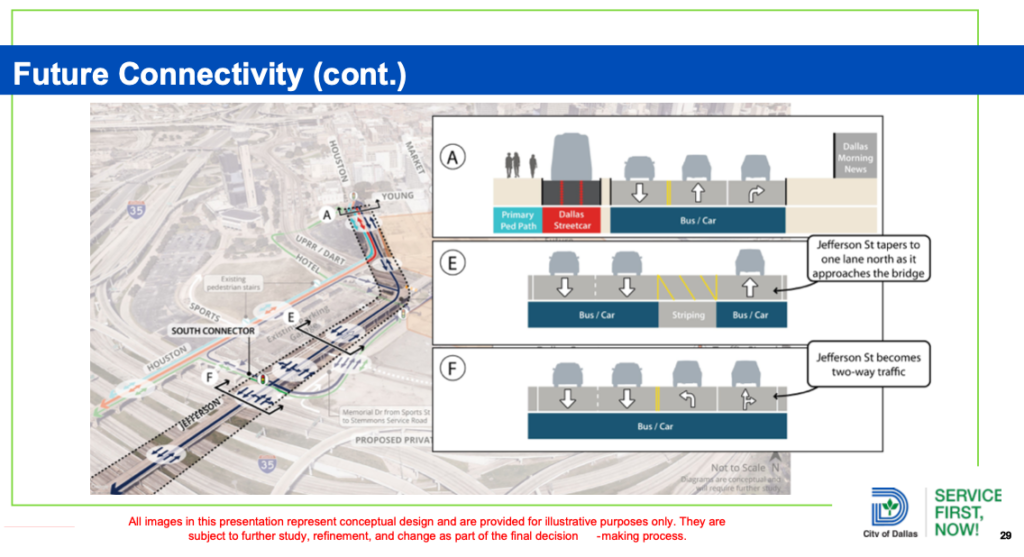
At present, Jefferson takes three lanes of one-way traffic north across the Trinity River into downtown. The adjacent Houston Street Viaduct runs two lanes of one-way traffic south back across the river into Oak Cliff. In a nutshell, staff want to link up Jefferson and Houston Viaducts through a connector, converting the latter into a two-way road so northbound traffic could be funneled around the convention center to Young Street. They also want a new ramp installed on Jefferson leading down to the convention center’s mobility hub.
Crucially, the northernmost stretch of the Jefferson Viaduct that turns into Market Street would need to be shut down to accommodate nearby demolition and would eventually be removed since it interferes with the planned convention center envelope.
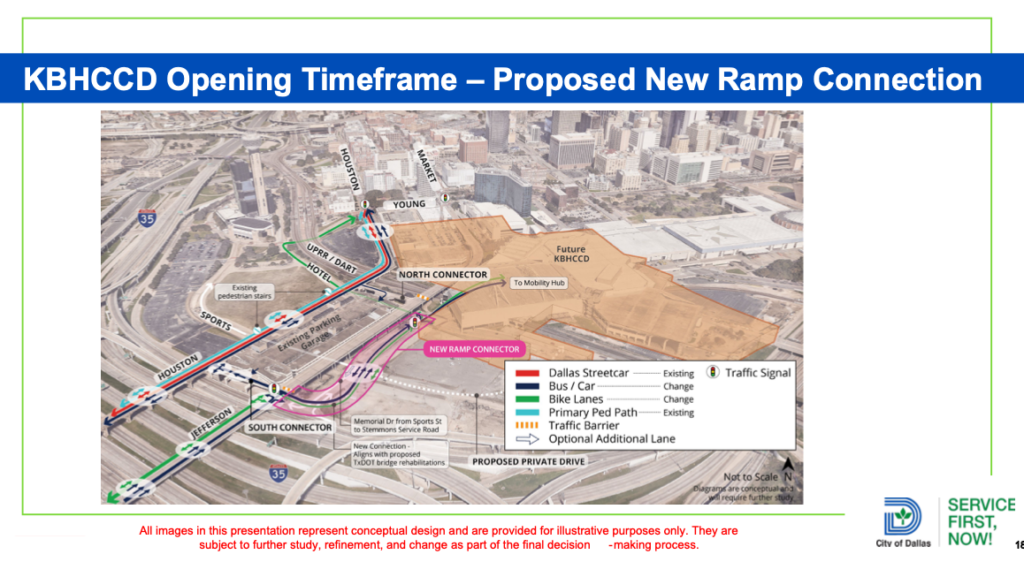
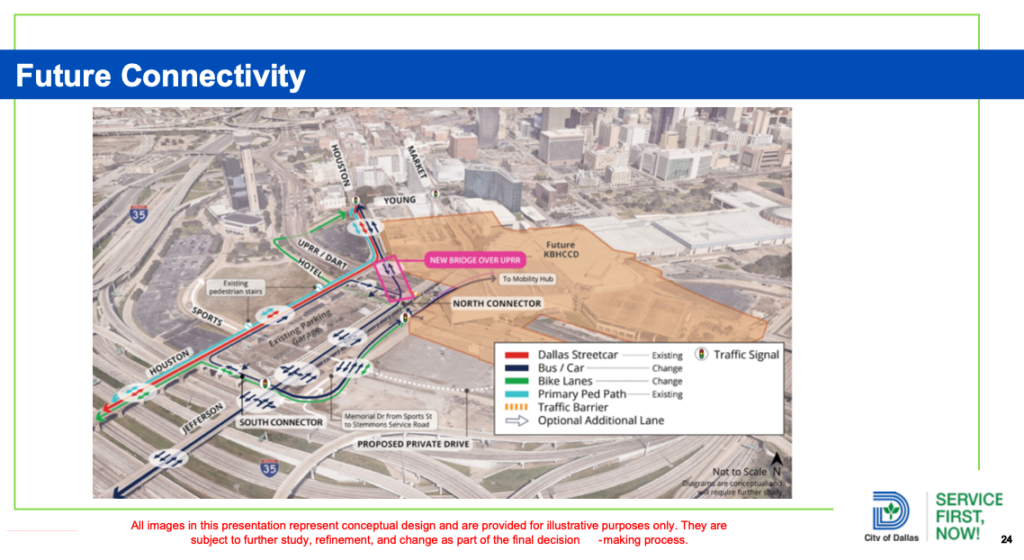
While there’s currently no funding for it, staff also want to eventually take all car traffic off the Houston Viaduct to implement the Oak Farms Corridor Study’s recommendation for a greenway on the bridge, reserving it for pedestrian, bicycle, and public streetcar traffic.
Staff were peppered with questions about potential impacts on traffic congestion and the various timelines at play, including convention center design and construction, Transportation Department planning, and nearby TxDOT projects, some of which have already dislocated traffic in the southern sector.
Council members also asked what kind of process would need to play out to adopt any new plan rerouting viaduct traffic. Staff pointed to an established Thoroughfare/CBD Plan Amendment Process, which calls for public hearings by the City Plan Commission and city council and all the community engagement that comes with it.
All but three city council members were present at one point or another, even though the committee comprises only seven. Virtually everyone was skeptical about the proposed viaduct plan, to say the least. Council members representing southern Dallas were particularly frustrated.
“I understand that what we’re trying to do is to stay on time with the project,” said Council Member Maxie Johnson (District 4). “However, when we get ready to make decisions like this, there needs to be preparation, conversation, and not anything that seems like it’s being forced down their throat.”
Council Member Lorie Blair (District 8) also expressed concerns, noting she and others who live further south than Oak Cliff use the viaducts to get in and out of downtown. She said it was already a cumbersome trip because of other TxDOT projects.
“Those impacts, as well as this with the Jefferson Viaduct, it literally cuts the southern sector off,” she said. “And one thing we did not do is have a conversation with the residents that we’re going to impact.”
Over the course of the meeting, though, it became clear that staff were going to proceed with shutting down part of Jefferson Viaduct regardless of where plans stood for long-term rerouting because of the convention center development timeline. Demolition is already underway at the old convention center, and demolition of the northern stretch of Jefferson Viaduct is expected to begin as early as next month.
Council Member Cara Mendelsohn (District 12) motioned to recommend to the city council that the building be raised, arguing that council members had not been adequately briefed on the potential consequences of the redesign.
“There’s a management problem happening right here, and putting the convention center back to the original height takes care of this problem,” she said, arguing the cost savings to the convention center project were not worth permanently disrupting some of southern Dallas’ long-established routes into and out of downtown.
“You’re going to ask us on any project, would we like the price to be lowered — I guarantee the answer is going to be yes,” Mendelsohn said. “But what didn’t happen in that conversation was to say, if we do that, here’s what we’re going to do, here’s the consequences of it. That discussion never happened.”
Staff did brief the city council a handful of times on the redesign, and in January, Council Member Chad West (District 1) raised some concerns about North Oak Cliff getting cut off. At the time, staff had several proposals to reroute Jefferson Viaduct traffic around the building but had not finalized them. The Transportation Committee was then briefed in March, which is when things really started sinking in.
On Tuesday, West said he hoped staff could devise something as soon as possible that might work as a compromise. He suggested staff’s latest proposal was essentially turning its back on Oak Cliff.
“Oftentimes in District 1, we see conflicts between our motorists, our cyclists, and our pedestrians, but in this scenario, everybody hates it,” he said. “Nobody’s happy. We really need a better option for Oak Cliff.”
Rosa Fleming, director of Convention & Event Services, said there could be serious ramifications to reverting the design. For starters, she said officials would be adding one year to the project timeline. Convention center bookings in 2030 would have to be cancelled, and there could be cascading effects in terms of costs and lost revenues from the delay.
The prospect of throwing the convention center redevelopment into further uncertainty unnerved Council Members Jesse Moreno (District 2) and Paula Blackmon (District 9).
“Just doing this without having all the information on the impacts to the economic vibrancy of our city, I cannot support this in good conscience,” said Moreno, who is not on the Transportation Committee.
The motion passed, with Mendelsohn and Council Members Zarin Gracey (District 3), Laura Cadena (District 6), and Bill Roth (District 11) voting in favor. Council Members Paula Blackmon (District 9) and Paul Ridley (District 14) voted against it, and Blair was absent.
Media strategist and former local reporter Brett Shipp called the vote a “watershed moment in city politics,” with council members opting to consider the potential impact on neighborhoods over staff’s plans for a major development project.
“We will now, for the first time, get to provide real input on actually making our connection between Oak Cliff and downtown Dallas better,” Shipp said. “While there’s no perfect solution, there is at least an opportunity to make the final viaduct plan make sense.”
Shipp and others in the Oak Cliff area have been campaigning against any changes to the existing viaducts’ traffic flows.
It’s currently unclear when the full city council will consider the Transportation & Infrastructure Committee’s recommendation.



Another screw up!
Thank God. Hope the city council does the right thing too.