
Is ‘Gentle Density’ Too Much for Single-Family Neighborhoods in Dallas?
Share News:


A throughline of Dallas’ population growth has been the tension between single-family neighborhoods and multifamily construction, and the stakes are high as limited housing stock makes living in the city a challenge for many.
While it’s no secret that dense projects near single-family homes tend to draw opposition, officials are looking to use zoning reform to make it easier to build duplexes, triplexes, and accessory dwelling units (ADUs) in such neighborhoods — a “gentle density” approach, as it’s been called.
Last Friday at the Dallas Housing Coalition’s second annual Housing Summit, a number of panelists showcased their efforts to deliver creative “missing middle” projects that fit the gentle density bill.
Benje Feehan, executive director of the Dallas-based nonprofit buildingcommunityWORKSHOP, touted the group’s experiment with duplex construction, testing whether building for an on-site landlord could open the door to affordable homeownership and a workable gentle density model.
The nonprofit built a roughly 1,600-square-foot duplex on a cluster housing lot, designing a three-bedroom main unit and a smaller one-bedroom. bcWORKSHOP’s objective was to see if they could design and build the project at a price point where an 80% AMI homebuyer could afford it after offsetting their mortgage by renting the smaller unit to someone earning around 30% AMI.
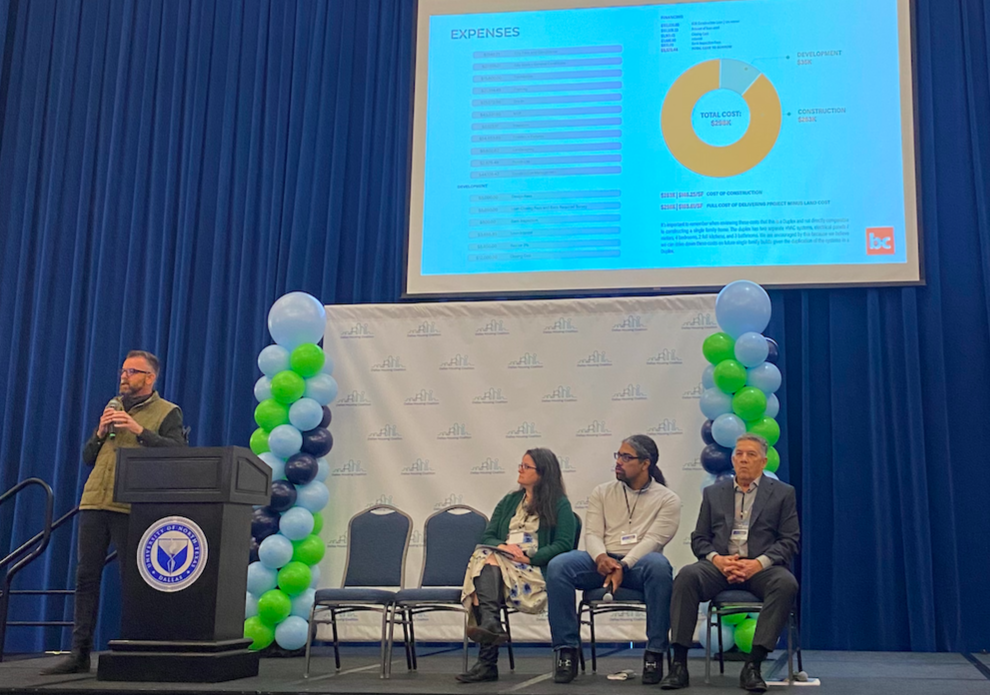
“We’ve got a lot of relationships in and around the city and a really important one with the UT Arlington School of Architecture, so we partnered with them a couple of years ago and just ran a really great little community design process,” he said.
bcWORKSHOP pulled it off, being able to list the home for $285,000. They declined investor offers and screened for income to make sure the buyer was in the bracket they wanted. A young woman who moved to Dallas from rural Mississippi ended up buying the house. She told Feehan she was going to live in the smaller unit and rent out the main.
“Market rent for the large unit is $1,600 a month. The underwriters at the bank recognized forward income for her in underwriting, which was a really big win and some good precedent for us all,” Feehan said. “So running the math on this … we think we just developed a home ownership option for less than $950 a month through this model.”
On the for-profit side of things, developers Paul Carden and Monte Anderson offered their perspectives and shared their respective approaches to housing delivery.
Carden’s Venture Commercial managed to execute on an all-townhome project totaling 38 units in East Oak Cliff’s Brentwood neighborhood after an initial proposal for a medium-density, 60-plus-unit development garnered community opposition. The design focused on matching the scale of the neighborhood’s historic homes.
He pointed out how the neighborhood has been undergoing significant gentrification, with teardown after teardown being replaced with significantly bigger builds.
“One thing we need to consider is just looking at the overall function of the neighborhood prior to gentrification and figuring out how to make sure that the function of being a middle-income or moderate-income neighborhood is still able to exist, even if the form may sometimes need to adjust a bit,” Carden said.
Venture Commercial managed to deliver for households earning 90-160% AMI.
For his part, Anderson showcased how he’s been simultaneously helping entrepreneurs with wealth creation while penciling in some housing units where they can fit. He pointed to a building in downtown Duncanville he outfitted to accommodate retail with a bit of housing on the side.
“We turned that little building into two retail spaces — one’s a barbershop and one’s a fruitstand — and then in the back are two real small units, little flats, and they face the residential neighborhood,” he said.
A longtime commercial broker turned developer, Anderson said his mission pairs profitability with doing good, centering on helping entrepreneurs gain ownership rather than simply providing cheaper housing. “Affordable housing is a symptom,” he said. “The real problem is not having enough money.”
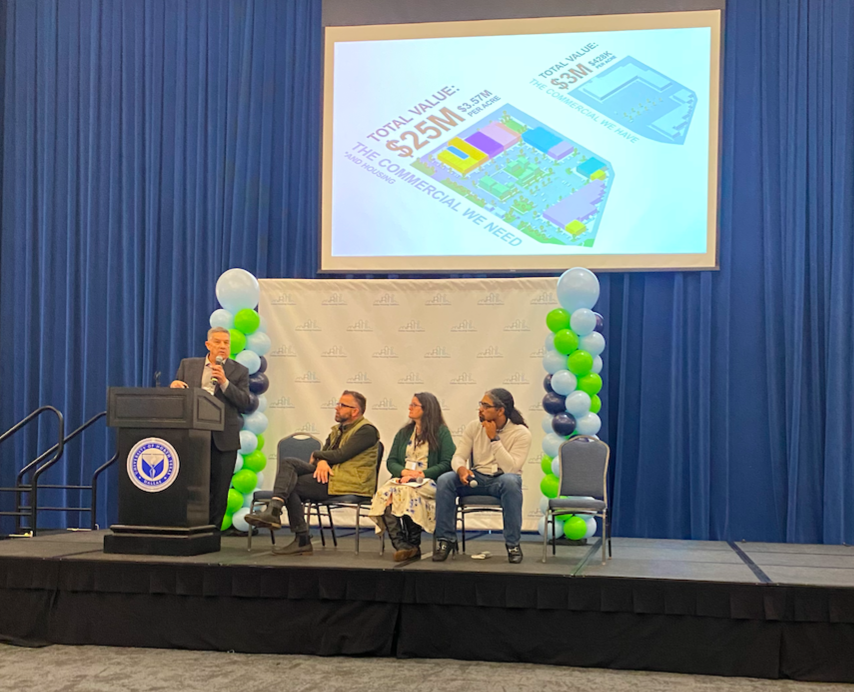
He also showcased what he calls a “roommate house,” a 3,000-square-foot single-family home he retrofitted into multiple, flexible living suites while staying within single-family zoning rules. Since you can have up to four non-relative roommates in Dallas, he brainstormed a design based on flex spaces and high-powered wet bars instead of kitchens.
Stephanie Behring, architect and design partner at Re Studio Architecture & Real Estate, posited that the issue of missing middle housing options is in many ways already settled.
“When I hear the question can multifamily and single-family housing coexist, it’s sort of predicated on the fact that it’s not already,” she said. “There are quite a few neighborhoods throughout the Metroplex where they coexist naturally and beautifully.”
She pointed to Kidd Springs in North Oak Cliff, where there are a lot of three- and four-unit buildings tucked among single-family homes, some nearly a century old. Many of them date back to the 1920s through the 1940s, a time when zoning rules allowed a greater variety of homes to be built on small lots.
Despite fears that apartments bring significant density, the average number of housing units per lot in the area is just 1.65, Behring said — a gentle level of density that has existed for generations.
“They can coexist. They’ve always coexisted. Let’s allow them to coexist again,” she said.


A rather one sided story by Candy’s Dirt. Density advocates talk about “gentle density” however in their minds that means building “plex” within existing single-family neighborhoods.
Homeowners in those single-family neighborhoods don’t want density and the issues it brings with it. Context sensitivity is a key element in the city’s land use plan known as Forward Dallas yet it is routinely ignored by advocates for density.
SB 840 will open the door to additional density across our city. That combined with the amount of land in the southern sector of Dallas and elsewhere in the city will enable more housing and at price points different income levels can afford. The message from the majority of single-family homeowners is clear.- hands off our single-family neighborhoods. They’re the bedrock of our city and they need to be protected.
Your article fails to define the term “gentle density”. It is not a term contained in the Dallas planning code or in the recently adopted ForwardDallas 2.0 master plan. Ask 10 people to define it, and you will probably get 10 different answers. We all know what housing density is – the number of dwelling units or people per acre. Generally accepted planning guidelines tell you that increasing the density of housing in a neighborhood or community should be done in a thoughtful, incremental, and context-sensitive manner. This means you don’t place 10 three story dwelling units on an R-16A (min. 16,000 sf) lot immediately next to a one or two story single family residence on a similar sized lot. You should incrementally increase density and include adequate transition buffers.
The City needs to move slowly on this issue, and adopt policies and procedures to guide planning staff, developers and residents before ruining the character of the city with ad hoc planning decisions. Dallas has no room to grow its boundaries, and as people have moved to the suburbs, it has slowly become a city of government agencies, financial services, lawyers, food services and sports teams. Now, even the sports teams are looking to follow the Cowboys to the suburbs.
How very “Dallas,” that all the speakers benefit financially from converting single family zoned dirt to multiplex.
The Dallas Housing Coalition bragged about supporting the Texas Legislature’s pre-emption of our local rule. Gee, thanks. With friends like you, Dallas needs no enemies.
Show me people demanding this who are not financial beneficiaries. Otherwise, it’s just more people trying to make a buck off of the established neighborhoods who prefer to be left as is. We don’t mind the nonconforming plexes. They were built in a different time, and they’re not going for $500k per unit like the horribly overscale new builds.
If we were serious about housing affordability, we would stop the demolition of existing single family structures for grossly oversized McMansions and McModerns…not to mention the “plexes.” We’d tighten setback regulations, and we’d limit overdevelopment of these lots.
The most affordable housing in Dallas already exists in single family neighborhoods all over town. Adding “plexes” to the mix raises the dirt value of everything around it, and creates a vicious cycle that makes ALL housing less affordable.
I have no idea what a “high powered wet bar” is. But it’s certainly not a kitchen, and that setup sounds a lot more like a party pad than compatible housing for a single family neighborhood.
My concern is that I live in an older neighborhood with narrow streets that cannot accommodate the size of current vehicles parked on both sides of the street and still allow emergency vehicles to get to an emergency. My single-family neighborhood already has multiple generations living in homes that were not built for so many people or vehicles. The infrastructure is dated and can’t handle the extra sewage, storm water runoff and other issues when you have 6 or 7 cars and trucks and parking for 2.
Mr. Jocks, I could not agree with you more. Those who are established where they are deserve to be protected by what they want. It is truly not fair to impose another person’s point of view on others.
You are entitled to live in your neighborhood on your and your neighbors they way you want. Protect each others rights is important.
Dallas Resident,
Very well pointed out.
Thank you for this