
Divided Federal Reserve Holds Off on Rate Cut, Leaving Antsy Homebuyers Waiting
Share News:


Prospective homebuyers might have to wait longer for mortgage rates to dip down after the Federal Reserve decided to maintain benchmark interest rates on Wednesday, despite some dissension on the central bank’s board of governors.
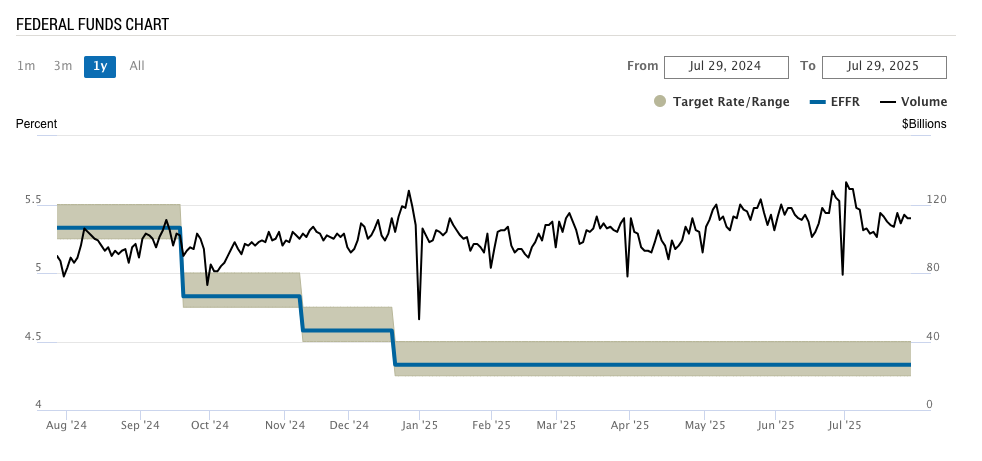
The move marks the fifth consecutive meeting the Federal Reserve opted against cutting rates. This month’s meeting, however, marked the first time in decades that more than one Fed governor on the seven-person body disagreed with the majority’s course of action.
Fed Vice Chair of Supervision Michelle Bowman and Gov. Christopher Waller voted against maintaining the benchmark at 4.25-4.5%. Both board members are being considered by President Donald Trump to replace the current chair, Jerome Powell, when the latter’s term ends in May 2026.
Trump has been waging a pressure campaign against Powell and the Fed’s board, calling on the central bank to make borrowing cheaper by loosening its monetary policy.
Now, mortgage rates don’t necessarily move in lockstep with the Fed’s benchmark, but they’re very much influenced by it. When the Fed raises or cuts interest rates, it shapes investor expectations about things like inflation and economic growth. Investor behavior in turn affects yields on long-term Treasury bonds, especially the 10-year note that serves as a benchmark for fixed-rate mortgages.
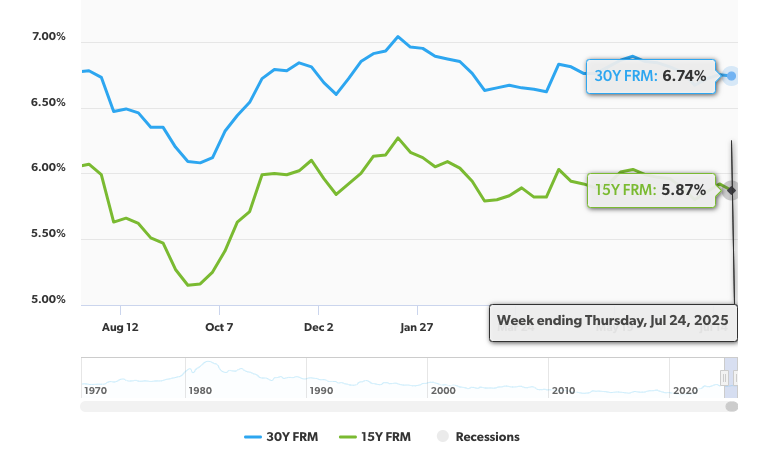
Freddie Mac had 30-year and 15-year mortgage rates pegged at 6.74% and 5.87%, respectively, the week of July 24 — roughly three times where they sat in 2021.
High mortgage rates, in conjunction with sky-high home valuations, have been keeping some first-time buyers out of the market. Earlier this month, National Association of Realtors chief economist Lawrence Yun said that if the 30-year came down to 6%, about 5.5 million households would have a better shot at affording a median-priced home.
In its official statement, the Federal Reserve said that despite economic activity moderating, inflation is still above the central bank’s 2% target, nearing 3% in June. Powell and the rest of the board (until Wednesday) have been wary of reducing rates because of Trump’s tariff policy and its potential to stimulate inflation.
“Higher tariffs have begun to show through more clearly to prices of some goods, but their overall effects on economic activity and inflation remain to be seen,” said Powell, according to CNBC.
The next meeting of the Federal Reserve will take place in September.
While forecasters weren’t really betting on a rate cut happening in July, Fannie Mae did revise its latest economic and housing outlook to project that rates would drop to 6.4% by the end of the year and hit 6% by the end of 2026. Such developments would almost certainly translate into increased transactions on the single-family home front.