
City Council Reacts to Recommended Version of ForwardDallas Land Use Plan
Share News:


Members of the Dallas City Council’s Economic Development Committee were briefed Monday on the latest version of the ForwardDallas comprehensive land use plan and said they didn’t have a lot of comments because they’d just received the draft the night before.
Then they went on to make a lot of comments.
Committee Chair Tennell Adkins said a special-called meeting would be held to deep dive into the controversial ForwardDallas, which guides future land use throughout the city.
The revised document — the version approved by the City Plan Commission on July 25 in a 10-4-1 vote — was released around 8 p.m. Sunday. Three of the four plan commissioners who voted against it said they wanted to see the final draft with revisions and felt the public should also have an opportunity to view it before a recommended version was passed on to the City Council.
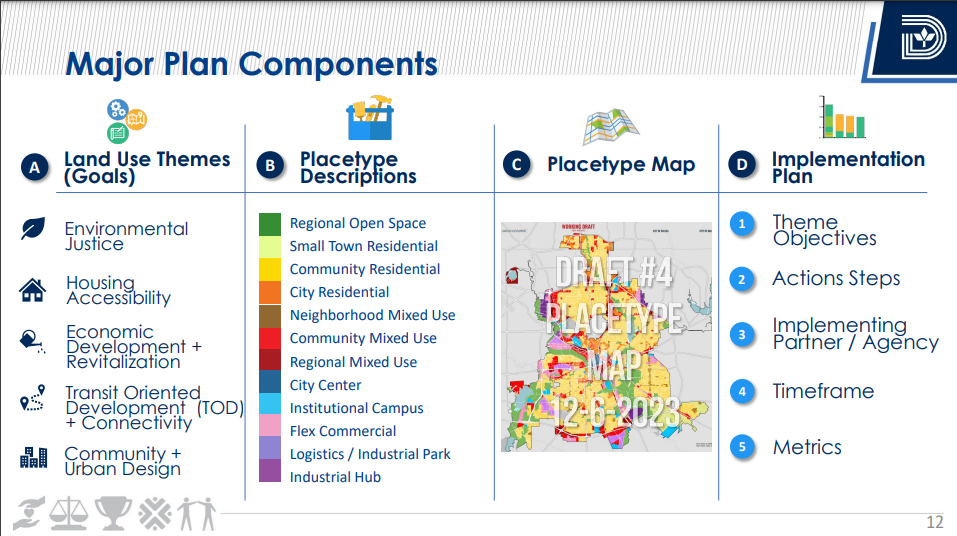
The comprehensive plan is a guiding document outlining future land uses for geographical regions of the city. Critics of the plan have expressed concern about greater density near single-family neighborhoods. Proponents of the plan, including a majority of the City Plan Commission, have said a rigorous zoning process with public input is required before new development occurs. Historic districts, conservation districts, and planned developments are “protected” from changes recommended in the land use plan, city officials have said.
“There’s a lot of misinformation out there,” Deputy Mayor Pro Tem Adam Bazaldua said Monday. “I think this is an important discussion to have. When we’ve heard of examples, even here today on the dais, of a duplex showing up in the middle of the neighborhood, that had to be approved by our body, by the representatives of the people that we hear from. It also would have to be approved by staff and/or the [City Plan Commission] to even make it to that point. What’s being proposed does nothing to the zoning process that’s already put in place that’s actually bound by state statute.”
Watch the Aug. 5 Economic Development Committee meeting or view the briefing packet.
Why ForwardDallas?
Assistant Planning Director Andrea Gilles reviewed the reasons why an update is needed to the original 2006 plan.
“A lot has happened in 18 years,” she said. “A lot has happened socially. A lot has happened in the market. A lot has happened in changes to housing and how we get housing. A lot has happened to the commercial and office markets. We really need to look at how we manage that growth. The area and the population have changed. It’s predicted to continue to change. So the question is, how does Dallas want to manage that change?”
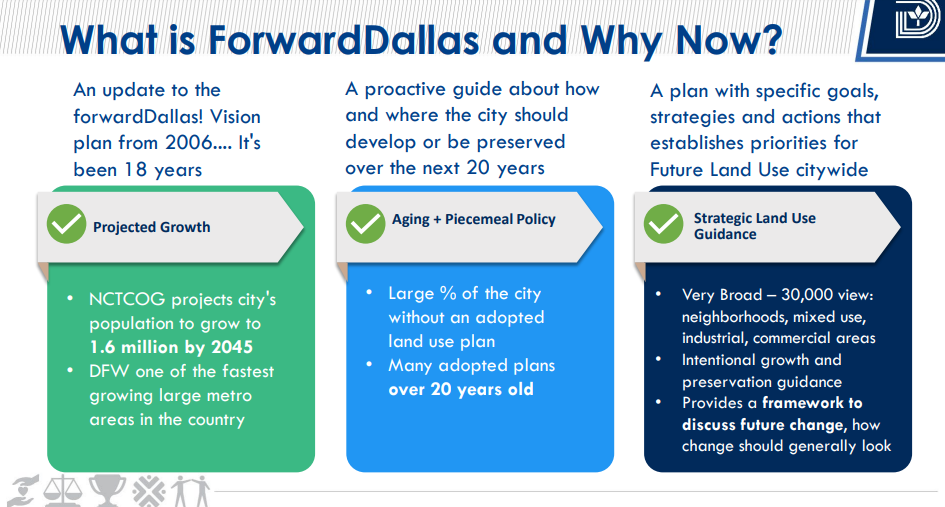
Gilles added that the goal is to establish a baseline for future land use in the city.
“We have had a piecemeal approach up until this point,” she said.
Single-Family Neighborhoods
Gilles outlined the discussion at the CPC level about ensuring that neighborhoods are preserved and protected.
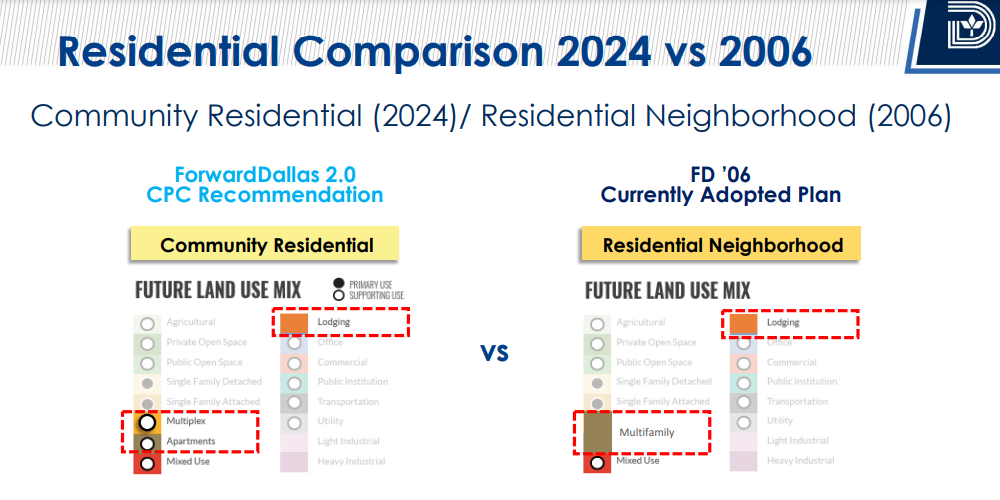
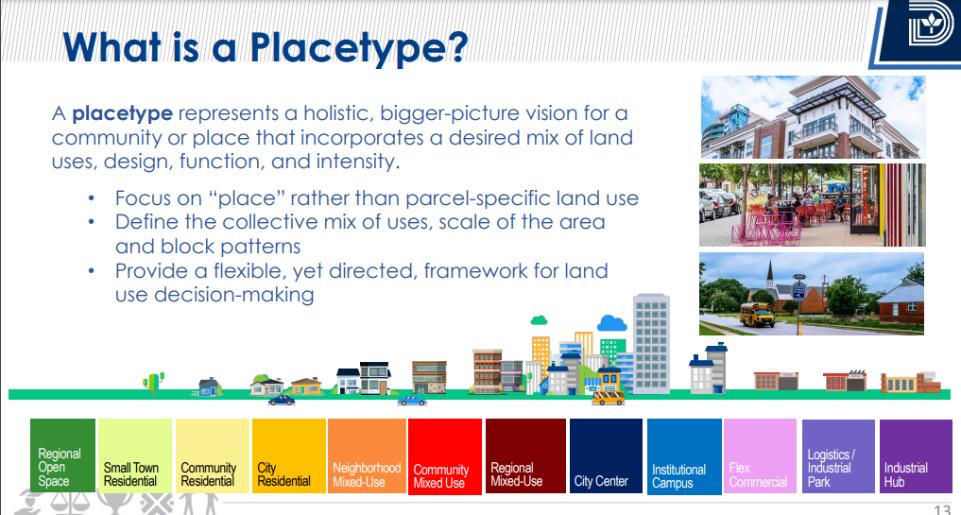
“It was made very clear that there was no intent to dismantle that or make a change to that,” she said. “CPC recommended some more targeted language about where specific different housing types should be located. With the concern that we could just do a multiplex anywhere, [they added] locational language and guidance that says, ‘Preferred locations for different housing types such as near transit stations, along commercial corridors, and transit areas between non-residential and existing residential areas, former civic institutional properties, and possibly on corner lots.’ If an application comes in for a different housing type, you review according to this language.”
Gilles explained that concerns were raised about displacement.
“Does this mean people can come in and demo everything and rebuild?” she said. “Well, first of all, it’s not zoning, so if you don’t have the zoning, you can’t do that. If you were to get the rezoning, there is more language added about displacement, about wanting to retain existing housing stock wherever possible to minimize the displacement of existing residents.”
ForwardDallas also specifically addresses design standards and necessary development code updates, Gilles said.
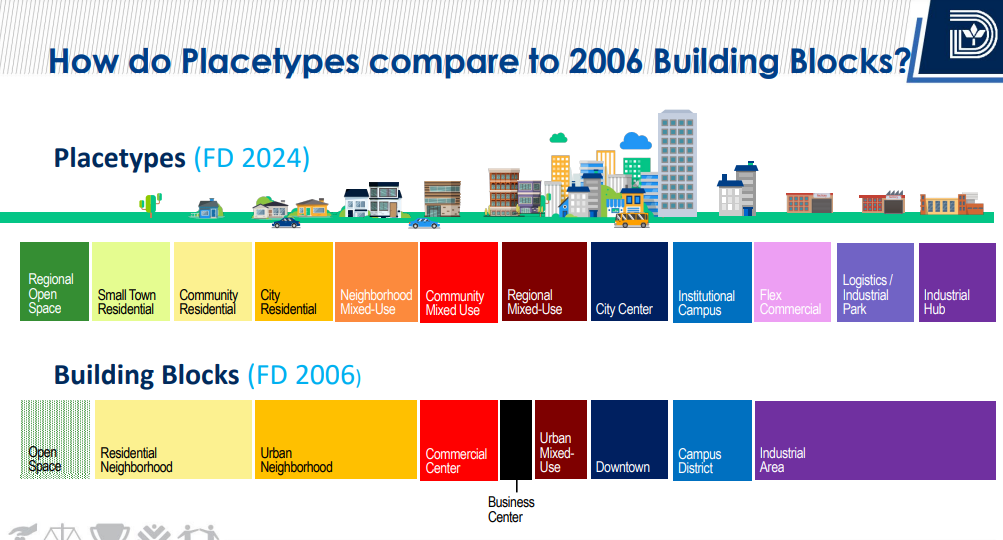
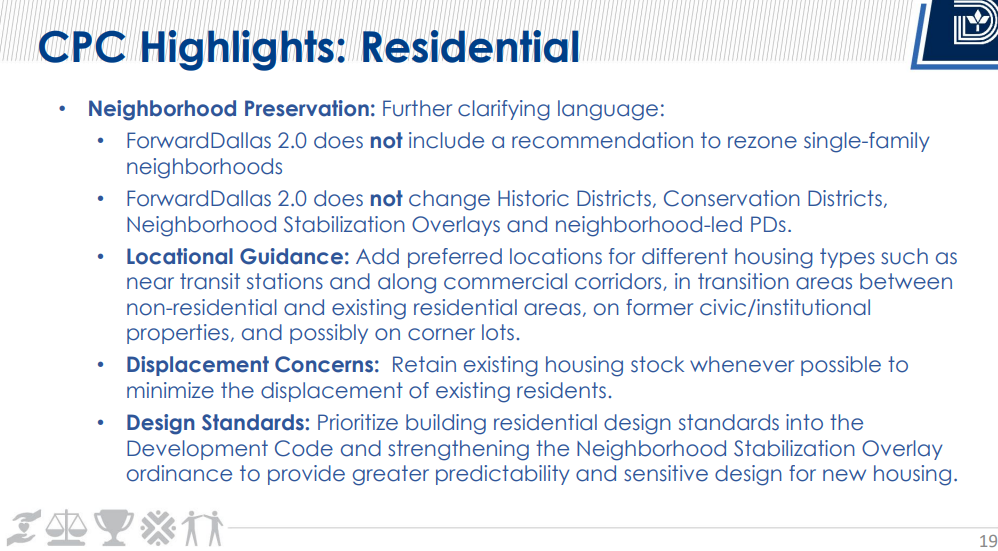
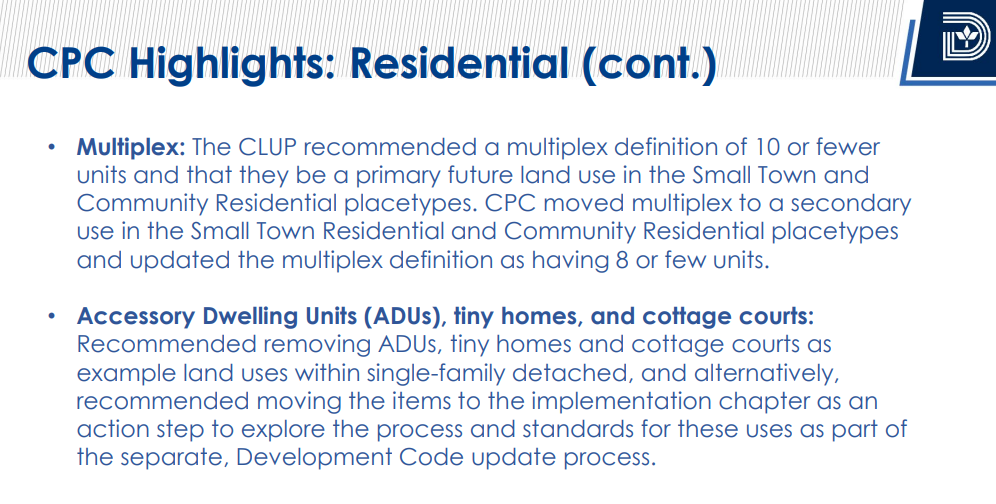
Tiny homes, cottage courts, and accessory dwelling units were removed from the land use table and placed into the implementation section of the plan, signifying that those uses will be explored as part of the city’s development code review.
East Dallas Councilwoman Paula Blackmon wanted to know if a return on investment has been considered.
“We’ve got a … I’m just going to round it up and say a $40 million deficit in our budget,” Blackmon said. “We’ve got available land. Has there been a dollar amount put on any of this to show … where we can be smart in using our land use? What is the bottom line?”
Gilles said that hasn’t been calculated but could be included in the next steps.
Blackmon said the city can’t keep taxing its residents.
“We’re going to have to grow responsibly,” she said. “We’re going to have to do it with planning and we’re going to have to do it together with our neighborhoods.”
More Council Response
West Dallas Councilman Omar Narvaez said density is needed for workforce housing. He suggested putting protections in place for “mom and pop” commercial businesses and neighborhoods near existing industrial uses.
North Oak Cliff Councilman Chad West said a one-size-fits-all approach won’t work throughout Dallas. West clarified that ForwardDallas is consistent with the West Oak Cliff Area Plan and while WOCAP is more detailed and in some cases, parcel-specific, it does not conflict with the comprehensive land use plan as recommended.
Lake Highlands Councilwoman Kathy Stewart said her constituents are primarily concerned about protecting single-family neighborhoods. That sentiment was echoed by Councilwoman Carolyn King Arnold, who reminded her colleagues that single-family homeowners are voters.
“I know how I got here,” she said. “I know who I came to the dance with.”
Councilman Paul Ridley said East Dallas, Uptown, and Oaklawn residents have not been pleased with the process.
“[They are concerned about] damaging single-family neighborhoods by the intrusion of multifamily development which will serve to destabilize those neighborhoods, result in potential resident flight, and a total transformation of treasured neighborhoods that are very stable currently and provide a high quality of life for the residents,” Ridley said. “I will be opposed to any plan that endangers that.”
Atkins said staff will meet with council members individually to address their questions and concerns about the recommended plan.
“We’re not going to get this done today or tomorrow,” he said. “We’re going to have another special called meeting. We’ve got to move forward. If we don’t get ForwardDallas in place it’s going to affect everything that we do. This is like playing baseball. We’ve got to get to first base.”






Can we trust new plans for land use to the same department the approved building permits that were in conflict with current building codes?
There is a factual error in this posting. It states, “The revised document — the version approved by the City Plan Commission on July 25 in a 10-4-1 vote — was released around 8 p.m. Sunday.” This is not accurate. The CPC voted on a version of this document that is almost 100 pages longer than the version that was released around 8pm Sunday. The version released Sunday is missing maps and appendices containing an essential glossary of terms. Councilmembers were misinformed by staff that what staff was giving them was a complete copy of the document.
That should be a problem for Andrea Gilles. She plays now you see it, now you don’t with both sides. This director is not transparent since the day she was hired. Andrea has a social agenda that does not work for Dallas. Hope our new city manager figures it out soon!
Andrea’s not the director. The new city manager hired a Director to replace Julia Ryan.