
What Are Other Cities Doing About Housing and Homelessness? First Stop, Denver
Share News:

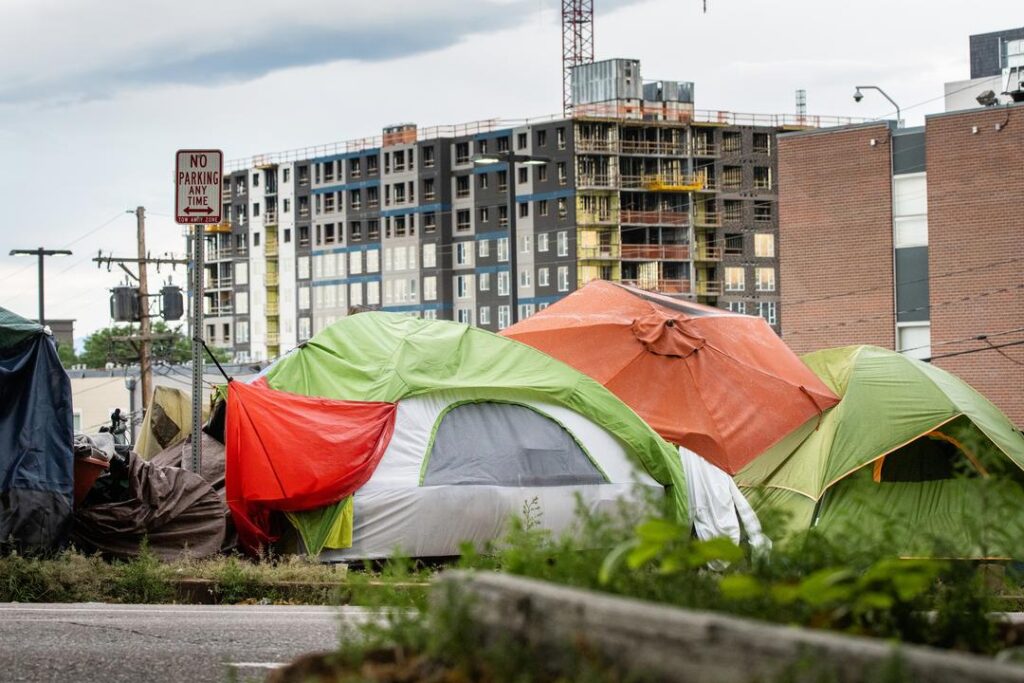
Dallas has explored numerous options to get the unhoused off the streets and away from once-thriving businesses, residential neighborhoods, and public parks and libraries. Permanent supportive housing appears to be the solution most agree has been successful, yet the challenges persist. What the city has not done, however, is hand out cash to the homeless.
That’s what Denver did — and a pilot program launched in late 2022 has reportedly shown results and cost savings to taxpayers of about half a million dollars.
Denver’s population is about 713,252, according to the 2022 U.S. Census. With a cooler climate, higher elevation, and mountain ranges, a comparison of the Mile High City to Dallas isn’t quite apples to apples. However, we set out to explore solutions that other cities are employing — and whether those could be employed in the Lone Star State.
Denver Offers a Handout That Can Become a Hand-up
Denver’s basic-income pilot program focused on more than 800 Coloradans experiencing homelessness, including people living in cars, temporary shelters, the outdoors, or other “nonfixed” living situations. Participants were given direct cash payments, no strings attached, and could spend the money on whatever they chose.
“Denver experimented with giving people $1,000 a month. It reduced homelessness and increased full-time employment, a study found,” declared an October 2023 headline in Business Insider.
A deeper dive, published in the Business Insider earlier this month, explains how the program works.
“The city’s program initially lasted one year and was extended in January for six months. Participants were randomly sorted into three groups: One received $1,000 a month for a year, another got $6,500 upfront followed by $500 a month, and a third got $50 a month as a control group,” the article states. “Overall, the program found similar outcomes among the participants — indicating the two trial groups didn’t outperform the control group.”
From the article:
During the program, participants were asked about their housing, food security, finances, and mental health. On June 18, the program released its one-year report, based on the self-reported surveys. It said that 10 months into the program, roughly 45% of participants in each group said they were living in their own house or apartment, up from 6% in both trial groups and 12% in the control group who said the same at the program’s start.
The report suggested participants spent less time in places like emergency rooms, hospitals, temporary shelters, and jails during the program than they did before. It estimated that this reduction in public service use saved the city $589,214.
These savings are a fraction of the $9.4 million it took to fund the program — with money coming from the city, the philanthropic organization The Colorado Trust, and an anonymous foundation.
BUSINESS INSIDER
While participants said the basic income primarily helped them pay for immediate expenses like transportation, hygiene, clothes, and groceries as well as recurring bills like rent, health insurance, or debt payments, one recipient told Business Insider he had to return to living in his car after the payments stopped.
Short-Term Solution
Basic-income pilot programs such as the one in Denver have become a “trending approach to poverty reduction,” Business Insider reports.
However, it’s a short-term fix, experts would argue. It allows the participants to rent an apartment and get career training, but there’s a huge risk when allowing the freedom of choice in how the money is spent.
“Though researchers described housing gains, it’s not clear how the basic income will affect participants in the long term,” Business Insider reports.
While participants in all three groups experienced higher stress levels at the 10-month mark, “fewer people across all participant groups said they were sleeping on the street, experiencing food insecurity, and feeling unsafe,” the report states.
“Even so, several of the results — including in housing — were similar for both the participants in the two groups receiving higher payments and the participants in the control group, suggesting that giving more money to participants didn’t significantly improve their outcomes,” according to the article.
CandysDirt.com reached out to Christine Crossley, director of the Dallas Office of Homeless Solutions, for comment on the Denver pilot program and did not receive an immediate reply.
District 1 Councilman Chad West told CandysDirt.com he is traveling to Los Angeles this week to tour various developments related to permanent supportive and temporary housing. Council members, including Housing and Homelessness Solutions Committee chairman Jesse Moreno, have studied homeless initiatives in Atlanta, Los Angeles, and Seattle.
Government Transparency
One thing the City of Denver does well when it comes to housing and homelessness is transparency, and it’s something at least one city council member said they’d like to emulate.
Denver Mayor Mike Johnston declared a homeless state of emergency on his first full day in office a little over a year ago, Denverite reported this month.
“He spent his first six months bringing more than 1,000 people indoors who had been living in downtown homeless encampments,” the article states. “Johnston’s aiming to bring in a total of 2,000 by the end of 2024. He also scrambled to address the arrival of thousands of new immigrants through rented hotels (that he eventually closed), subsidized apartments, and, later, workforce authorization clinics. The project was a mighty collaboration with residents and nonprofits, many of whom expressed burnout throughout the year.”
The mayor “drew boos and cheers” from community groups at public meetings and on social media.

“He made himself available at dozens of press conferences and published progress on many of his aspirations through dashboards, increasing transparency throughout the year,” the Denverite reported.
When it comes to housing, we are quite frankly awestruck by Denver City Council president Amanda Sandoval’s monthly report on land use updates that highlights important city projects, rezonings, and land use news specific to each neighborhood in her district.
Dallas Councilman West said he plans to launch a similar dashboard for his North Oak Cliff neighborhoods in January.