
David Voss: Dallas Is Making a Historic City Hall Decision With ‘Faulty Information’
Share News:

By David Voss
Former Assistant Director of Building Services for the City of Dallas
The Dallas City Council is making one of the most important decisions in Dallas history based on faulty information. The Council voted 9-6 to move forward with a plan to abandon the City Hall building* based on a report titled “Proposed City Hall Repair Program.” This report was presented to the Council in two parts, Phase I on May 20, 2026, and Phase II on June 3, 2026. This was not information worthy of staking a decision on, much less the future of Dallas City Hall.
The report was a very expensive answer to the wrong question.
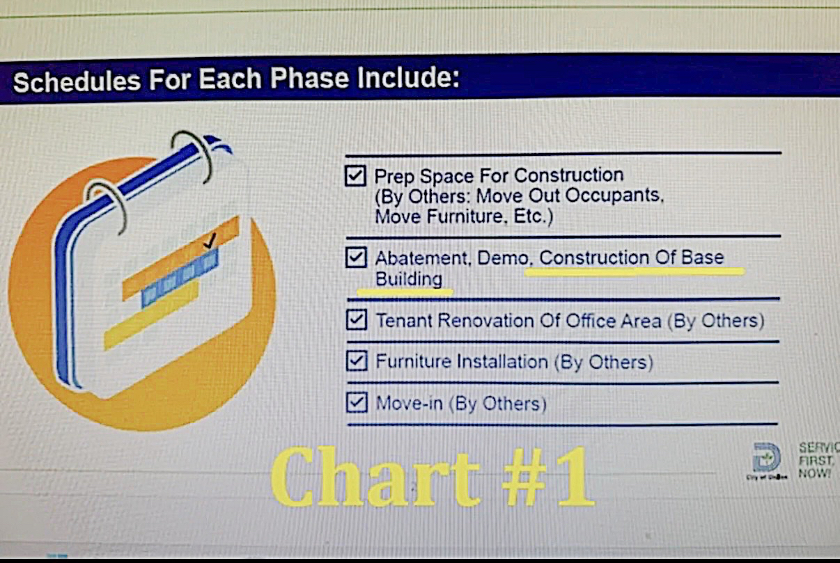
It turns out that the Proposed City Hall Repair Program is not a repair program at all. The Phase II report proposes a scope of work that basically demos the interior of the building to near shell condition, and then constructs a new building inside the existing concrete structure of City Hall.
This proposal is not a repair project. It is a construction project. They made a mistake and called it what it really is, “Construction Of Base Building,” in the Phase II report.
Let me repeat: THIS PROPOSAL IS NOT A REPAIR PROJECT! This is a scheme that replaces the electrical system, replaces the HVAC system and controls, demolishes and replaces the restrooms, replaces lighting, demolishes the interior, and adds fire protection.
What the city actually needs to do is repair what needs to be repaired and then maintain it — not gut it.
Right now, no one knows what the repairs to City Hall will cost. But the numbers that have been and are being proposed by the City are on the far extreme of high-end estimates, outside of the necessary scope, and well beyond realistic.
I’ve spent 50 years examining, negotiating, contesting, and accepting proposals and estimates related to maintaining, repairing, and constructing buildings, some of them older and larger than Dallas City Hall. At the planning phase, consultants and contractors always (1) inflate the base costs to make up for the lack of detailed knowledge of the project, (2) add extreme amounts for contingencies to cover their asses, and (3) increase soft costs to line their pockets if they get the project.
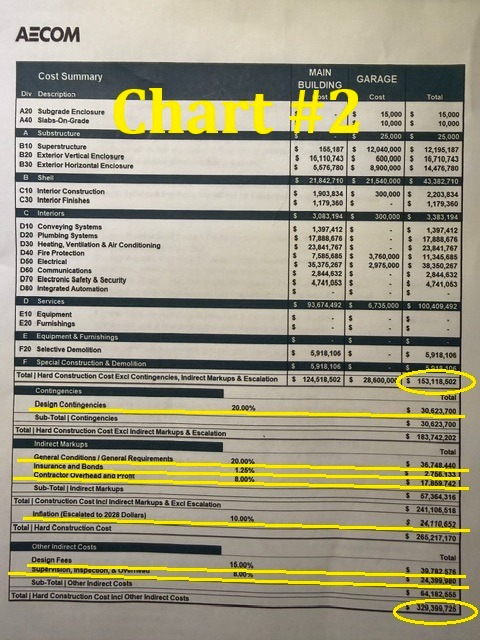
The AECOM report, which was completed last fall, admittedly, is the “not re-estimated” baseline (meaning those numbers were taken at face value) for this new Proposed City Hall Repair Program. If you remember, the AECOM report had a “Total Hard Construction Cost Incl. Other Indirect Costs” of $329 million. They arrived at the $329 million by taking the “Hard Construction Costs” of $153 million, then adding 20% for “Design Contingencies,” then adding 29.25% for “General Conditions, Insurance, Bonds, and Contractor Overhead and Profit,” then adding 10% for inflation, then adding 23% for “Design Fees, Supervision, Inspection, and Overhead.”
All of these “Indirect Costs”/soft cost percentages were compounded, creating a whopping total of 109% of soft costs (very soft, I might add) added to the project to create the $329 million price tag. (See Chart #2 from the AECOM report).
So, based on this scheme, let’s say you replaced the roof early on in the project (which should absolutely be done) and the City contracted directly with a competent roofing contractor. Then they directly hired a roofing consultant to provide the specifications and supervise the installation for 2%. The cost savings would be over 50% of the number in the AECOM report. The actual cost would be half. An $8 million roof replacement shouldn’t cost $16 million plus. These kinds of numbers became the “baseline” for the Proposed City Hall Repair Program.
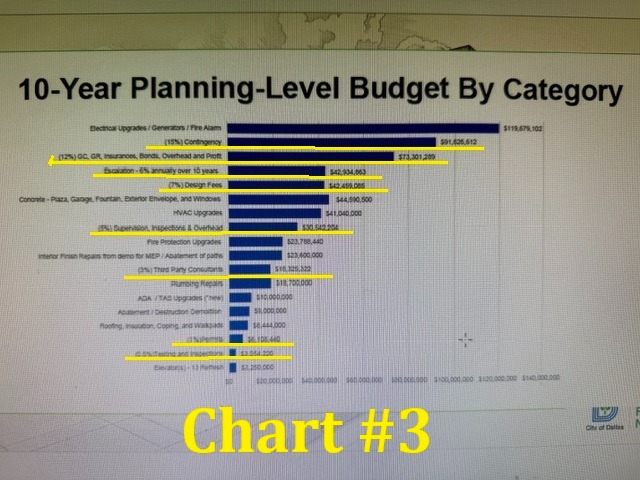
The new Proposed City Hall Repair Program identified four “hard cost” numbers of between $531 million and $610 million, depending on the consultant and the phasing of the project. The Phase II report increases the base cost by adding 15% for contingencies; 12% for GC, GR, Insurances, Bonds, Overhead and Profit; 6% for Escalation; 7% for Design Fees; 5% for Supervision, Inspections & Overhead; 3% for Third Party Consultants; 1% for Permits; and 0.5% for Testing and Inspections. These percentages add up to 49.5%. (See Chart #3 from the Phase II/WM2 Company report).
There was not enough detail in the numbers to determine if these percentages were compounded (as they were in the AECOM report), but if they were, it would mean a 60.37% increase over the base cost. This is an enormous, unnecessary cost representation of the costs to repair City Hall.
Many of the elements of the needed repairs at City Hall could, should, and would (by any realistic, real-world building owner) be contracted directly with specialty contractors. For instance, you would hire an electrical contractor, an elevator contractor, and a mechanical contractor to do that work. You would also hire a specifically disciplined engineering firm, an electrical engineer, a vertical transportation engineering firm, and a mechanical engineer to design, assist with the bidding process, and supervise that work. You would not hire a general contractor and a boatload of consultants to effectively and efficiently accomplish the repairs.
However, some of the repair elements are more complex and would require a multi-disciplinary approach with several subcontractors and trades. This would include restroom upgrades and fire protection systems, but careful orchestration and management of the elements would reduce the soft costs greatly.
The City Council has made decisions based on its assumption that it’s too expensive to repair Dallas City Hall. The City Council has not investigated what it would actually cost to repair Dallas City Hall. At some point early in this discussion, someone decided the answer that they wanted and then framed the question and the facts presented to support that answer.
There is no reason to continue trying to fast-track this decision — the Mavs have made their choice. We need to collectively slow down, catch our breath, and gather some more detailed (much more detailed) and accurate (much more accurate) information. We need to calmly hear from and listen to both sides (in a more meaningful format than limited one-minute, one-way speeches) about what needs to be done with the City Hall building. We also need to have broader discussions about what needs to be done with the City of Dallas. In the meantime, let’s authorize repairing some stuff that there is money available for, and let’s mandate maintaining some stuff — that’s what needs to be fast-tracked.
David Voss spent nearly five decades managing and maintaining major public and commercial properties. He began his career with the City of Dallas, rising from a maintenance employee to assistant director of Building Services, before holding executive operations roles with Trammell Crow Company, Crow Holdings, and the Dallas Market Center. He later founded David Voss Consulting, advising clients on facility and construction management until retiring in 2022.
*EDITOR’S NOTE: The city council voted to shelve a phased repair of City Hall and continue exploring relocation and redevelopment options.
17 Comments
Leave a Comment





Thank you David
Very informative .
City leaders can’t build a better city if they tear down the big accomplishments of the previous generation.
Just because the council and mayor cannot appreciate historical architecture and want something new and shiny and possibly more personally lucrative is not a good reason to tear it down and does not benefit Dallas citizens.
What will the cost be if you move city hall to a new Permanent home ? WHERE WILL THE NEW HOME BE? what will go in the present place? what will the city sell the present land for ? If the citizens knew all this it would be helpful.
Thank You
It has been a very hard decision and I thank the council for all it’s work on this very important project.
You can do a search on our site and find most of the questions you have answered in depth but to jump to the bottom line: originally, the thought was City Hall would be sold so the Mavs could put a new arena there and so their new majority owner could build a casino. That was the scuttlebut anyway. Because the former Valley View mall site is shovel ready, it was always a smarter move for the Mavs. The larger part of that 1 billion dollar cost story on repairing City Hall was the move to a place that would be rented. Bear in mind no one was having a conversation about leaving City Hall just two years ago.There is indeed an elephant in the room and no one in city leadership has had the courage to tell the truth yet. Also bear in mind citizens paid for our City Hall. We own it. Do you sell your home when it needs maintenance and repair and go rent? Is that fiscally responsible?
It’s not very hard to see where this group is headed and bankruptcy is a sure thing. Your insight is a positive and powerful one as always. Thank you for caring.
David, can you please share all this info with the lawyers who are working on this issue with “inform Dallas” and let’s block Tolbert from continuing any further back room deals and sue Tolbert in court!
I had the pleasure of meeting David Voss at a June 9 Listening Session hosted by CM Jesse Moreno. As he did in this article, Mr. Voss made a well thought out argument about the REAL cost of maintaining Dallas City Hall and the grossly inflated estimates the 9 council members consistently used to justify voting to leave Dallas City Hall. I thought for sure CM Moreno would reconsider and change his vote based on the information Mr. Voss provided at the Listening Session. Mr. Voss provided supporting documentation. Unfortunately CM Moreno voted against saving Dallas City Hall.
Our City Council needs to wake up the fact that everything is not above board and realize that we citizens own Dallas City Hall and we intend to keep it.
Our Mayor has been bought twice and has sold-out the city for behind the curtain money or quid pro quo!
There is plenty of room behind the Pei hall to construct a new 500,000 SF city office building. Move office functions to new building, connect staff to existing with Bridges. Keep public functions, plaza, parking garage, police dispatch operational. Partition off the rest and renovate over time with surplus funds. Keep the cultural icon, keep budget under control, free city government out of the clutches of the big time development club. Happy day!
Hi Steve, This was brought up so many times by the UTA architecture students, the group of 10 architects. No one in city leadership wants a solution. They want to invent issues we never even heard of just two years ago. It was never about the building. It was always a land deal in my opinion.
This phased repair approach sounds nice in theory, but does not deal with the fact that the interior spaces were designed for a 1970s workplace or that the entire site is isolated from the urban fabric and to integrate it and make it pedestrian-friendly, would require hundreds of millions in redevelopment. The best City Hall proposals completely reworked the site, but would cost more than even the AECOM estimate. Finally, this phased repair approach does not account for things like asbestos remediation, which is makes any project unsuitable for piecemeal contactor-by-contractor work.
Have you been to City Hall? The interior spaces work beautifully today. Pei was forward thinking. He designed the interior to be highly flexible. As for pedestrian freindly: over the years there have been concerts, lunch tables set up on the plaza, celebrations and marches.Marathons have begun here.THere was even a beach party years ago. Its pedestrian friendly and takes a few minutes to walk to the library or city center. The large plaza not only serves as a gathering space, it serves as a level of protection. I’m not sure what proposals you are talking about but when you have ten of the most brilliant architects in the city AND cutting edge UNT architecture students, all with nothing to gain financially telling us to save the building, and how… well I find it’s important to listen to folks without a dog in the race. AND remember this was not even a converstaion just two years ago so it’s not about the building. The asbestos issue was addressed over and over and yes it can be remediated piecemeal. You should consider attending all the council meetings we do.
I have a few comments…
– All of my information is shared with the lawyers working on this project and others working to Save Dallas city Hall.
– I also thought that Jesse Moreno was reconsidering his position after the District 2 Town Hall / “Listening Session” but I was disappointed.
– The interior spaces of DCH were designed to, and remain, extremely flexible and can support advanced technology but have been misused with bad planning and poor space utilization for the last 30 years.
– Asbestos remediation is routinely accomplished in a phased manner while a building remains occupied.
– And thank you Karen Eubank for your insightful and accurate replies to comments while I was travelling and unable to reply.
David Voss
Bravo, David Voss, and Karen Eubank, for your excellent work and insights. I’ve said it before and will do so again: the city manager is compromised, less than forthcoming and needs to go.
You’ve clearly never worked in government, whether federal, state, or local. There is no one inside these agencies with the time to procure and manage dozens of subcontractors for one project. Government salaries don’t pay people that can operate at that level enough money, and most project managers have to manage 5-10 projects at a time. For every major capital project, there is always a main design firm that often sub-contracts with specialty firms or to supplement their workforce, and a main construction company that may subcontract with other firms to supplement their capability. For mega projects, a project may be contracted with one firm as design-bid-build, with the one firm managing sub-contractors.
The roof quote may be high, but this is an initial estimate to give a ballpark cost. What will happen during procurement is they will argue the roof cost, for example, and reallocate the funds to something that looks too low (like the $1 million for interiors or the 10% inflation) or reduce the price tag by a little. Considering that most major projects in Dallas end up having major cost overruns, starting with a high cost estimate rather than a nickel-and-dimed estimate is better. And the 20% design contingency makes sense if you’ve ever met City Council, and 20% for design is fairly standard.
Also, I would encourage anyone that says City Hall is in great condition to go work there for a month, especially in one of the basement offices. You probably also thought the Surfside Condos were in great condition.
From what I’ve seen, the cost estimate doesn’t seem to address the City Hall parking garage, which has had a persistent leak from the plaza’s fountain for years (decades?) that has visibly and significantly corroded the interior columns.
Hi Kathryn. I believe the idea that the leak is from the fountain may not be well founded. The estimates indeed do not address all that should be addressed nor did they address what the council actually asked for which was not to gut and replace every single thing inside.