
Property Tax Protest Deadline Just Two Weeks Away
Share News:

Single-family home listings may be shifting in North Texas, but that won’t change your property tax bill for this year — and you’ve only got two weeks left to meet the May 15 deadline to protest your home’s value.
By now, everyone should have received their 2026 property value notice from their county appraisal district, which is responsible for estimating the market value of all taxable property in the jurisdiction. And if you don’t file your intent to protest by May 15, you’re going to be locked into that valuation.
The protest process allows homeowners to argue that their home’s appraised value exceeds the actual market value or is unequal compared to similar properties. It’s also an opportunity to catch any flat-out mistakes your appraisal district may have made, like leaving off an exemption you’re entitled to. Click here to read about other errors that could be in there.
More often than not, though, the most common “mistake” is the overvaluing of your property. Appraisers have to rely on statistical models and recent home sale data to estimate market values. Most counties in Texas have adopted computer-assisted mass appraisal software to help with this and do it more efficiently. The problem baked into this approach is the use of “comparable sales” data, using recent sales of similar homes in the same area to estimate what a property could reasonably sell for.
Been to any open houses in or around your neighborhood recently? Was it a property with similar acreage, square footage, age, and features? It might be that the listing goes for around what the appraisal district claimed your home is worth. Then again, maybe not. Market fluctuations, renovations, and just-in-time-for-sale upgrades are getting factored into the closing, and that comparable sale might not be so comparable after all, skewing valuations.
Homeowners can use more accurate or better-matched comparable sales in a tax protest to show their property is overvalued, especially if similar nearby homes sold for less, potentially lowering their tax bill. Demonstrating what YOUR home is actually worth will also be important, which can involve photographic evidence and repair estimates for a cracked foundation or those other expensive items you’ve been putting off. We’ll get into the ways you could go about this later this month, but needless to say, mass appraisal techniques might get homes in the ballpark, but it’s not the equivalent of a boots-on-the-ground home inspection.
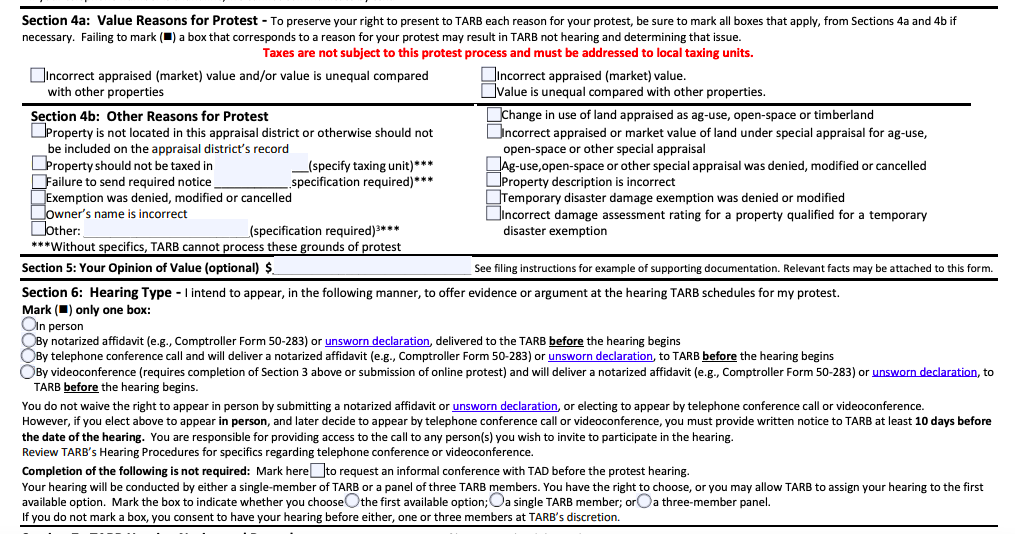
You should have received a protest notification form along with your property value assessment. This is what you’ve got to action to make sure your appraisal district gives you a fair shake. Protest notifications can be filed online, by mail, or in person with your local appraisal district, but it needs to be done by May 15.
To make that deadline, you’ll need to select a reason for your protest among the options provided. You’ll also need to select what kind of hearing type you want to appear at to offer evidence or argument in support of your protest. Read over everything closely, and you might want to consider consulting a tax protest professional (there’s a whole little industry dedicated to this in Texas) if you have any questions or concerns.
You’ve still got two weeks, so don’t panic! But don’t sleep on it either, you could save yourself some money. And every dollar counts these days. Here’s some parting guidance from an economist with the Texas Real Estate Research Center at Texas A&M University:
“If you miss the deadline, you lose your right to protest the annual assessment. So, even if you don’t know what your case will be but think you may have one, timely file the protest and submit or update your opinion of value and evidence soon. Then, as soon as practically possible, determine your position. If you decide the appeal is not worthwhile, withdraw your protest as soon as possible.”
Here is more information on the process with respect to county appraisal district:
Dallas County
Tarrant County – form
Collin County – form
Denton County