
Hosts of Y’all-itics Give Debrief on State Legislative Session
Share News:

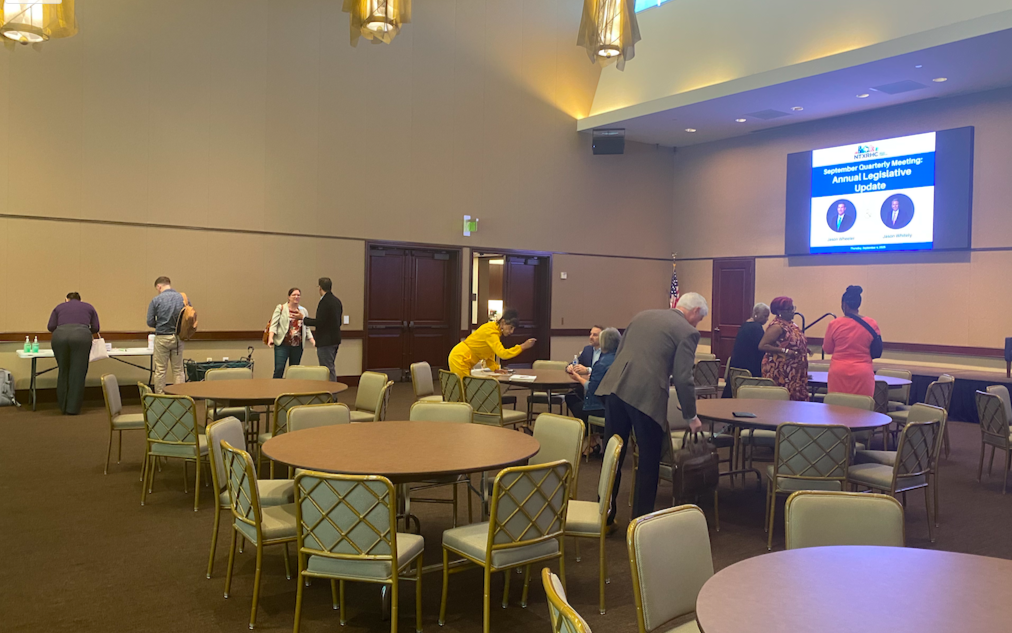
WFAA reporters Jason Wheeler and Jason Whitley of Y’all-itics and Inside Texas Politics fame addressed housing activists and stakeholders on Thursday at the Mabel Peters Caruth Center, debriefing the crowd on the big-ticket items that came out of the Texas Legislature this past session.
The event was put on by the North Texas Regional Housing Consortium, which aims to make housing accessible to everyone through its research, policy, and advocacy efforts.
Wheeler and Whitley said the most recent legislative session was notable for the relative absence of serious, drawn-out conflict between Gov. Greg Abbott, Lt. Gov. Dan Patrick, and Speaker Dustin Burrows. The three Republican leaders managed to enact some of their top political priorities, including school vouchers and mid-decade congressional redistricting.
On the housing front (which is what we’re actually concerned with), there’s plenty to parse through. Lawmakers have been cognizant of the state’s housing affordability crisis, and they delivered a number of bills intended to mitigate the situation.
Affordability Factors Get Short Thrift
Property tax relief was one of the big wins this session, but swelling valuations have been curbing any actual gains.

“It’s unsustainable in this state. We have the 7th highest property taxes in the U.S.,” said Whitley, noting that homestead exemptions have steadily increased but that it’s still not enough when factoring in other elements in the homeownership equation.
“The other thing in that escrow is insurance, and man, people are struggling with that. I hear about that all the time,” Wheeler added.
The pair said they were surprised officials didn’t try to tackle homeowner insurance costs in more substantive ways, pointing to missed opportunities like investing in fortified roof replacement to save both homeowners and insurance companies.

“There was a bill … to create a grant program that would give you money to go harden the roof of your house, and then you get an insurance rate reduction because of that,” said Wheeler. “States — and we’re not talking about California and New York, blue states — I’m talking about Alabama, Oklahoma, they’ve done this, and they’re giving people $10,000 a pop to go fix that roof and make it more hardened. And because of that, the insurance companies [would] have agreed to knock your premium down by 10%.”
Another affordability factor brought by the Y’all-itics co-hosts was the cost of water and energy. Without major investment, Texas risks shortfalls that will directly impact communities.
“People don’t realize this, but the state is really running out of water,” Whitley said, pointing to a desalination project on the Gulf coast that failed to get off the ground. “Water is a huge deal. In Dallas-Fort Worth, they’re talking about buying water from a lake in Arkansas and piping it all the way to D-FW.”
The pair also highlighted Republican-led efforts at the state and federal levels to disincentivize renewable energy projects and consumption.
“We got to pay to put the stuff out there to capture it, but once we’ve done that part, for decades we collect [energy] for free, and overall that’s keeping the cost of electricity down and mitigating some of that cost that comes from gas,” said Wheeler.
“Remember, it was Republicans who were the ones who started this and championed this and built Texas into this powerhouse of wind and solar,” he added.
New Laws Empower Property Owners
Wheeler and Whitley also touched on a couple of new laws that empowered property owners (namely, landlords and developers). A new anti-squatting law, for instance, makes it easier to remove a delinquent tenant or legit squatter. Housing activists and tenant rights advocates lobbied against the measure, fearing it would strip occupants of the few rights tenants have in Texas. The final piece of legislation that was enacted was the product of negotiations between those on opposing sides of the issue.
“I think it’s going to be applied specifically to squatters,” Whitley said. “You might have a few wild cases, and the legislature might have to come back next session to handle that, but I don’t think it’s going to be as bad as people think it is.”
SB 840 was also brought up. The law allows developers to build multifamily and some mixed-use projects on land already zoned for commercial use, bypassing the zoning approval process.
Wheeler acknowledged that securing municipal zoning approval could be slow in some cities, but he said that infrastructure studies and public hearings exist for a reason.
“What is this going to look like once we start seeing things really go up in some of these places that weren’t really designed to handle that many people?” he said. “Does the infrastructure hold up? Is the congestion absolutely horrible? Who gets blamed for that? Are people going to be mad at their local leaders, or are they going to remember — probably not — that the state was the one that passed this and made it this way?”
Winding down the discussion, Wheeler made an interesting point about how legislative solutions in Texas require patience. He said Sen. Royce West (D-Dallas) told him it usually takes three attempts across three legislative sessions to get a bill enacted into law.
“Keep in mind these sessions are two years apart,” he said. “That’s six years from start to finish, if you’re lucky… so you got to have patience and you got to play that long game.”