
The Lakewood Conservation District Expansion Passes Unanimously With an Amendment
Share News:


Following a three-year fight by residents seeking conservation protection against teardowns, the Dallas City Council voted unanimously on Wednesday to approve the expansion of the Lakewood Conservation District District with an amended map excluding a few properties.
Council member Paula Blackmon moved to amend the already redrawn map by removing a connecting section from Copperfield Lane to Wendover Road and a home at the end of Tokalon Drive.

“The neighborhood-led process seeks to protect the homes in Conservation District 2,” Councilmember Blackmon said. “The surrounding areas include six conservation districts and five historic districts. Staff have worked to accommodate everybody’s needs.”

Lakewood resident Summer Loveland was pleased with the result, saying the council recognized that this was an effort of neighborhood self-preservation. Loveland is one of the neighbors who helped initiate the expansion.
“We took the steps the city made available to protect our rights and to protect our neighborhood,” she said. “They appreciated this was neighborhood-led and there was a lot of recognition of that by council members. The majority [of residents] who were opposed were removed from the map. It’s a win for Lakewood, and it’s a win for the city.”
The Debate for Conservation District Expansion
For the past three years, East Dallas residents in Lakewood have argued the merits and drawbacks of expanding the City’s original 1988 conservation district ordinance.
A conservation district allows neighborhoods to establish exterior design criteria and other standards to preserve the character of an area. An ordinance is established for each conservation district that details the regulations homeowners must follow in any renovations or new construction and must ultimately be approved by the Dallas City Council.
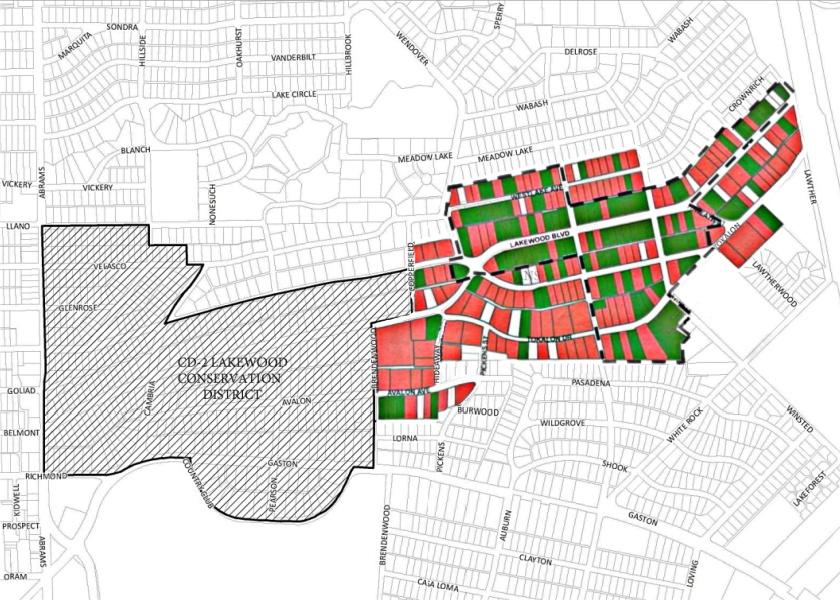
The expansion’s proponents say an expansion was important because the original 1988 boundaries did not include many of the architecturally significant historic homes on Lakewood, Lakeshore, Avalon, Tokalon, and Westlake that have defined the neighborhood’s look since its inception.
There are 15 conservation districts in the City of Dallas, and 14 more neighborhoods are seeking a conservation ordinance.
After 15 ordinance meetings, the opposition mobilized, and as a compromise, the pro-expansion district group worked on a revised map to remove areas that were opposed. More meetings ensued, and in November 2024, the City Plan Commission unanimously agreed to remove a significant area of the original expansion plan.
Lakewood resident Wilson Schoellkopf came forward to speak Wednesday in opposition to the expansion.
“The lion’s share of support falls on two blocks. Take out those two blocks, and you can see the opposition is very strong,” said Schoellkopf, who lives on Tokalon within the boundaries of the proposed expansion.
Willis Winters, a former Lakewood resident, architectural historian, and author of seven books on the architecture of Dallas, spoke in favor.
“The only feasible way to save Lakewood from the ongoing plight of the Park Cities where there is no historic protection is through the thoughtful regulation that is contained in the ordinance before you today. I support the expansion to support the architectural integrity of Lakewood.”
Kim Edge, a Lakewood resident for 30 years, noted that in the time she has lived in the neighborhood, 34 homes have been demolished, eight by architects Dines and Kraft and two by Clifford Hutsell, both significant in creating the look of Lakewood.
Lakewood resident John Mareno added: “We are losing too many historic homes and stripping away character in the name of progress.”
City Planner Andrea Gilles remarked that home values generally increase in conservation districts throughout the country.
“Living in Wynwood, a neighborhood at the beginning of the conservation process, I’m concerned about the trend of tearing down historic homes,” said Michelle Walker, Preservation Dallas vice president of preservation issues. “The architectural history of our city is part of its attraction.”
Ron Siebler, President of the Board of Trustees for Preservation Dallas, expressed the board’s strong support for the expansion. “Conservation district status is one of the best tools we have,” Siebeler said. The criteria are specifically designed to strike a balance to protect the neighborhood’s identity.”






Hey Candy,
As I read the article I began to wonder; what is “historic”? I grew up in what would be considered a historic home in Hinsdale, Illinois (built around 1880). Google just told me the oldest house in Greenwich, CT was built in 1645. While not a direct comparison, the median age of homes in Los Angeles, CA is around 50 years (“the typical home was built in 1976”).
My point is that “historic” in real estate is a hyper-local word, sometimes even defined street-by-street (as the article points out). Being in the redevelopment business my radar stays up in order to get a better understanding of this ongoing debate (replacing old with new) and realize “historic” varies as we go from east (oldest) to west (youngest). Meaning the definition itself varies depending on location.
Personally, I’m on both sides. I completely understand liking and wanting to live in a home with a long history, but also understand that some people want a new look, feel and the modern features only available in newly built homes.
I understand from seeing it up close, the fabric of neighborhoods in transition look strange and IMO, unattractive. However, I’ve also seen those same neighborhoods transition completely with successful results (the area’s old homes have been replace or renovated into new-like).
IMO, the most important point of the debate is that any prospective buyer understands what protocols come with purchasing a home that requires third-party approval to make changes (moving the water heater, updating windows, paint color etc.). I’ve seen this be a problem first hand. Hopefully, buyers of historically designated homes do their homework before buying. A surprise can be costly (emotionally and financially). Thanks, Brian
To be considered “historic,” a property must possess three essential attributes: it must have sufficient age (minimum of 50 years old), a relatively high degree of physical integrity, and historical significance.The Secretary of the Interior defines a historic property as any building, site, structure, object, or district that is listed in or eligible for the National Register of Historic Places. The National Register is a list of properties that are considered worthy of preservation.
Hi Karen,
That was kinda what I was afraid of. Besides the 50 year hard fact, the rest of the description is subjective. I guess that’s why the subject has “sides”. Thanks again, Brian
Hi Brian, Its really not subjective. If you read the site, it’s very detailed as to what fits into the historic category.
So happy to see this! I was Vice President of the original conservation district effort in the 1980s and the sole survivor of the committee.