
Texas Is Dominating When It Comes to CRE Activity
Share News:


Everything’s bigger in the Lone Star State, and that includes the CRE industry.
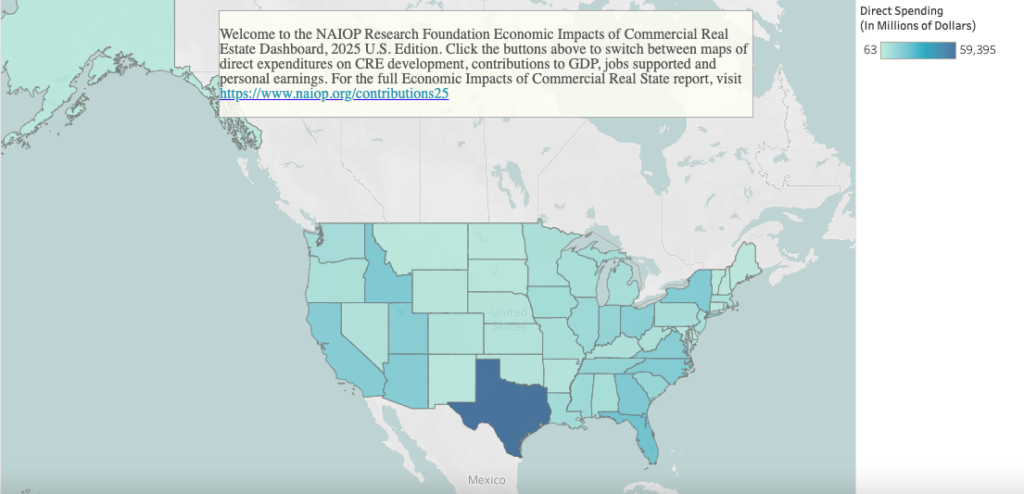
Texas claimed the top spot nationwide in 2024 for direct expenditures on commercial real estate and overall industry contributions to state GDP, according to a study by the NAIOP Commercial Real Estate Development Association.
Looking at the numbers, it’s not even close. Direct CRE expenditures totaled $59.3 billion in Texas last year. The state with the second highest figure was Florida at $20.2 billion, followed by Georgia at $16.6 billion. Overall contributions to state GDP that year for the three states were $146.3 billion, $42.1 billion, and $38.3 billion, respectively.
The Lone Star State’s outsized footprint in CRE can at least in part be credited to its business-friendly policies (limited regulation and relatively low taxes). Corporate relocations have been a testament to that in recent years, with many companies describing the economic environment in Texas as preferable to states like California, Illinois, and New York.
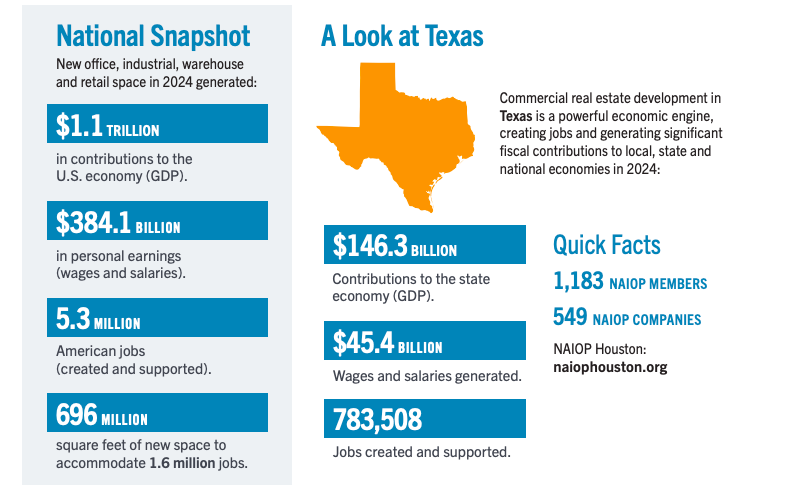
When it comes to personal earnings and jobs supported by the CRE industry in Texas, the state obviously came out on top. Some $45.4 billion in personal earnings were clocked, and the industry supported 783,508 jobs.
Broken down by sector, direct CRE expenditures in Texas shook out as follows in 2024:
- Office – $19.8 billion
- Industrial – $19 billion
- Warehouse – $13.8 billion
- Retail – $6.8 billion
D-FW Did Its Part
The Metroplex has been a CRE standout in certain CRE sectors. Last year, retail saw “unprecedented growth” with 3.1 million square feet of net absorption. The absorption was driven by new builds, virtually all of which are expected to be fully leased by the end of 2025, according to a report by M&D Commercial Group.
On the office front, leasing volume more or less returned to pre-pandemic levels. Vacancy is still hovering around 20%, but developers are making moves in anticipation of an expected end to the remote work trend. Industrial, however, saw a significant lag in 2024 because of an “unprecedented surge in new construction” the few years prior. The oversupply resulted in D-FW maintaining the highest vacancy rate out of the 20 biggest metro areas in the country.
Even still, D-FW was named the top market to watch for CRE investment and development in 2025 by PwC and the Urban Land Institute in their 46th annual Emerging Trends in Real Estate report. Population growth and the metro’s diversified economy were cited as two of the most important factors in the report’s determination.

The Metroplex has also been seeing its share of corporate relocations. In fact, an annual survey of corporate site selectors recently found that Dallas was the top city of choice in which to establish headquarters.
“This distinction should come as no surprise — Dallas has been on an economic winning streak in recent years and shows no signs of slowing down heading into 2025,” Mayor Eric Johnson said in a press release about the survey earlier this year.
Some National Stats, Possible Hiccups Down the Road
Direct CRE expenditures across the entire U.S. totaled $898.5 billion in 2024. Overall, some $2.5 trillion of the nation’s GDP stemmed from the industry, which also produced $862.5 billion in personal earnings and supported 14.2 million jobs.
“The commercial real estate development industry remains an engine for growth across the United States,” NAIOP president and CEO Marc Selvitelli said about last year’s CRE activity, per a press release.
CRE could face some obstacles this year because of President Donald Trump’s trade war policy and possible disruption in construction due to ramped-up deportations. Still, with any luck, the administration’s intention to cut taxes and deregulate could neutralize the expected price increases.