
The Boedeker Ice Cream Factory in The Cedars Will Soon Have a New Life
Share News:

By Jay Firsching
According to State Rep William Allen in 1887, “Eating ice cream on Sunday affects the morals of the people.” And not in a good way. Allen was arguing to include ice cream on the long list of immoral things to be banned as part of Texas’ “Blue Laws.” In response to Allen, I say, count me among the fallen. Ice cream may be my favorite food. And I am happy to tell you Allen’s plan failed, ice cream was exempted, and the “ice cream sundae,” so named to ease the minds of the blasphemous, was born.
To understand why Allen was so concerned about frozen treats, you first need to understand the context. In the 1880s, ice cream was a huge deal. The arrival of the railroad made daily access to ice possible, and that made commercial ice cream manufacturing possible. People went crazy for the frozen treat. By 1886, if you were hosting a summertime party, a barbeque, a church social, or a fundraiser, it was going to include ice cream. “Ice cream poisoning” was actually a thing and was a topic of discussion in the Dallas Morning News. No, not because they were eating too much of the stuff, but because of a lack of proper sanitation in the unregulated industry.


It was a messy and difficult business. In those days there weren’t grocery stores as we know them or even soda fountains. Commercial refrigeration didn’t exist, so making, storing, and transporting even relatively small amounts of ice cream involved tons of ice and salt. An ice cream party typically meant calling a specialty caterer who would use trucks to deliver frozen treats molded into specialty shapes to fit any occasion.
The Biggest Name in Ice Cream (You’ve Never Heard Of)
Frederick “Fred” Boedeker was a German immigrant and confectioner who arrived in Texas in the 1880s. The availability of ice allowed him to open a specialty business selling luxury indulgences, among them fresh oysters and ice cream. And business was good. So good that ten years later Fred and his young son, George, formed F. W. Boedeker & Son and opened the Elite Restaurant at 289 Elm Street. The restaurant was celebrated for its high-quality food and homemade ice cream, produced using a hand-cranked ten-gallon freezer in the basement. The ice cream was so popular, he sold the café in 1902 and opened the Elite Ice Cream Factory at 213 S. Ervay Street (where Dallas city hall is today). Botto Ice Cream, F. Kindberg & Co., and Creesey Ice Cream Company were among the major competitors, but Boedeker dominated.


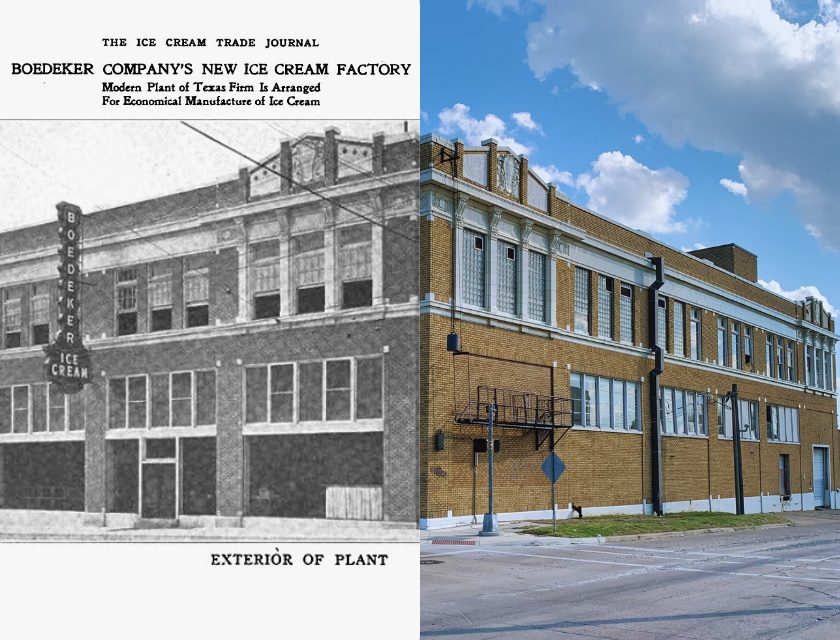
By 1919, the Elite factory had quadrupled in size. The Boedekers were looking for a new, larger home when opportunity struck. In 1920, builder Wyatt Hedrick was constructing a fine new Pierce Arrow auto dealership for T. E. Gray, owner of the Gray-Reardon Company. When Gray was charged with sixteen counts of “forgery and swindling,” the Boedekers bought the still-under-construction dealership at S. Evay and Pocahontas and converted it into a state-of-the-art ice cream manufacturing plant. Sadly, Fred Boedeker died in 1920 before the new plant could be completed.

Opened in 1921, the new facility could produce 3,000 gallons of ice cream per day. It featured advanced refrigeration systems, a steam-powered pasteurization process, and specialized rooms for mixing, freezing, and storing ice cream. The factory’s efficient design and capacity made it a regional leader in ice cream production.
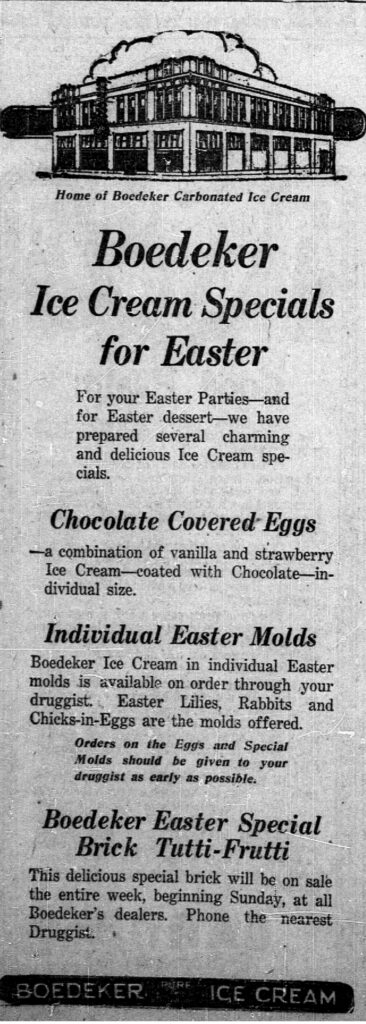
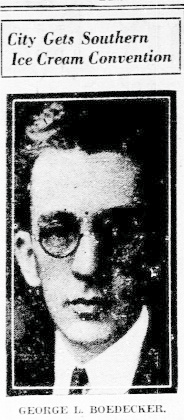
George Boedeker carried forward the family legacy, becoming a national trade-industry leader. He pioneered the chest-type ice cream freezer, which he leased to druggists, and soda fountains that served his products. He was also an early adopter of dry ice in his delivery trucks, eliminating the need to manage tons of ice and salt. The company opened plants in McKinney, Paris, and Sherman. This was all years before ice cream would be commonly available in grocery stores.

In 1951, the Boedeker Manufacturing Company merged with the Carnation Company of Texas. George Boedeker stayed on as the plant manager until his retirement in the early 1960s. The Boedeker name was eventually dropped, but the legacy of innovation and quality that the Boedekers established lived on through the Carnation brand. The Boedeker Ice Cream Factory remained a significant part of Dallas’ industrial history until it ceased operations in 1975. Today, the building stands as a testament to the pioneering spirit of one of Texas’ earliest and most successful entrepreneurs in the ice cream industry.
Boedeker Ice Cream Becomes Art
Vacant for decades, the Boedeker Ice Cream Factory will soon begin a new life as an arts incubator. The Cedars Union was formed in 2015 “to provide resources such as studios, tools, programs, and pro-bono services for creatives, foster a collaborative and supportive artist community, and advance the arts in North Texas.” Creative Director Matthew Bowden and the Bowden Family Foundation intend to rehabilitate the Boedeker Building to house advanced labs with modern equipment, flexible studios, and event and exhibition spaces.
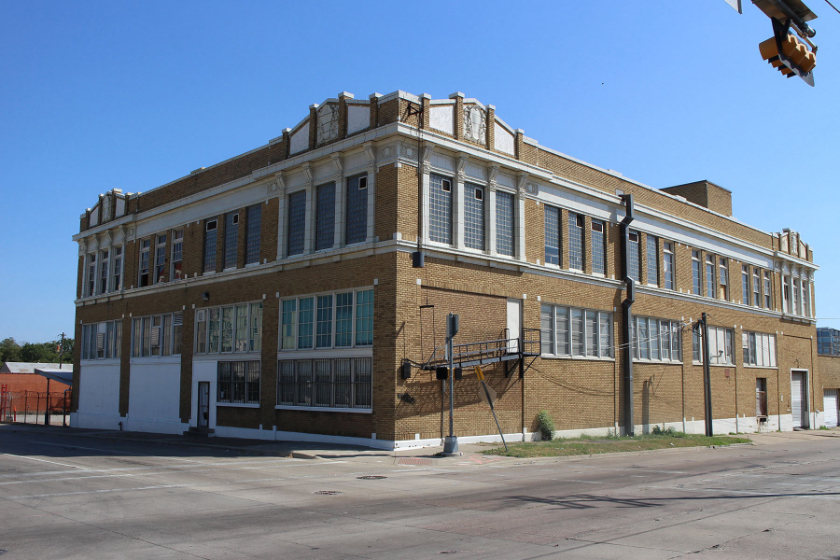
As the project’s historic rehabilitation tax credit (HRTC) specialist, I am working with the Cedars Union and architect Michael Karnowski of Architexas to make the project possible while preserving the building’s unique architectural legacy. The factory will also soon be one of Dallas’ entries in the National Register of Historic Places. To find out more about the project and how to support it, visit the Cedars Union website at CedarsUnion.org.
________________________________________
Jay Firsching established HRTC Services in March 2023 after almost 25 years of service with Architexas – Architecture, Planning, and Historic Preservation, Inc. Jay served as the firm’s in-house historic preservation professional, working both independently on his own projects and as part of larger project teams within the firm. He helped the company grow into the largest and most respected preservation-focused architecture firm in Texas.







I have an item that was an advertisement for Boedeker ice cream for collecting photos of movie stars, the one in particular is of gene autry on one side of what looks like a 3″ cardboard coin. I have a picture if interested.
Hi Randall, I’m sure Jay would love that. Shall I send him your email?