
Multifamily Developer Larkspur Capital Makes a Case For Why Dallas Needs Public Facility Corporation Projects
Share News:

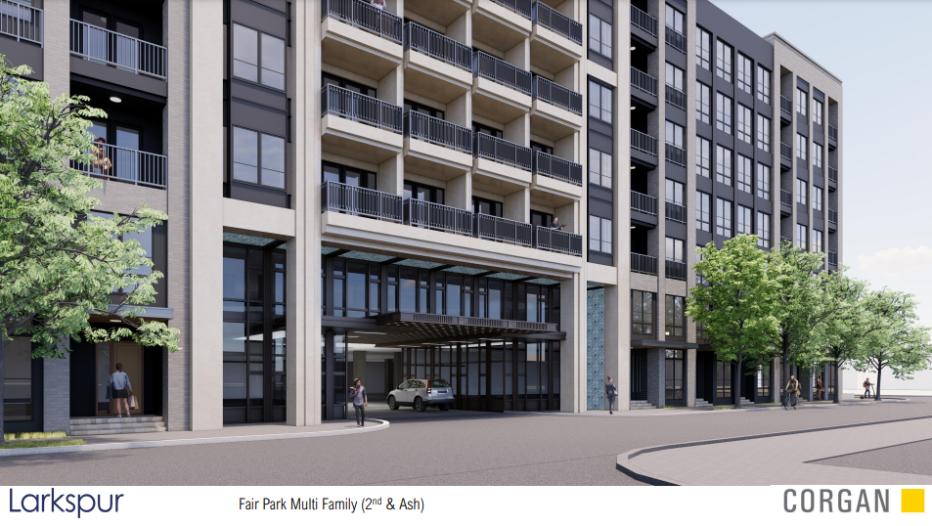
A briefing on Public Facility Corporation housing projects — what they are and what merit they bring to Dallas — is tentatively slated for June, and affordable housing developers are already building a case to support what they say is a valuable and necessary funding mechanism for missing middle housing.
Larkspur Capital development associate Cole Wade spoke exclusively with CandysDirt.com about a presentation he prepared for the Dallas Public Facility Corporation staff.
The Dallas PFC was created in 2020 to assist the city in financing, refinancing, or providing “public facilities” as defined by the Texas Local Government Code.
“In general, the DPFC seeks to develop and preserve mixed-income workforce housing communities to serve residents earning at or below 80 percent of the area median income (AMI) as well as provide non-income restricted units,” according to the Dallas PFC webpage.
Public Facility Corporation Projects
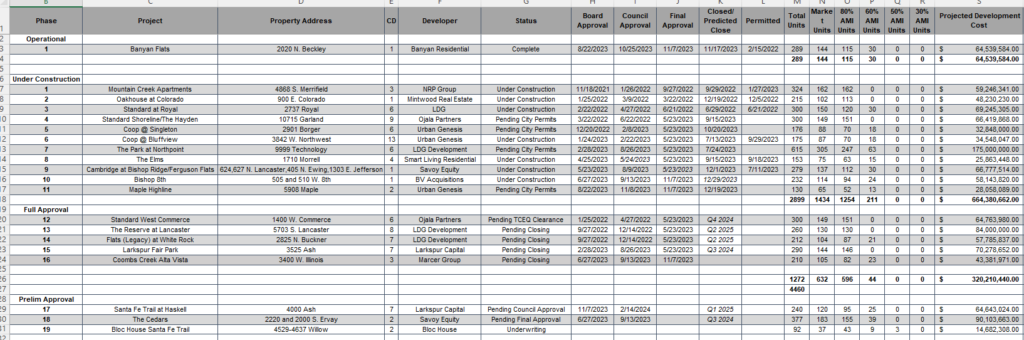
A Dallas PFC project pipeline spreadsheet obtained by CandysDirt.com shows that 20 projects have been approved or are pending.
We’ve covered this financing mechanism extensively and referred to PFC projects as “controversial.” However, just one Dallas City Council member, District 12’s Cara Mendelsohn, has routinely voted against PFC projects, citing an agreement between the city and developer that takes such projects off the tax rolls for up to 75 years.
To receive the exemption, a private apartment developer transfers land to a PFC set up by a local government entity, which then leases the land and any buildings on the land (including those built in the future) back to a limited partnership controlled by the developer.
Heather Way, director of the University of Texas Entrepreneurship and Community Development Clinic, told CandysDirt.com in 2022, that there are “some structural flaws” with PFC projects.
“It’s a big, huge tax break,” she said. “That results in shifting the property tax burden to other taxpayers. There are no reporting requirements and no accountability. In the case of the City of Dallas, they’re also giving up county and school taxes. That’s really problematic.”
Way’s comments came prior to the 2023 Texas legislative session when lawmakers passed House Bill 2071. The new legislation provides affordability, accountability, and transparency. It also makes headway in curbing abuses and tenant protections, advocates say.
So what does the city get in exchange? Proponents say the answer is much-needed affordable housing units.
“You’re not technically collecting property taxes, but … you are getting the land for free,” Wade said. “You’re getting affordable units. You’re getting a large annual fee. You’re getting a percentage of every single sale of the property. When you add all that up, the actual dollar value to the City of Dallas is higher than it would have been as a market rate deal collecting property taxes.”
District 1 Councilman Chad West said the PFC program has leapfrogged the Low Income Housing Tax Credit program as “the most impactful tool in the city’s toolbox to enable the construction of more affordable housing.”
“I’m cautiously optimistic that it will also prove to be a sound financial tool into the near and far future for the city, providing both revenue and housing development,” West said.
Larkspur Capital PFC Projects
Larkspur has assets all over Dallas but specializes in “transitional markets” such as North Oak Cliff, The Cedars, and Fair Park, Larkspur’s Wade said.

The developers have had two PFC projects approved, both on Ash Lane.
In light of recurring claims that PFC projects yield negative financial impacts to the City of Dallas, Larkspur Capital created an analysis detailing the financial benefits of PFC projects against alternative market-rate options. Wade said their hope is the data will be adopted by staff and included in the June briefing.
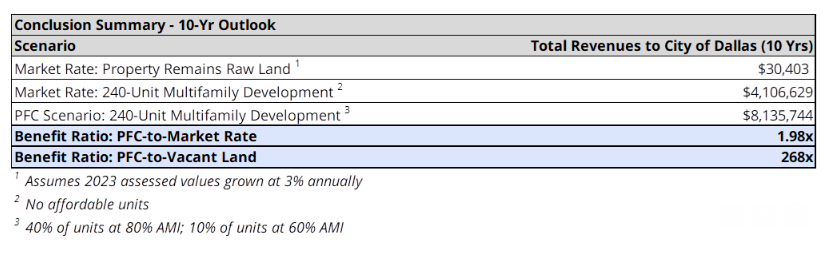
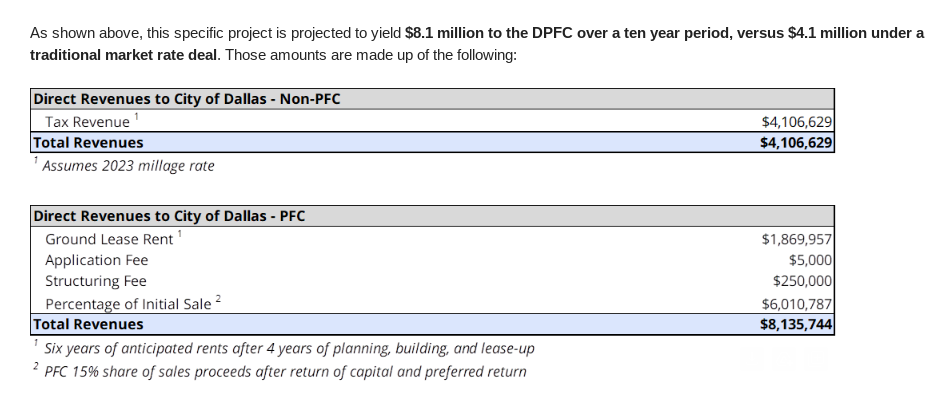
“Our ultimate conclusion is that a PFC-structured deal will contribute roughly twice the revenue to the City of Dallas versus an identical market rate deal, and 267 times compared to leaving the existing property as vacant land,” Wade said. “These findings are consistent with other PFC deals we have discussed with other developers.”
The developer added that the comparison between market rate and PFC “does not factor in that realistically a market rate deal would not be feasible in a standard PFC location until the area had grown to support such a project.”
“In reality, the site would remain vacant or have a less lucrative use for the next 10 to 15 years,” Wade said.
An estimated revenue foregone of about $2.6 million was noted in the lease agreement with Larkspur Capital for one of its Ash Lane projects. Santa Fe Trail at Haskell will include 240 units, half of which will be affordable.
“You can talk about the principle of it but I think a lot of it really comes down to, is this program beneficial or not beneficial to the city,” Wade said. “What we’re trying to do is break it down from a numbers perspective and show this is the benefit if you don’t have PFC; this is the benefit if you do have PFC. It’s pretty simple to look at and see one number is significantly higher than the other. That part of the argument is settled, you would think.”
Because PFC projects didn’t start coming through Dallas until two years ago, construction is just now wrapping up on some of the projects, meaning the city will begin to see revenues this quarter.
‘Greedy’ Developers Making a Profit
The narrative that greedy developers are lining their pockets by building a cheap product and getting a massive tax break has been alluded to in the conversation about PFC projects.
But affordable housing developers — even those who don’t use PFCs — say it’s not an accurate characterization.
First of all, the Class A projects being approved aren’t cheap. The building materials aren’t cheap. And the developers have to have a financial scenario that makes sense, Wade explained.
“At the very foundation, the wood that’s used to build these projects, the concrete, the labor that you have to pay for, it all costs something,” he said. “That money has to come from somewhere. Most of it comes from a bank. A lot of it comes from investors. You have to justify that this investment makes sense versus another investment. Investing in real estate will provide this return, and you have to provide them that return. Otherwise, they’re going to invest their money somewhere else and make more.”
Simply put, the developer has to raise the money to build the project and in turn be able to provide affordable housing.
Affordable housing developers and council members who support PFC projects have emphasized that no one is creating such affordable projects without incentives and there is high demand for affordable housing in Dallas.
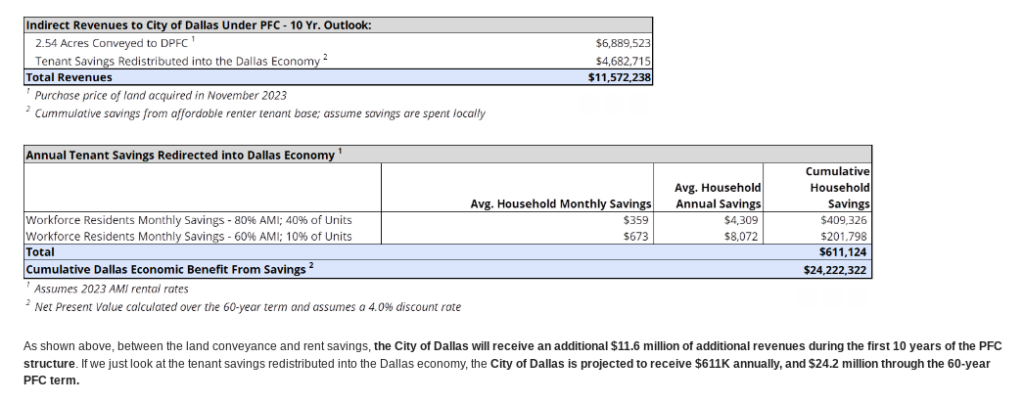
“In addition to the direct revenues the City of Dallas receives through the PFC, we also wanted to highlight the indirect revenues the city receives throughout the hold,” Wade said. “These are made up of the land that is conveyed to the city, and the rental savings that affordable rate renters receive through the PFC. The assumption is that these savings are redistributed into the Dallas economy.”







I first learned about these while I was watching a Dallas city council meeting online regarding one of the 75 year gifts developer Larkspur. One of the city council members asked them what the difference in the affordable rent would be on a studio unit as compared to market rate. Larkspur said that there was a $6 difference in the monthly rent they would charge between market rate and “affordable”. I even had to rewind the video to make sure that I was hearing was correct.
In a city Council meeting regarding one of their 75 year gifts from the city, Larkspur stated that there was a $6 difference between what they would charge as affordable versus rent market rent.
Imagine thinking that a developer providing much needed affordable housing is a “gift from the city” – another low information person.