
Alan Hoffmann on Elm Thicket Permitting Debacle: Does Dallas Need to be Known For This?
Share News:


By Alan Hoffmann
Guest Columnist
I was recently alerted by two past presidents of the Dallas Builders Association, who also happen to be builder colleagues, on the issuance of mid-stream building permit stops in the Elm Thicket neighborhood of Dallas. They share my deep concerns over the serious consequences of the stop work orders that have halted construction on several homebuilding projects in this Dallas neighborhood, but also the impact on future growth in this city.
Michael Turner of Classic Urban Homes and Jeff Dworkin of JLD Custom Homes both think that what has transpired is a very bad look for the City of Dallas. We discussed our concerns about the impact of this decision by the City of Dallas. Michael Turner has built several homes in the area, and we were all equally alarmed by not just the action but the precedent the City of Dallas was setting with this action. Given that our building community has been through four years of turmoil because of the dysfunctional Dallas building services department, our collective reaction was, “Here we go again!”
For those unfamiliar with the recent problems with the City of Dallas building department, just be aware that former city manager T.C. Broadnax’s employment came close to termination this past year chiefly because of the department’s poor performance for several years on his watch.
We don’t know the exact count of homes that received stop work orders, but we understood that it may be as high as 20. Given the fact that the building department is relatively silent regarding the impacted property owners, the legal department has probably made staff aware of possible litigation with the property owners.
Details in the press indicate that the stop work orders began when an Elm Thicket resident complained to the building department of a potential zoning problem with the new builds. In 2022, the city had enacted development standards beyond the existing zoning at the request of the neighborhood. But new Dallas building department leadership discovered that the newly approved development guidelines were mistakenly not included in the plan reviews of the approximately 20 homes that received the stop work order.
In other words, the city gave approval in error.
Additionally, the new leadership discovered that the previous building department management regime had failed to ensure that these development details were disseminated to the planning and zoning reviewers. As a result, these building permits were reviewed, approved, and issued by the City of Dallas’ building department by mistake.
The permitting process for most cities is very detailed.
After a building permit is issued, critical financial decisions are made by the builder and their clients. Financial commitments are made in the form of large cash expenditures and in most cases loan documents are executed and financial obligations are accepted by contract. Most lenders will not proceed with financing a project unless the borrower possesses a permit.
Projects also have time commitments, and, in most cases, there is a buyer who is waiting to move into a home. Individuals and families base decisions on their existing rental agreements for their current housing to conform with the projected completion date of their new build. They await the completion of the homes, and their lives are impacted based on the decision to build as well as the review and approval of building plans and permits. This doesn’t take into consideration the entire permitting process.
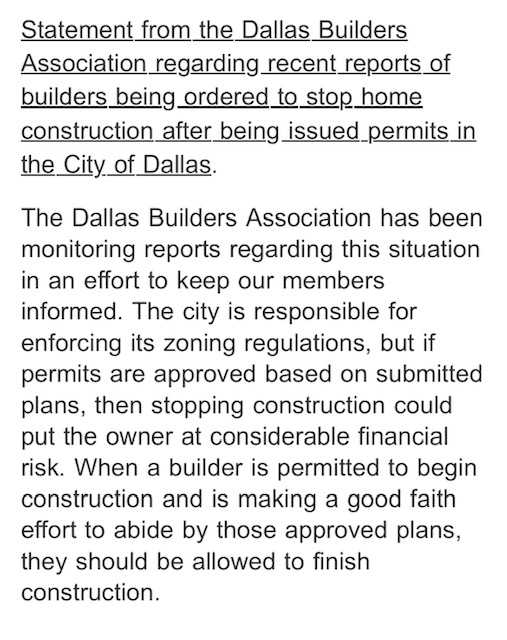
In applying for a permit in the City of Dallas, builders must always provide a Dallas County-certified plat with our permit application. We must have our plans reviewed for code requirements, setbacks, height, and zoning, to mention a few critical details. We work with our architects, engineers, and designers to make sure we are complying with the rules set by the City, as well as state and national code standards. We as builders have a lot of boxes to check in moving projects through permitting. We want to make sure that we are complying with the rules. Also, myself and most of my colleagues are exceeding these standards regarding structural integrity and energy performance.
I raise these points to stress that we are not attempting to buck rules with the city.
We are seeking compliance when we apply for a permit. If we don’t do this in our process, we are asking for poor consequences. The actual act of applying for a permit is an act of recognition that we will comply with rules. Also, consider this: when the city issues a permit, it is acknowledging that the builder is following the rules of the city and that they are then permitted to execute a build based on the reviewed and approved plans.
When the City of Dallas chooses to reject their approval of a permit, there is a chain of devastating consequences. In the case of the home buyer waiting to move into the home, there is a negative ripple housing effect. Also, in the case of the property owner, when their plans are stopped, the financial consequences can be devastating: facing two housing obligations at once is beyond most homeowner’s financial bandwidth. In the case of the builder who has executed loan obligations, the financial consequences can be existential to their business.
I want to express here the level of complexity that the building department in the City of Dallas faces in doing a review for a new build. The city has approximately 1,200 zoning districts in the form of Planned Development Districts, development overlays, historic districts, etc. I know that there are additional categories I have not mentioned, but suffice it to say that development code and rules for builders and developers are overwhelmingly long and complex and create confusion and difficulty for the City of Dallas staff and everyone involved in evaluating projects.
City of Dallas leadership over the years has created these districts and in turn, given the staff of the building department a very difficult task. Correct zoning information was not uploaded in the department’s review system — and that is the basis of this current problem.
It’s important to note the building community now has a promising and positive relationship with the new incoming leadership staff. We have agreed to meet quarterly and go over issues that are occurring and that need resolution. This permit problem was not initiated or created by the people who are now in charge of the department. This issue occurred on the previous leadership’s watch.
Previous department leadership created a serious problem for the new leaders trying to rebuild their process and improve services to the building community. The fact that we did not hear from city staff on this additionally tells me that the decision to issue stop-work orders did not originate with staff.
My colleagues and I don’t know where the decision was made to issue the Elm Thicket stop-work orders. This action is an obviously extreme response and will have devastating consequences for the City of Dallas. A more nuanced approach, such as working with the property owners and builders individually, is a more prudent course of action. We know that from recent turnover, leadership staff in the City of Dallas development services office are new to their roles. Ultimately, this drastic action would be unlikely for someone new in their job to initiate.
These stop work orders need to be resolved immediately. The city needs to acknowledge this mistake and support the needed resolution. If there are further delays in resolving this issue, damages will mount, and the city will be faced with more negative costly consequences.
This incident sets a new precedent of negativity for progress in the City of Dallas. If you are a property owner in Dallas and you seek a permit to build in the city, you now need to proceed with extreme caution. This means a building permit in Dallas is essentially provisional, and the city reserves the right to shut you down if they have made a systemic and internal-produced mistake.
Who will want to build homes in Dallas with this nightmare track record?
Even worse, this new reality also means that lenders may look at construction loans for builds in Dallas now differently. The consequential action by the City of Dallas is that an individual or home builder considering a project in the City of Dallas needs to be aware that if the city makes a permitting mistake, you are the one who will bear, and pay for, the consequences.
Dallas does not need this new reality. I hope that wiser actions prevail.

Alan Hoffmann is a Dallas resident, homebuilder for Hoffmann Homes, and past president of the Dallas Builders Association.






Very well put Alan! The City cannot just stop Builders from Building a home to Code that they approved because of their error! This sets a VERY BAD precedent!
As a long time resident, I am not surprised that the permit was issued in error. The right thing to do would be for the city to pay the costs for building the homes according to the new zoning requirements which took several long years to get thru the city council. In addition, the department responsible should be penalized and the persons who did not update the database held responsible with a demotion and a pay cut. Unfortunately, when the city does something wrong no one pays the price except taxpayers.
This is ET/N permitting mess is just one more failure in a long list of city mismanagement that demonstrates why we cannot trust our current city council to successfully implement and oversee the monumental task described in Forward Dallas.
And then the city council wants to double the salaries’ of the city council members in a November vote.
We need competent leadership to work with and balance all the competing interests in Dallas and sadly this is not the lineup.
Such questionable actions by the Dallas Building Department creates a big black eye for the City of Dallas. It also reminds us of many other questionable practices by former City Manager T.C. Broadnax who abused the city’s rights of eminent domain to strongarm beneficiaries of various property rights, such as running roughshod over deed restrictions on property. Broadnax unleashed a list of horrors of California-type government abusive real estate practices, remindful of from whence he came. Glad he is no longer now in Dallas. Kudos to you and other members of trade organizations for exposing violations of constitutional rights of private property ownership and to the mayor for no longer countenancing such outrageous conduct. Cities do not need anti-private property rights reputations. Thanks to you and the mayor for saving Dallas’ reputation.
What the city of Dallas did in Elm Thicket was a major error! If the community will not allow for an exception to zoning then the city of Dallas must reimburse the builders AND owners for ALL expenses which may include temporary housing cost for buyers AND find a way to compensate builders for the delay.
What Dallas did is approaching criminal and unfortunately the citizens must pay for the city’s mistake even if it calls for higher taxes!
Since Dallas doesn’t fire for incompetence, please name these clowns and where they are now working.
Thx
A building permit isn’t just a formality; it’s a commitment by the city to the future residents, their neighbors, and the builders/workers who trust in the city’s word. In competent jurisdictions, this commitment is rigorously upheld long before the first drop of concrete is poured. When the City of Dallas shirks this responsibility and tries to absolve itself from the very regulations it alone creates and enforces, it sends a clear and troubling message: Dallas is an unreliable, negligent partner—failing both its residents and those who seek to invest in its future.
From what I was told by the City Staff, the City Attorney is who demanded the stop work orders be filed against the Builders who were issued permits in error. The City Staff said some of the vocal neighbors had the City Attorney’s ear and were putting pressure on him to assure the City issued the stop work orders.
Excellent article!
Certainly the builders have a legitimate beef to settle with the city, but the way to resolve it is not to trample the very hard-fought protections the neighborhood has managed to establish for itself. That would be a terrible precedent — one the next set of pushy builders would be sure to cite when they wanted to biolate the protections. The neighborhood must draw a line in the sand and defend it vigorously. The builders who lost their permits need to get good lawyers.
Jim, it’s a mess. And these are not big builders: small businesses getting screwed.
We stayed in litigation for over a year. With home builders i,nvestors and developers. I’m so sure that those building over here new somebody that built before they ever came and knew that it had been voted on. Builders in this neighborhood are determined to build whatever they want ,however they want. They building them fast and building them wrong. No one have a problem with building in this Community. Long time residence welcome our new neighbors. We respect them but we get nothing back. A lot of these builders knew they was building wrong they start early in the morning to late at night a house would be up in 2 weeks with just the insides to do they made it their business to build fast knowing that they was building wrong. Just follow the guidelines that the residents of this historical neighborhood agreed to. If City inspectors would have been on their job they would have caught a lot of the errors in building.