Plan Commissioners Spar Over Multiplexes in ForwardDallas’ Community Residential Placetype
Share News:

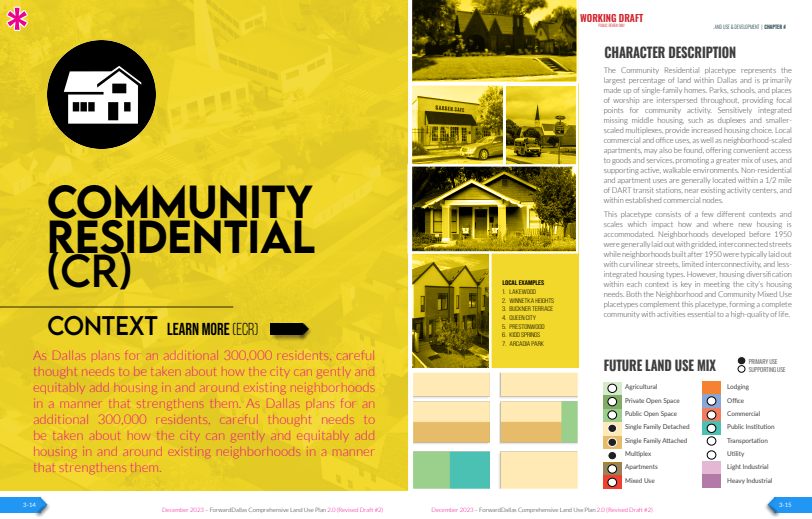
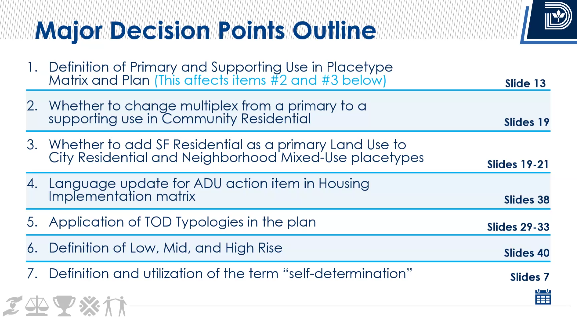
The revised ForwardDallas 2.0 comprehensive land use plan is a long way from consensus but plan commissioners continued an intense conversation earlier this month on how they can hone in on providing more quality housing options within the widely debated Community Residential placetype.
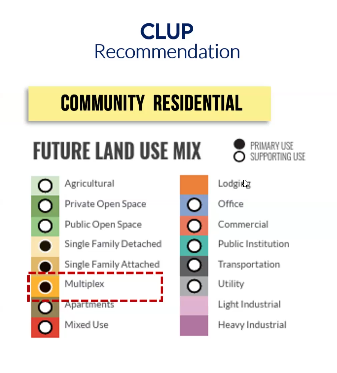
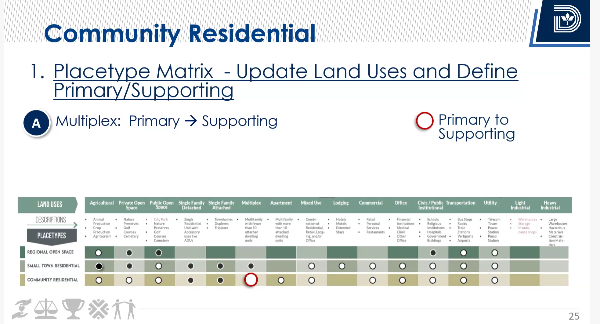
City Plan Commission Vice Chair Brent Rubin suggested during a May 16 meeting that the key to getting the Community Residential placetype to work “while keeping a meaningful opportunity for missing middle [housing] is to keep multiplexes as a primary use but at the same time acknowledge very frankly that we need meaningful design standards.”
“Yes, townhomes, but maybe not the townhomes we’re seeing so prevalent right now,” Rubin said. “The other piece is to acknowledge that considerations will vary from location to location.”
Commissioners Christian Chernock and Melissa Kingston (in a “rare instance”) agreed with Rubin.
Newly-appointed District 4 Plan Commissioner Tom Forsyth did not.
Forsyth, appointed in February by Deputy Mayor Pro Tem Carolyn King Arnold, told CandysDirt.com last week that the draft ForwardDallas document isn’t doing enough to protect single-family neighborhoods.
“We have a choice here,” he said. “None of us are opposed to density, but what we agreed to was that density would not be on a vacant lot that comes up in a single-family neighborhood. Multiplex should be a secondary land use in this placetype … I’m sure this plan is going to pass the CPC but we’re looking at some ferocious opposition from folks in single-family neighborhoods when this comes before the council if we don’t address their concerns here.”
Plan commissioners expect to have a complete draft document next month that incorporates all the feedback they’ve provided. A public hearing is scheduled for 9 a.m. June 6, and the CPC could vote on the plan at its June 20 meeting. The Dallas City Council is expected to review ForwardDallas 2.0 in August or September.
Watch the May 16 City Plan Commission meeting here.
Meaningful Design Standards
Plan Commissioner Darrell Herbert, who represents District 3 in Southern Dallas, said his neighborhoods already have multifamily adjacent to single-family neighborhoods, a sentiment echoed by Rubin and other commissioners.

“I go to Twin Oaks, Harbor Glen, all along Kiest, there are apartments abutting residences,” he said. “How do I make a plan that says, ‘You are no longer supported or a primary use. We don’t even need you here.’ That’s hard for me. I understand that single-family residents want protection. I think this gives us the protection we need further than ForwardDallas ‘06. ForwardDallas ‘06 called for multifamily across the board as a primary use. It did not say multiplex. It did not say townhome.”
Kingston said it’s important to include language about location and design standards.
“I think there’s a lot of opportunity to address the form within our code to make some of the smaller multifamily fit in better — not necessarily in the middle of a single-family neighborhood — but on some of the thoroughfares on the outskirts of neighborhoods where we historically see them in our communities now,” Kingston said. “I think that’s something important to include in the language of this document so we’re clearly communicating the intentions going forward in order to assuage some fears and hopefully pick up some support.”

Kingston later added that she supports single-family housing advocates but thinks Dallas ought to plan for density in areas “where it makes sense.”
“I don’t think that means in the middle of every single-family neighborhood,” she said. “I think that destabilizes communities. I don’t support every vacant lot. Clearly, Council has said they don’t support it either so I don’t know why we continue to have that conversation.”
Multiplexes in Locations Where It Makes Sense
Chief Planner Patrick Blaydes said staff has heard from southern Dallas residents that they aren’t anti-duplex.
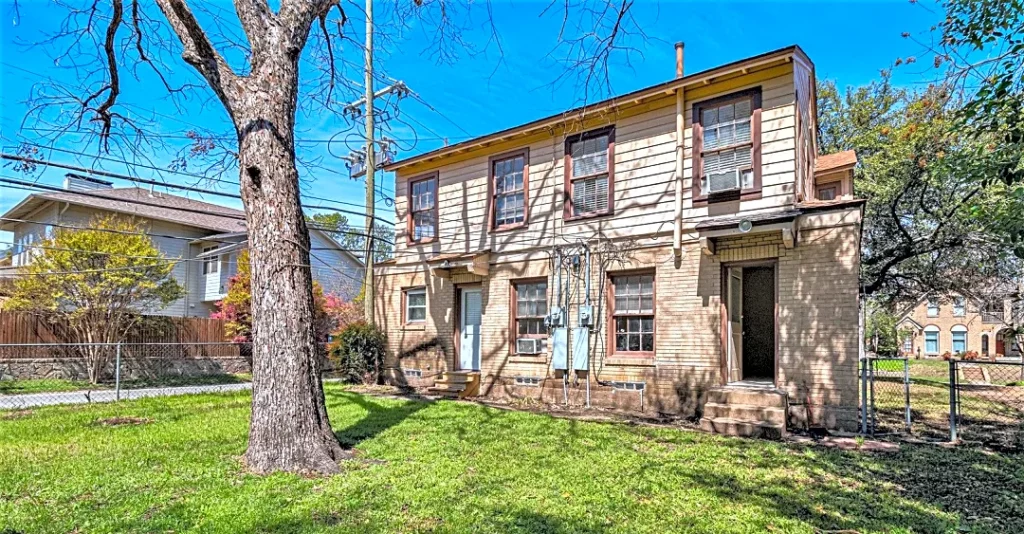
“They just didn’t like the duplexes that were being built there, the new ones,” he said. “So we worked with them on design standards. It’s really simple. It’s a porch in the front, a garage in the back, two stories in height, a pitched roof, and a less prominent driveway. That works in southern Dallas. It might not work everywhere. I think we can give some broad design guidelines to say if we are going to build missing middle, here are those concepts and the underlying design guidelines that could be applicable.”
Rubin explained that there are existing multiplexes that are “not very good in large part due to our current zoning.”
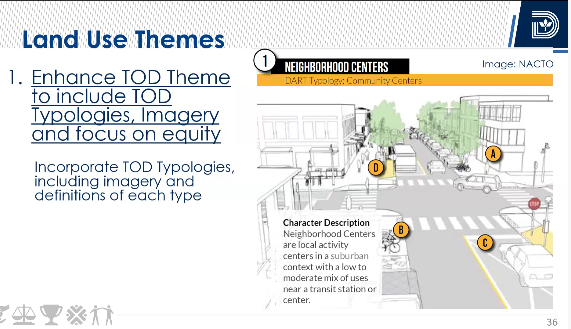
“If someone wanted to knock down the home next door to me and put a nine-plex, I might have some qualms about that, but that’s not to say that there aren’t places where multiplexes, a triplex, a quadplex, would fit in a neighborhood,” he said. “Not necessarily mid-block but maybe on corner lots, maybe as you get closer to major corridors. I think they’re still a very meaningful part of a neighborhood.”
Rubin added that his street is lined with single-family homes but there are four quadplexes near Gaston Avenue just a couple of blocks away that are “perfectly compatible with each other.”
“They’re two stories; they have entrances on the street,” he said. “The parking is all in the rear. I think locational language is really key and we don’t have to come up with all the answers on location right now, but I think the important thing is that we talk about being sensitive to location.”
Chernock pointed out that after zoning, design development, and permitting are complete, construction would take about two years. Factor in time for leasing or sales and market adaptation and “we’re hitting a moving target that is nearly a decade out,” he said.
“As we go into this discussion I would like everybody’s mind to be oriented toward what would be the state of our communities given the current trajectory,” Chernock said. “We are on a 10-year crash course for becoming a highly, highly unaffordable city. If that continues, what will it look like in 10 years?”
Forsyth Won’t Back Down
The original ForwardDallas plan adopted in 2006 referred to single-family neighborhoods as the “lifeblood of Dallas,” Forsyth pointed out.

“They’re an enduring part of Dallas’ legacy; it’s what makes Dallas a strong world-class city,” he said. “We need to be protecting those folks that represent 80 percent of the land mass within this Community Residential placetype.”
The Community Residential placetype is littered with language about gentle density, missing middle housing, duplexes, townhomes, and multiplexes, Forsyth said, adding that developers could use the plan to justify infill development within single-family neighborhoods.
“If that’s not our intent, then we should make these changes that the citizens have asked for,” he said.
Plan Commissioner Tip Housewright said he’s on the fence about multiplexes but is a big supporter of accessory dwelling units, townhomes, duplexes, and triplexes.
“I feel like even if multiplex dropped off here, we would benefit 90 percent or more toward the goal of creating housing by some of these smaller types,” he said. “I’m listening. I may get there.”
District 7 Plan Commissioner Tabitha Wheeler-Reagan said her constituents are fearful of what greedy developers will do when given the leeway to build multiplexes on vacant lots. She also mentioned “scope creep,” a term used to describe how a project’s requirements tend to increase over time.
“We have longtime renters in these communities,” she said. “I don’t believe that we don’t want it. I believe that it’s the fear that developers have gotten greedy.”
Commissioner Lorie Blair said she’s leaning toward not supporting multiplexes as a primary use.
“When we see the next version, we should see some better wordsmithing, we should see some better definitions, some standards, where placement can and cannot be,” she said. “At this point, until I see that, I would have to vote for [single-family neighborhood] protection, with the opportunity to re-look at it at the vote … because it could go both ways.”
Planning staff said design standards and location criteria would be included in the next update.