
Fort Worth Aims to Close $66 Million Road Repair Gap But Won’t Pursue ‘Street Maintenance Fee’
Share News:


Editor’s Note: Fort Worth Mayor Mattie Parker’s Office and Councilman Michael Crain contacted CandysDirt.com on Wednesday to advise that the city will not be pursuing a street maintenance fee.
“Street maintenance is a top priority for the City of Fort Worth leadership,” officials said in a public statement. “Through this commitment, staff members have been examining recurring street maintenance funding alternatives. A part of this has been the possibility of a street maintenance fee. This year, discussions between staff and the City Council concerning the budget began earlier than in the recent past. It is through these discussions and deliberations that the organization has decided to further evaluate other funding alternatives before any consideration of a street use fee.”
Crain said residents were blindsided by the fee proposal because it did not first go before the City Council’s Mobility Committee.
“I am committed to keeping costs down for residents and businesses,” Crain said. “While we need to make sure our streets are adequately maintained, I’m confident we can find the money in our budget without imposing additional fees.”
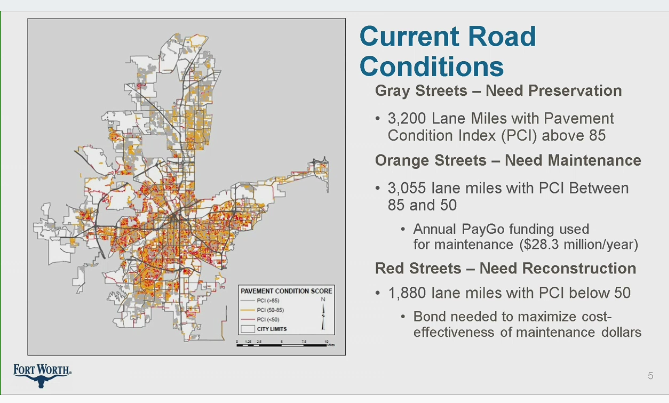
Fort Worth needs to reconstruct 650 lane miles of roadway in the next five to 10 years, and city staff is proposing a monthly fee so property owners can help fund the repairs. The “street maintenance fee” would increase property owners’ annual city service bills by about $110 to address a $66 million deficit in needed road repairs. It would also bring Fort Worth in line with service fees charged by other North Texas municipalities.
But Fort Worth isn’t the only city seeking funding options for pothole-filled roads.
Earlier this month, Dallas voters approved a $1.25 billion bond. Of 10 bond propositions on the May 4 ballot, $521.2 million for streets and transportation passed with the greatest margin. About 33,743 voters, or 86.45 percent, cast ballots in favor of the measure.
Fort Worth City Council members discussed the street maintenance fee during a March 5 work session and will revisit the topic again on June 4, according to a spokeswoman with Mayor Mattie Parker’s Office.
Council member Elizabeth Beck said the matter should have been reviewed by the city’s Mobility Committee before coming to the full council, adding that the city needs to revisit developer impact fees.
“We are proposing to levy an additional fee on our residents, our single-family homeowners, our businesses … when we don’t make developers pay for the actual cost of their development,” Beck said. “We are still subsidizing that. That’s going to be a hard sell for me to take back to my residents and say we’re going to charge you $9.22 a month … when we aren’t charging the developers, when we’re subsidizing them. If we can subsidize folks wanting to come to the city, we should certainly think about what that looks like for the people already in the city.”
Fort Worth’s Proposed Street Maintenance Fee
Assistant City Manager Jesica McEachern said street maintenance is a top priority identified by residents in a community survey. Fort Worth encompasses about 8,100 lane miles, and it costs about $2 million to construct one lane mile, officials said during the March meeting.
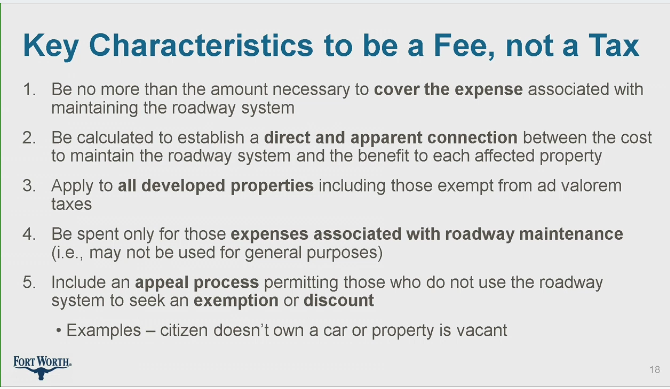
The proposed Fort Worth fee increase, as outlined in this article by Cecilia Lenzen of The Fort Worth Report, would raise monthly city service bills by an average of about $9.17 per month.
Fort Worth property owners currently pay an average of $1,183.44 in residential fees annually, or $98.62 monthly for things like stormwater, environmental, water, and sewer services, according to a staff report, the FWR article states.
City Manager David Cooke issued a May 7 memorandum suggesting the fee increase.
There was no discussion on the report when it was presented to the Fort Worth City Council during a May 7 workshop.
“Under consideration is a new Street Maintenance Fee which, at roughly $110 annually for the average City resident, would carry the equivalent cost burden of a property tax rate of approximately 4.8 cents,” Cooke wrote in the memo. “This is with respect to out-of-pocket costs paid by an average household and does not necessarily mean the Street Maintenance Fee would raise revenue equivalent to a 4.8 cent increase on the property tax rate.”
Based on staff’s proposal, the monthly street maintenance fee would be based on the type of property owned:
- Single-family residential: $9.22
- Multifamily residential (per unit): $5.65
- Office/1,000 square feet: $9.08
- Retail/commercial/1,000 square feet: $12.06
- Dining/1,000 square feet: $15.80
- Industrial/1,000 square feet: $2.67
- Institutional/1,000 square feet: $2.71
The Cost of Road Repairs
The Fort Worth Report news article states that of the top 10 most populated cities in Texas, Fort Worth charges its residents the second least in city service fees. Average annual residential fees are about $1,281.85 per property owner in Dallas.
If the street maintenance fee is approved, Fort Worth would rank as the fourth-lowest with an average annual total of $1,293.44. Austin charges an average of $2,115 annually for city services; Houston charges about $1,660. Plano charges $1,403 per year, while Arlington’s annual city services fee is about $1,293.
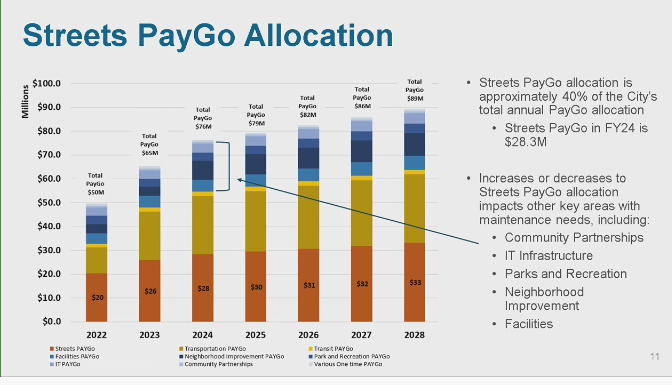
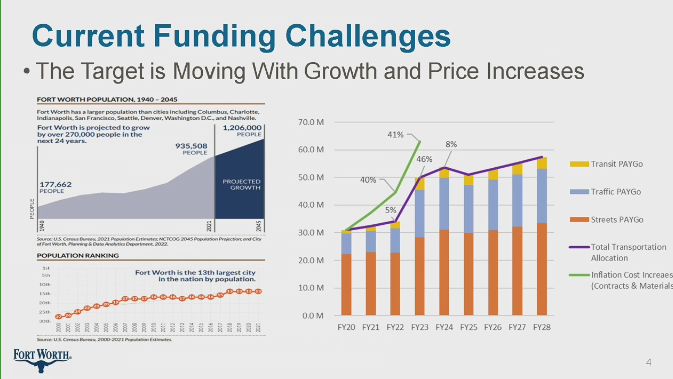
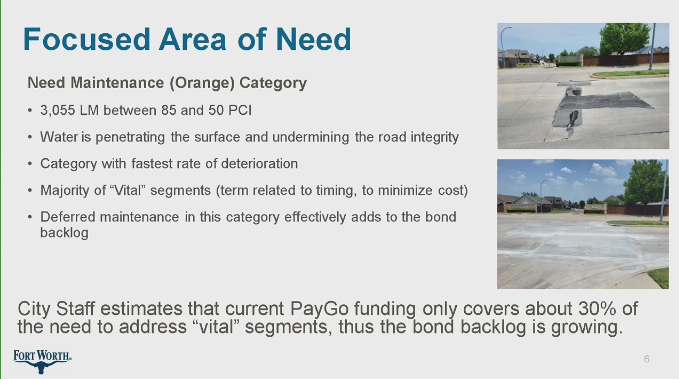
Fort Worth uses a dedicated $28.3 million fund from property tax revenue called “PayGo,” or Pay As You Go, to maintain streets and facilities, said Lane Zarate, transportation and public works assistant director. The city estimates that its dedicated PayGo funds to maintain streets and facilities will cover just 30 percent of the city’s to-do list for road improvement and construction, officials said.
“The challenge that we have is that the target keeps moving, both with growth and population increase,” Zarate said during the March work session. “While we have been increasing our PayGo allocation, we have not been increasing it enough to keep up with our contract costs. Our money isn’t going as far as it used to.”
Fort Worth is planning its budget for the 2025 fiscal year. If approved by the council in October, the city could begin collecting fees in the fall. The measure does not require approval from residents.
“Our current maintenance funding is not sufficient to prevent deterioration of our average [pavement condition index] score,” Zarate said. “[The data] also tells the story that the impact of deferred maintenance and underfunding maintenance reaches everyone in the city, not just where we currently have the worst-condition streets in our network.”