
Judge Halts Dallas City Hall Votes With Temporary Restraining Order
Share News:

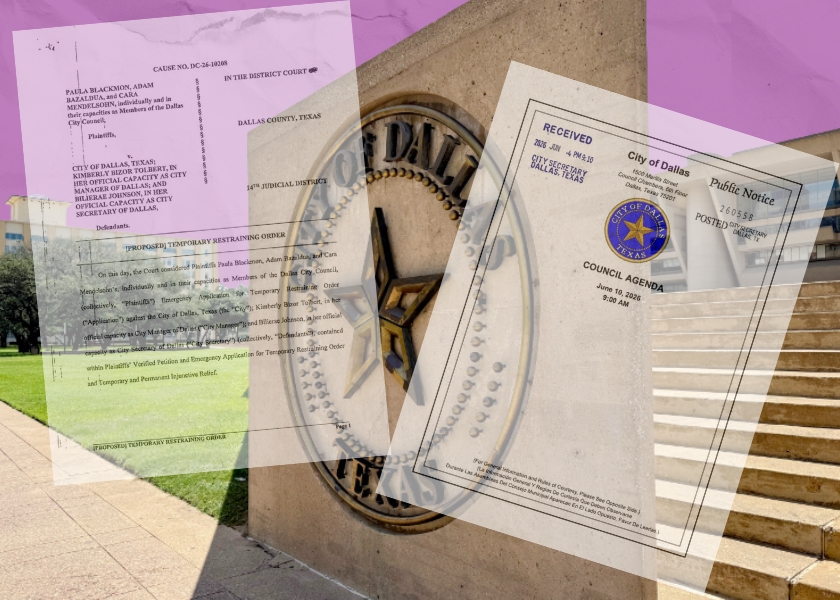
A state district judge on Tuesday temporarily blocked Dallas officials from voting on a series of City Hall relocation and repair proposals, delaying a decision that could have significantly shaped the future of Dallas City Hall.
During a special-called Wednesday meeting, council members were expected to either authorize the city manager to begin work on implementing a phased repair program for 1500 Marilla St. or initiate relocation and redevelopment processes. Now, it appears they will have to wait for some litigation to play out. The restraining order is in effect for 14 days unless otherwise ordered by the court.
A follow-up hearing in the district court is scheduled for June 18.
The restraining order was initially requested by Council Members Adam Bazaldua (District 7), Paula Blackmon (District 9), and Cara Mendelsohn (District 12) on Monday. In their lawsuit, the council members alleged that the city violated its Council Rules of Procedure and Financial Management Performance Criteria, as well as the Texas Open Meetings Act.
Council Member Cara Mendelsohn (District 12) pulled out of the suit Tuesday morning around 9:30 a.m., filing a non-suit without prejudice. She did not respond when asked via text message why she dropped out of the suit.
Bazaldua praised the judge’s order.
“At its core, this case is about the City following its own rules and providing residents with adequate notice and opportunity to take a position on important issues affecting our Dallas City Hall building,” he said in a statement. “The court’s ruling prevents certain City Hall matters from being discussed until those requirements are met.”
The plaintiffs argued that the agenda items don’t identify potential relocation sites, define what redevelopment of City Hall would entail, or specify how much money will be appropriated for due diligence and related work. They also alleged the city failed to follow its own rules by neglecting to require financial forecasts and other analyses before undertaking major facility projects and ignoring landmark requirements.
Judge Eric Moyé, who issued the restraining order, said that allowing the voting to proceed would set in motion “processes that may be difficult or impossible to reverse.”
“Once the City Manager is authorized to negotiate with developers, solicit proposals, or otherwise pursue redevelopment, the City will have made representations and potentially created contractual or quasi-contractual relationships that cannot be easily undone,” Moyé wrote in his order. “The public’s right to transparent and lawful decision-making will have been violated, and no after-the-fact remedy can restore that right.”

CandysDirt.com reached out to the city about the implications of the restraining order, asking whether the special called meeting would be cancelled in its entirety or council members might convene to discuss closed session items related to possible relocation sites.
“We respect Judge Moye’s decision and will work to ensure that the posted agenda language complies with state law,” said City Manager Kimberly Tolbert. “We value and encourage continued public discussion of these items, as we have for the last year, and we look forward to receiving clear direction from the City Council on the next steps.”
Council members still have a regular meeting scheduled Wednesday at 9 a.m., and there’s a briefing item on the special called meeting agenda that may still be heard. That briefing will go over public safety financing needs and two funding strategies devised by staff to implement either a phased repair of or relocation from City Hall.
According to the presentation, relocating City Hall functions would likely be less expensive over the long term than repairing and modernizing the existing building. Estimates range from $532 million to $611 million in corrective repairs alone, with modernization, temporary relocation, and potential financing costs pushing the totals well over $1 billion.
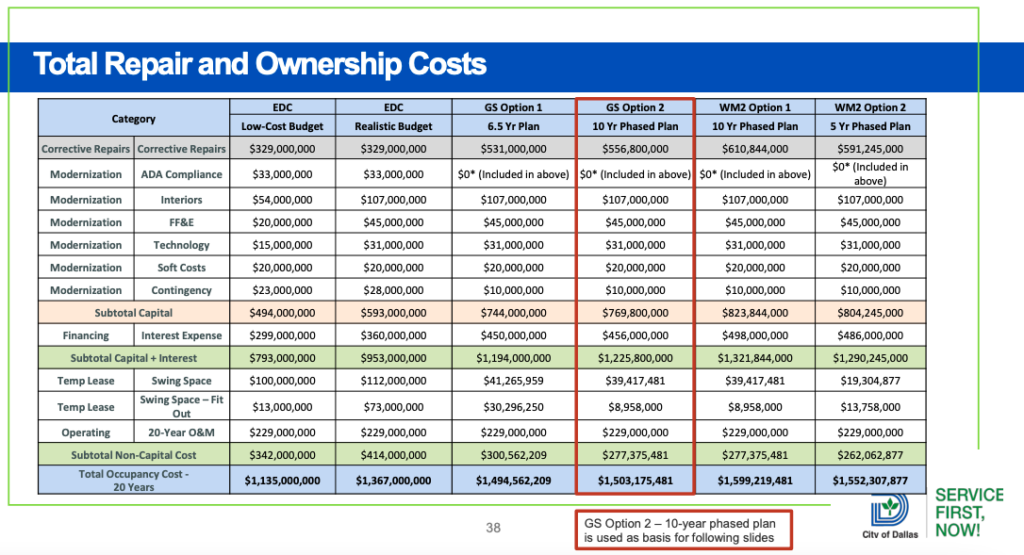
City CFO Jack Ireland outlined a potential debt strategy and a cash approach for repair. The presentation warns that financing those repairs through debt could consume borrowing capacity otherwise available for future infrastructure and bond programs, while a pay-as-you-go approach could require significant property tax increases or deep reductions to city services.
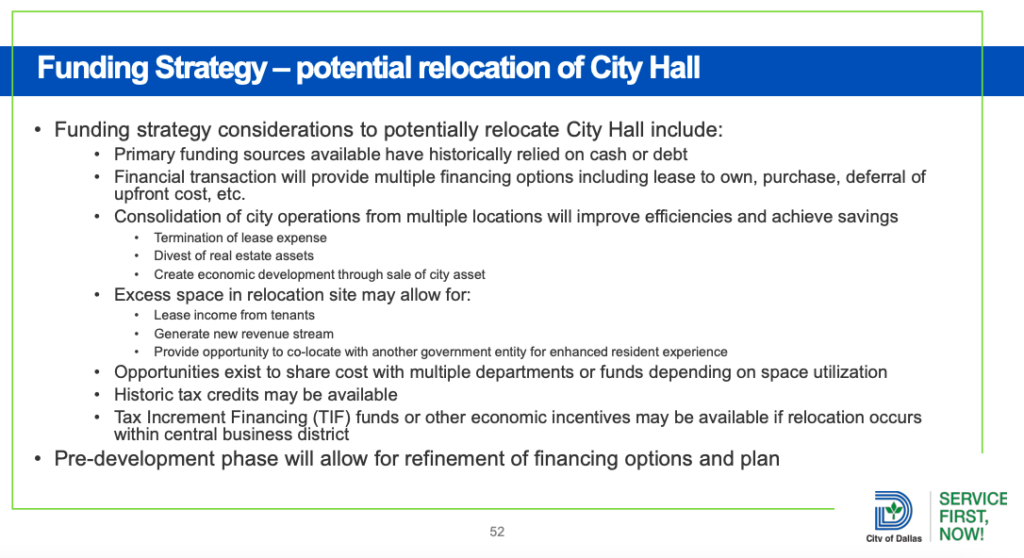
Staff have previously noted that the downtown office market is favorable at present, with opportunities to increase municipal efficiency and enhance the customer experience at a relocated City Hall. In addition to a traditional lease, officials could consider lease-to-own or purchase. And the presentation notes that the city could generate new revenue streams or lease income from excess space.
No figures were provided as to potential relocation sites as officials continue to discuss available options in closed session. The same city council resolution back in March that directed the city manager to come up with phased repair programs and funding options also asked for no fewer than two sites for both City Hall functions and emergency dispatch operations.
While no votes on the future of City Hall will be taken on Wednesday, dozens of residents on both sides of the issue are still expected to turn out to participate in public comment.
5 Comments
Leave a Comment







The solution is to sell Dallas City Hall to the Las Vegas Sands Hotel Corporation for use as a high dollar casino which at the present time is not yet a legal use in the State of Texas. But don’t worry. Las Vegas Sands group is making substantial campaign contributions to ensure that the State Law concerning gambling is changed! One question-why was the building allowed to deteriorate to its present condition? It is only 48 years old. There are many other buildings older than that! Look at Memorial Auditorium-it was built in 1957!
Thank you for the wisdom you have written.
Tear it down! Who has $1.5 billion to repair and bring up to speed that fugly building? The whole south side of Downtown next to the multi-billion dollar new convention center can be activated to become a major boom for the City of Dallas. A distinct synergistic reality of a new AAC like district right next to the convention center is the pot of gold at the end of the rainbow. The Mavericks want to be downtown, the Mavericks absolutely should be downtown. Let’s let them spend their billions to develop the next AAC. And by the way, the owner of the Stars just said on an interview that he did not want to leave the AAC. The Stars are using Plano as negotiation leverage and absolutely will stay at the AAC with some tweaking to keep them there. Dallas can’t cut its nose off to spite its face with this major opportunity! Tear City Hall down!
History will repeat itself.
Paying through the nose to acquire vacant land that we already own is a non starter. The expense to demolish of that building could exceed the cost to renovate it. So someone ends up with the land City Hall sits on (part of it park land) and We the taxpayers end up with an exorbitant bill and no assets. ALL on the promise whatever ends up on that property will miraculously revitalize the down town of a declining City.
No one has analyzed why AT&T left; Why BOA is leaving downtown; why Neiman’s closed Safety is everything and Dallas failed to provide that