
Dallas Weighs Slower, Cheaper Path to Repairing City Hall
Share News:

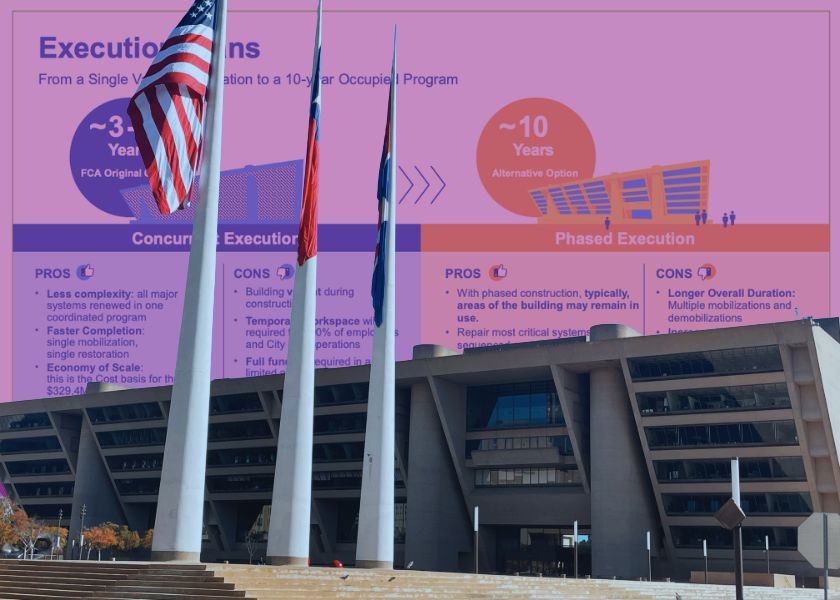
Dallas City Council on Wednesday heard new phased repair strategies and a brand new estimate for City Hall repairs — for less than half the original $1 billion assessment.
Consultants Gresham Smith and WM2 Company were hired after a March 4 city council resolution called for phased repair scenarios and a corresponding funding strategy for 1500 Marilla St. The move followed criticism of an earlier AECOM property condition assessment that projected roughly $1 billion in repair-related costs spread over 20 years.
The actual structural and mechanical repairs were pegged at $329 million, a figure critics of relocating from City Hall dispute.
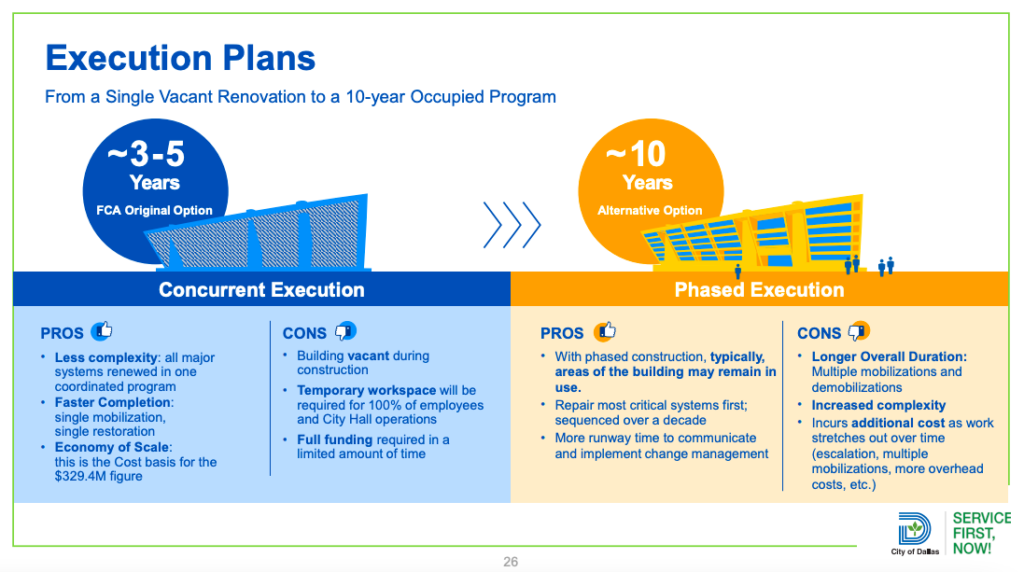
Some council members argued the estimate unnecessarily assumed full evacuation of the building for a 3-5 year period and included costs like temporary office space, upgraded interior outfitting, and borrowing costs.
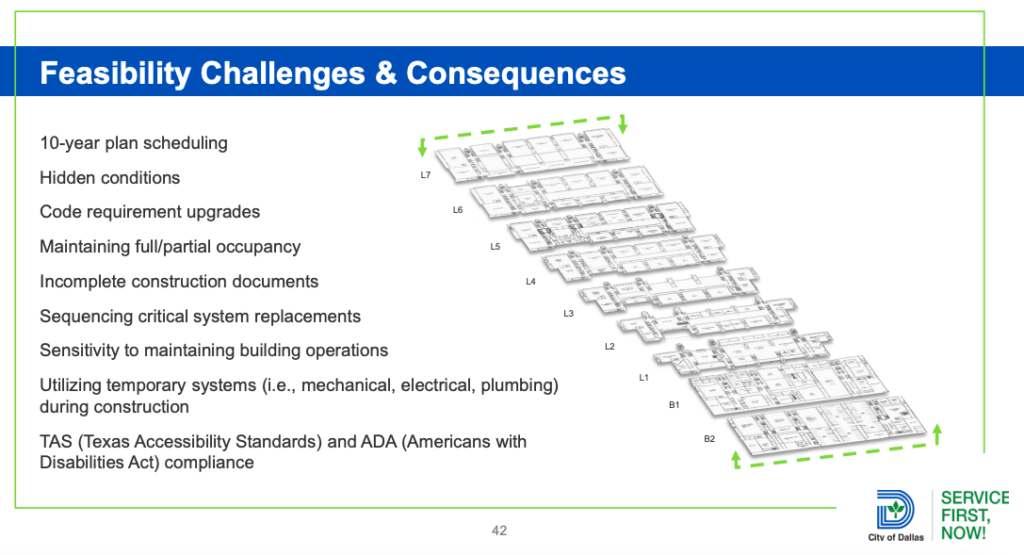
Officials said the new consultants used earlier reports as a baseline while independently surveying building conditions, interviewing staff, and evaluating operational constraints for a 10-year phased repair. Their work is ongoing.
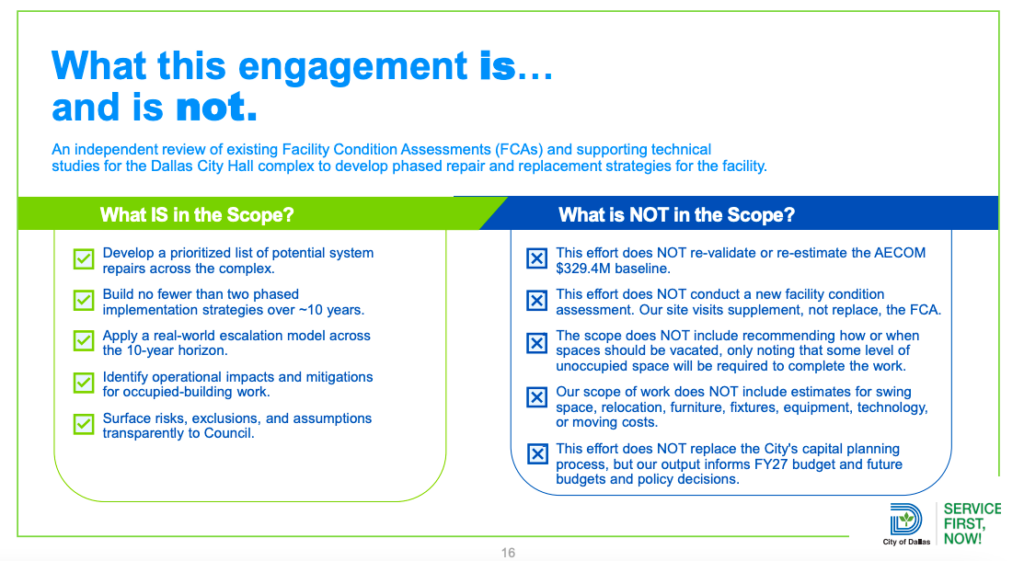
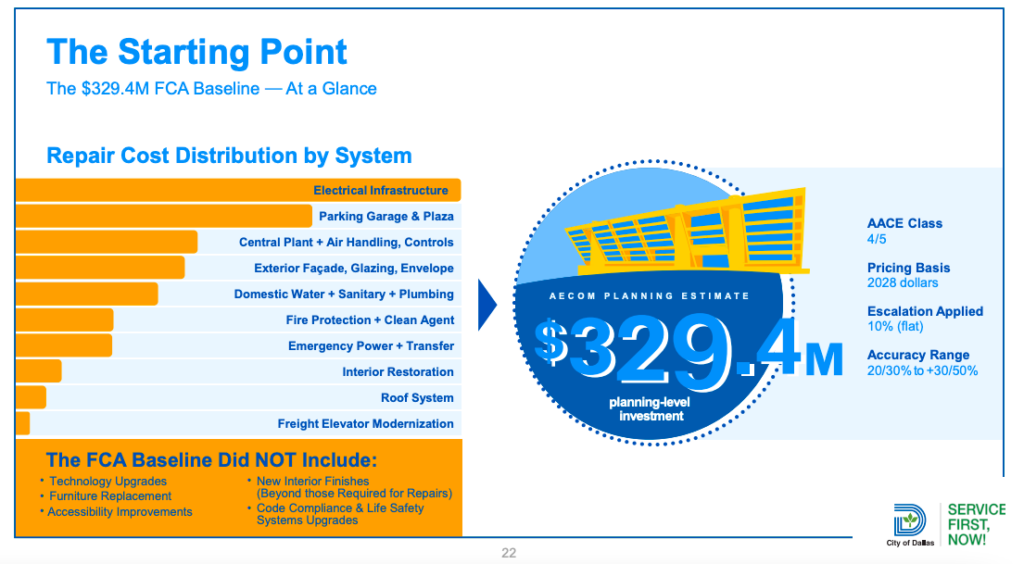
While a phased repair would reduce operational disruption and spread costs over time, the consultants acknowledged it would also increase the complexity of the job and likely increase costs in some areas. They described the building’s most pressing infrastructure concerns, which include the emergency generators, the leaking roof and plaza/garage waterproofing issues, deteriorating mechanical systems, and the difficulty of getting to systems behind the structure’s concrete slabs.
An area of seeming disagreement with the AECOM report was on what it would cost to fix damage to the building’s exterior. Don Powell, executive vice president of architecture and planning for FRP, was brought on for the phased repair project, and he said modern sealants could address the issues for less than was projected ($36.9 million). As for City Hall’s structural concrete frame, he said the thing could last centuries.

“The thing that makes office buildings particularly obsolete is not the structure,” he said. “It’s the limitation for pathways for enhancements for technology. That’s the number one reason we run into failed buildings — that you cannot update them cost effectively, or even possibly in some cases.”
Council members pressed the consultants with questions about a number of considerations ranging from the scale of relocation that would be necessary to technical issues surrounding things like needed HVAC and electrical replacements.
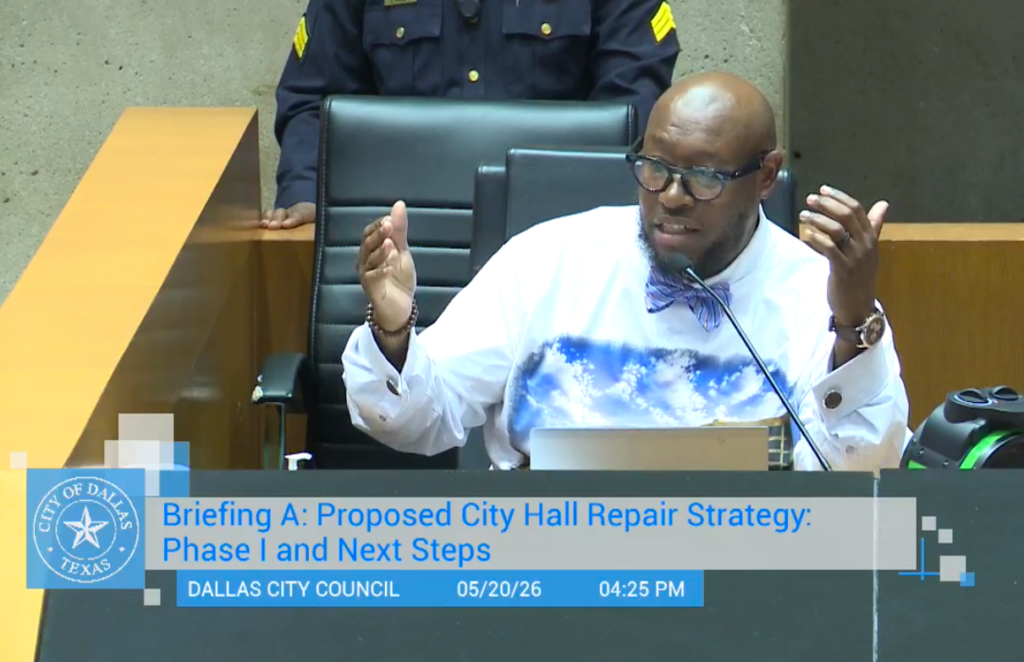
Asbestos abatement remained a major concern for Council Member Maxie Johnson (District 4), who seemed unconvinced that phased repairs with staff present could be done safely, despite modern techniques that allow hazardous material work to be executed in occupied buildings.
“I don’t support being here with the drilling and all those things and I don’t support keeping our workers here during massive construction,” he said.
Council Member Gay Donnell Willis (District 13) acknowledged that everything seems doable, but she expressed skepticism about the costs.
“It’s the money, so I mean, to me it’s less I.M. Pei and it’s ‘what will taxpayers pay,’ you know?” she said, questioning the consultants about how disruptive phased repairs might actually be.
Phased repair estimates are still in the works and will be presented to the city council on June 3 along with two repair strategies: one that would prioritize efficiency by bundling work together and minimizing construction “mobilizations,” and one that would prioritize minimizing disruption to city operations — even if that meant a slower and more expensive process.
Council Members Bill Roth (District 11) and Paul Ridley praised the briefing for its focus on some of the minutiae. Both suggested the consultants shouldn’t be shy about asking for more time to finalize their assessment.
Wednesday’s meeting was less contentious than those in March, but some underlying tensions remained. Some council members — namely Adam Bazaldua (District 7) and Cara Mendelsohn (District 12) — in the Save Dallas City Hall camp previously suggested that staff and the first batch of consultants led by AECOM were trying to stack the deck in favor of relocation over repair, insinuating they were operating on behalf of private interests who would stand to profit from redevelopment of the property and its surrounding acreage.
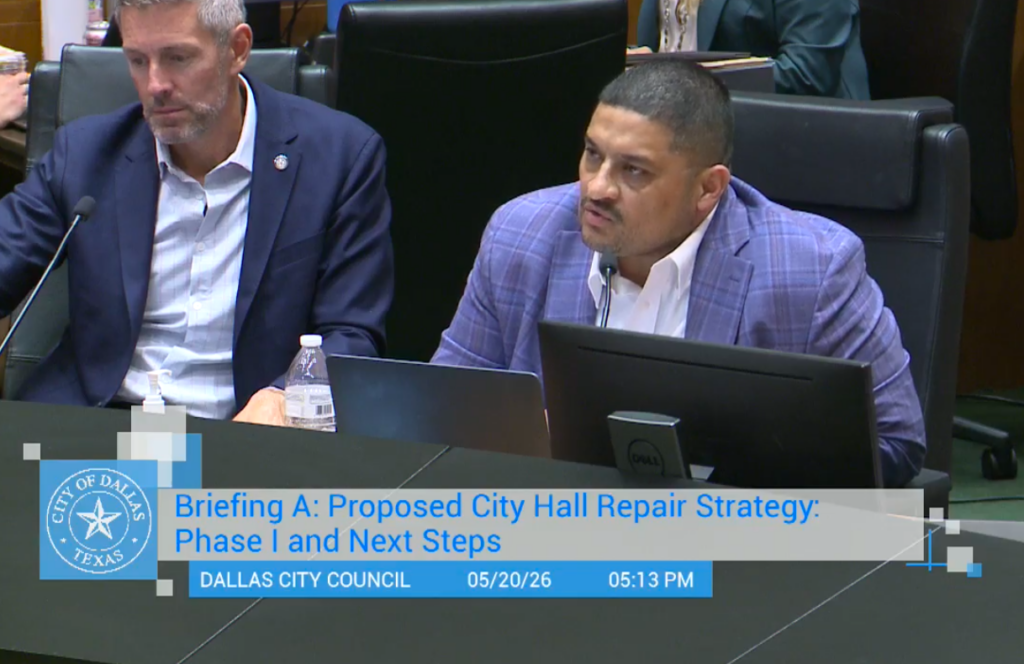
“It’s hard not to notice that today’s consultants, fortunately, are being treated very differently than the prior team that delivered conclusions some of us disagreed with,” said Council Member Jaime Resendez (District 5). “Disagreeing with the recommendations is absolutely fair, but questioning the integrity or motives of professionals simply because we dislike the information they present is not how this body should conduct itself. We should absolutely ask hard questions, but we should also be mature enough as a governing body to debate policy choices without attacking the character of the people presenting information or creating an environment where experts or staff are criticized simply for doing the work we hired them to do.”
Timing is important, though. The Dallas Mavericks have all but confirmed they would prefer 1500 Marilla St. and its surrounding acreage for their new arena and entertainment district, and the team’s CEO said they’d like to announce the location by early July. City Manager Kimberly Tolbert also suggested it’s important that the city council indicate soon whether they want to repair the building or relocate so staff could know what, if anything, needs to be budgeted for during this summer’s budget development process.
While things were more toned down at the horseshoe, the ground game of outside partisans in the fight over City Hall appears to be heating up some. Supporters of the Say Yes to Downtown campaign, an initiative launched by former mayor Mike Rawlings to urge council members to relocate from 1500 Marilla St., turned out in force with matching shirts distributed outside the building. Plenty of Save City Hall advocates showed up too, with dozens on both sides of the issue speaking during public comment before the briefing.

Most supporters of relocation decried the lack of activation at the site, lamenting the surrounding area has remained stagnant while other neighborhoods like Uptown have exploded with growth and amenities.
“I’ve seen neighborhoods transformed and areas once written off become thriving economic engines for the city, but this area around City Hall has largely remained frozen in time,” said longtime Dallas resident Jim Lake. “The reality is this space has become a disconnector. Great cities succeed when they create connectivity, energy, improved walkability — not barriers in the middle of our downtown.”
Two speakers played videos produced by local activist group Next Generation Action Network, including one criticizing attacks on City Manager Tolbert and another highlighting past comments from Council Member Cara Mendelsohn questioning City Hall repair spending.
“Are you concerned at all that it would appear self-serving for almost $30 million to come to City Hall, when it’s not really something that’s benefiting the residents like streets or parks or public safety would?” Mendelsohn asked then-city manager TC Broadnax in the clip.
Later in Wednesday’s meeting, Mendelsohn referenced the video, saying the back-and-forth with Broadnax was “very much about not using debt to do facility maintenance, which arguably should be general fund dollars.”
Deferred maintenance has been an ongoing issue at 1500 Marilla St. for years amid debates over city spending priorities, which has led critics of relocation to describe the current situation as a case of “demolition by neglect.”
“I’m not prone to conspiracy theories, but you can understand why so many people don’t trust anything coming out of City,” said District 2 resident Calen Bedford, who argued for repairing City Hall. “Let’s be candid about why we are here. Those in positions of power have failed this building and have failed taxpayers. That is a governance pattern, and it will produce the next failure unless we change how we steward civic assets.”
Some supporters of the I.M. Pei-designed building stressed that it is already fully owned by taxpayers, arguing that relocation would burden Dallas with long-term leasing costs. Others emphasized how the building and its plaza have served as local symbols of democracy and a source of pride for residents.
“It’s not a real estate opportunity for billionaires,” said Dolores Levy Sorroka. “It is a public asset, a civic landmark, and part of the identity and heritage of this city. And because it belongs to the people, it carries with it a responsibility. This responsibility does not disappear because maintenance may be expensive.”