
Neighborhood Coalition Sues Dallas Officials Over Pepper Square Approval
Share News:


Residents Say Pepper Square Approval Violates ForwardDallas 2.0
The SAVE Pepper Square Neighborhood Coalition, a citizen action group fighting against high-density redevelopment at Preston and Beltline roads, is now suing Dallas officials and the respective developer, claiming last month’s rezoning runs counter to the city’s current comprehensive land use plan.
According to a lawsuit filed Friday, officials on the Dallas City Council and City Plan Commission who voted to approve rezoning the aging North Dallas shopping center for mixed-use did so in violation of ForwardDallas 2.0, the land use guide that went into effect on September 25, 2024.
Although the rezoning for Pepper Square was approved after the adoption of ForwardDallas 2.0, the developer originally submitted its zoning application in 2022 — before the new plan went into effect.
The lawsuit points to the Pepper Square site being located in a “Community Mixed-Use (CM)” place type, which, according to the character description in ForwardDallas 2.0, calls for development in the form of “larger complexes, often with fewer stories while offering a large amount of retail, restaurant, and personal services that are generally separated by large parking areas or open spaces along the perimeter” in cases where a project is in “more suburban areas of Dallas.”
Pepper Square is situated near the intersection of Belt Line Road and Preston Road, nearly 11 miles away from the outer edges of the Central Business District.
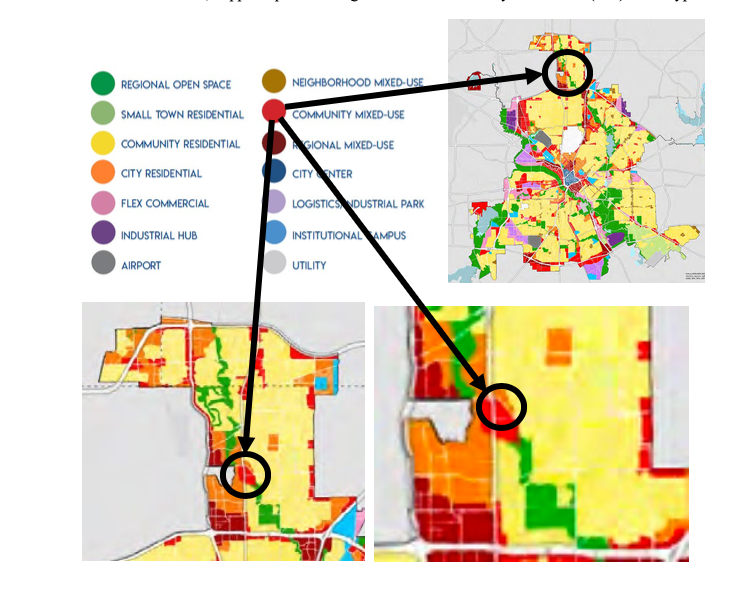
“[T]aller buildings with more and denser housing options are suited for Downtown Dallas, while shorter buildings with less focus on residential and more focus on community retail, restaurant, and personal service options are better suited for suburban areas,” the lawsuit states in its assessment of the comprehensive land use plan.
Readers may recall that during the fight over ForwardDallas 2.0, which was opposed by detractors over its perceived emphasis on pursuing greater density at the expense of single-family neighborhoods, officials stressed that the comprehensive land use plan was not a new zoning mandate but broad policy guidance on future development.
As previously reported by CandysDirt.com, a majority of Dallas City Council signed off on rezoning for the Pepper Square development at a contentious meeting on March 26. Dozens of neighborhood residents turned out that day to speak out against the residential component of the project, claiming the proposed 12-story apartment buildings would result in increased traffic and privacy concerns. While a number of individuals showed up to support the development, many in the opposition argued officials were running roughshod over the majority sentiment of the neighborhood.
Comments made by Council Member Paul Ridley (District 14) at the meeting were also cited in the lawsuit.
“This proposal does not fully align with ForwardDallas 2.0 goals of enhancing housing choice, affordability, and quality of life. Redevelopment should not be density for density’s sake. It should add value through thoughtful design,” Ridley said.
“We must also look to provide housing choice, including affordable units of housing. I am shocked that this development proposing 984 units, none of which will be affordable for people of lower income levels. Additionally, the comprehensive plan supports mixed-use, pedestrian-friendly development that blends residential and retail. This proposal is primarily residential and lacks the creativity and meaningful design that could maximize the site’s potential as a mixed-use hub,” he added.
The developer, Henry S. Miller Companies, opted to massage down its proposal from a proposed 2,300 apartment units to 868 and its maximum allowable building height to 165 feet (11-12 stories).

It is not immediately clear whether building height comes into play for “placetypes” — not zoning. When it comes to Community Mixed-Use placetypes, ForwardDallas 2.0’s only guidance says to “Taper building height and bulk in edge areas to transition to less intense development in neighboring areas.” It also advises that new development should “transition along the edges to nearby residential neighborhoods with landscaping buffering, complete streets, pedestrian pathways, and lower building heights.”
Speaking with CandysDirt.com, Matt Bach of the SAVE Pepper Square Neighborhood Coalition, said his group wants Pepper Square to be redeveloped, but that the residential component should’ve been negotiated down to something along the lines of several four- to five-story apartment buildings.
Referencing Council Member Jaynie Schultz’s support of the project, Bach said he thought the developer felt emboldened to advance it as is.
“So you don’t negotiate when you don’t have to, and that’s kind of where we ended up and how we ended up having this needlessly long, drawn-out fight over Pepper Square,” he said.

In a statement to CandysDirt.com, Greg Miller, president and CEO of Henry S. Miller Companies, said:
“Dallas City Council passed the rezoning after a full public process. The city followed a multi-year zoning review process, including traffic impact analysis studies and public hearings. We are hopeful that we will prevail and proceed with delivering an exciting new mixed-use development for the neighborhood to enjoy.”
At the May 26 council meeting, Miller said that the project wouldn’t be financially feasible without the density he was asking for.
CandysDirt.com reached out to the City of Dallas for comment on the lawsuit, but did not hear back by publication.
Correction: This article was updated at 11 p.m. on April 21, 2025, to correct the number of stories the Pepper Square apartment buildings will likely be.



As usual with this planning department, Pepper Square was proposed to have 12 stories so how did we get to 14 stories in a compromise at the hearing? The city negotiated with Henry S Miller. The neighborhood was left out of all discussions. The city planners would not communicate and share information with the neighborhood.
No poker house or Casino at Peppersquare develop
This entire boondoggle rests square on Jaynie Schultz. She was so obsessed with density and “taller is smaller” that she never relented on height. Anyone who drives by the sight and sees the houses and condos right next to Pepper Square understand what an invasion of privacy this proposal was and how it made absolutely no sense to put high rises in this spot. But Schultz could never be bothered with the little people aka her constituents and pushed forward anyway. And now, here we are, with taxpayers footing the bill for litigation. This was completely preventable had Jaynie chosen to work with neighborhoods and found a suitable compromise of 4-5 stories, mixed use.
Higher density housing always results in a shift of politics and demographics. Want your neighborhood to change forever? Cram it full of people. Want to make those people less invested in longer? Replace houses with apartments.
They need to stop wasting everyone’s time and attention. The sooner Pepper Square is redone, the better for all of them.
All they risk doing is souring the developer and creating another Valley View disaster.
It never went to 14 stories. It dropped about 20 feet in the final week, (probably 10-11 stories, depending on ground floor design) and 165(?) units were taken out as being an option. There was never talk of a casino. The idea of a boutique hotel was scrapped in year one.
The nearest neighborhoods and the Coalition were in regular contact with the city planners, councilmembers, the developer, and their consulting firm literally for years. We had to cycle out our negotiators, because unlike the professionals, the resident reps weren’t doing it as part of their day job. It was long, arduous, contentious, and exhausting, but had to be done with full commitment because it was/is that important to our neighbors and our community.
The height was a sticking point for 3 reasons.
1, if you spread 800 people out over 2-4 stories, that makes a lot of rooftops and pavement, and not much green space. Buildings that low don’t get parking garages, so you get surface parking like all the other aging complexes. Heat island doesn’t get any better. Taller buildings mean smaller footprints, which means more green space.
2, under 5 stories, apartment buildings are built of wood, which poses a greater fire risk and deteriorates faster – it’s got around a 20-year shelf-life. Over 5 stories, the building has to be steel. Safer, and far more durable. The taller towers can accommodate internal parking garages, which are safer and more desired by tenants (also 5x more expensive to build per space). Those garages were mandated in the deal. And those garages have to be wrapped by retail, so pedestrians have access to restaurants and shops, not just walls. More small storefronts. Each green space (park) has to be at least 50% bounded by public retail – think Hillcrest Village.
3. Higher floors mean higher rents. You can make as much income from fewer units, fewer people. Empty nesters downsizing or young professionals just arriving will have a reason to prefer the towers to the cookie-cutter apartments and condos around town. Something like 185 units have to be retirement living for at least 20 years after they’re built.
There’s a million reasons for all the myriad requirements in the final plan. Some, the city wanted. Some, the developer wanted. Some, the neighbors wanted. In the end, everyone got most of their goals, but not all. How much the missed goals bother them depends on which ones they valued most.
One thing is certain. If this development ever sees the light of day, the Spirit store is going to need a new place to pop up each fall.