
It Doesn’t Get Any Greener Than New Crescent Point Tower in Uptown
Share News:


With Earth Day coming up, it’s a good time to put a spotlight on one of the most environmentally friendly projects in the Dallas pipeline: Crescent Point Tower.
Dallas City Council approved rezoning for the 30-story luxury high-rise on March 26 after the City Plan Commission (CPC) unanimously endorsed the project. Crescent Point Tower will occupy the northern tip of The Crescent commercial development in Uptown, which is hemmed in by Maple Avenue, Cedar Springs Road, McKinney Avenue, and North Pearl Street.

City officials and local activists have celebrated the plan as a win for the environment and an example of “responsible urban densification.” The key to that designation is the developer’s decision to repurpose existing excess parking, a move supporters say will spare the environment considerable pollutants.
When The Crescent was first built in the 1980s, parking was built to code to accommodate the 1.3-million-square-foot office, luxury hotel, and retail complex. Apparently, all those existing spaces are still enough to support an additional residential tower comprising roughly 215 apartment units.

According to District 14 CPC Commissioner Melissa Kingston, some 1,800 tons of additional CO2 would be expelled if the project included more parking. For reference, it takes between 31 and 46 trees to offset 1 ton of CO2.

“It’s a significant amount of environmental savings. We’re not putting that CO2 and particulates into the air, and we’re not putting that debris that’s the byproduct of building that type of below-grade parking into our landfill,” Kingston said.
She credited the developer (Crescent Real Estate LLC) with taking the opportunity to reimagine the entire property so as to maximize the environmental impact by minimizing their environmental footprint.
“They are incorporating about twice as many trees as they’re required to under existing zoning, and they’re adopting what we call the habitat garden landscaping standard, which is something that we’ve been trying to get developers to adopt in the core of the city,” Kingston said.

Broadly speaking, habitat-friendly landscaping standards are guidelines that encourage or require developers to use native plants, trees, and environmentally friendly design elements. The goal is to create green spaces that support local wildlife, manage stormwater naturally, reduce pollution, and enhance overall ecological health in urban areas. Central to the idea is supporting native pollinators.
Dallas is situated in the Texas Blackland Prairies, which spans from the Red River down to San Antonio. Ian Seamans, the local City Hall advocate for the nonprofit Environment Texas, said that much of it has been ravaged over decades due to historic cotton farming and low-density development. Consequently, a lot of the plants (yellow indiangrass, big bluestem, little bluestem, tall dropseed) and wildflowers (gayfeathers, wild indigos, asters) native to the region have been eliminated.
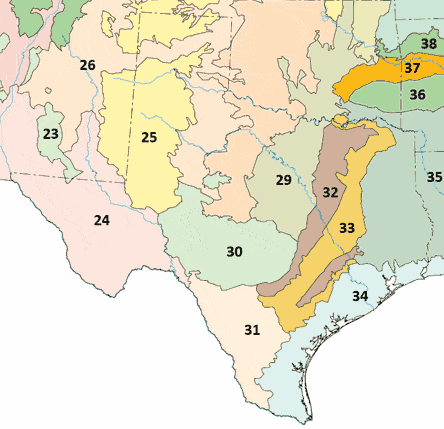

“They’re increasingly replaced with non-native varieties that just don’t have the ecological benefits of the native versions. Our insects and animals that are from here evolved to interface with plants they evolved along with,” Seamans said. “Having more native plants in developments is definitely something that we want to see more of. They have a really great ecological benefit for all our native pollinators.”
In addition to leaning into the region’s native vegetation, Crescent Point Tower will also feature an apiary, solar power elements, on-site water reclamation, and permanent protective habitats for pollinators.
Kingston agrees, noting how the protective habitats will give pollinators a fighting chance in the months when mowing and leafblowing vegetative debris will put them at a severe disadvantage.
“I was really heartened whenever they were talking about their native gardens. One of the best ways you can help the bees is actually to leave things like fallen branches and fallen leaves and stems and stuff to stand somewhere because that’s how our native pollinators — our native bees and moths — are able to overwinter,” Seamans said.

Crescent Point Tower will be constructed in accordance with at least a silver designation on the LEED rating system, which scores projects based on adherence to a number of environmentally friendly elements.
If all goes according to plan, these high-end apartments will come online sometime in 2027. The building will house ground-floor retail space and two outdoor dining areas and feature a new landscaped parkway on Maple Avenue.
2 Comments
Leave a Comment



LMAO
Is this a sponsored post? Yay – I am glad that they are planting more trees “than required”, but my god this is basically bowing down to the developer and kissing their feet. It’s reminiscent of the recent Trump cabinet meeting where everyone went around and told him how great he is.
Melissa Kingston must be getting paid – her quotes here are utterly ridiculous from a public official.
They are building a new building in a nice part of town. They made it nice to match the rest of the development.
It’s super cool that they don’t require more parking to be built – woohoo! A building in that much of an urban environment shouldn’t require much parking at all anyways.
Anyway – I want to see this level of celebration when anything is built in South Dallas. Go throw a party for Monte Anderson and all the other cool developers that are doing the hard work. Building a shiny new tower in Uptown is not difficult.