
Proposed Developer Fee Schedule Could Severely Limit New Parks in Dallas
Share News:

A surprise move by the City Plan Commission to reduce fees that developers pay the city caused consternation at the most recent Dallas Park & Recreation Board meeting, with board members claiming the reduction could imperil the city’s ability to buy land for new parks.
Admittedly, the intricacies of the controversy are a little convoluted so we’ll try breaking things down to the broad strokes that have deeply divided two of Dallas’ municipal bodies.
On one hand, the City Plan Commission (CPC) seems to believe it is worth drastically reducing certain developer fees that undergird spending on new parks — all in the hope that the savings would be passed on to renters. The folks at Dallas Park & Recreation, however, see CPC’s proposal as a straitjacket that could prohibit the development of new parks.
How Did We Get Here?
The issue stems from a CPC meeting earlier this month in which commissioners considered an update to the Dallas Development Code meant to bring the city in compliance with state law.
Last legislative session, state lawmakers passed House Bill 1526. The measure changed how municipalities with a population over 800,000 should assess “parkland dedication fees” for multifamily, hotel, and motel developments. Under HB 1526, cities can require developers to dedicate up to 10% of their project’s land area for park use, pay a fee, or both.
Specifically, parkland dedication fees are fees that real estate developers pay to a city or municipality to help fund parks and green spaces when they build new residential developments. Instead of requiring developers to set aside land for parks within their projects, many cities allow them to pay these fees, which go toward acquiring land or improving existing parks nearby.
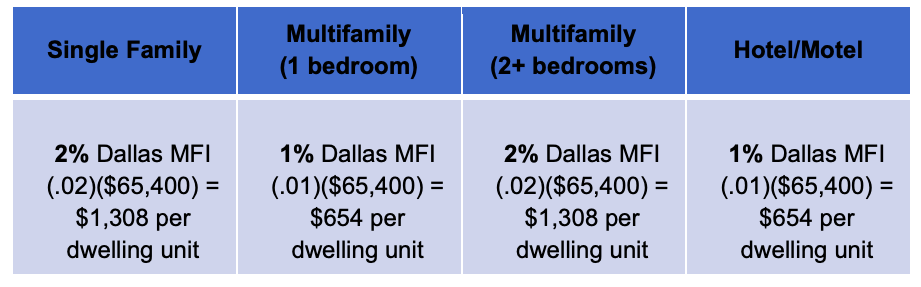
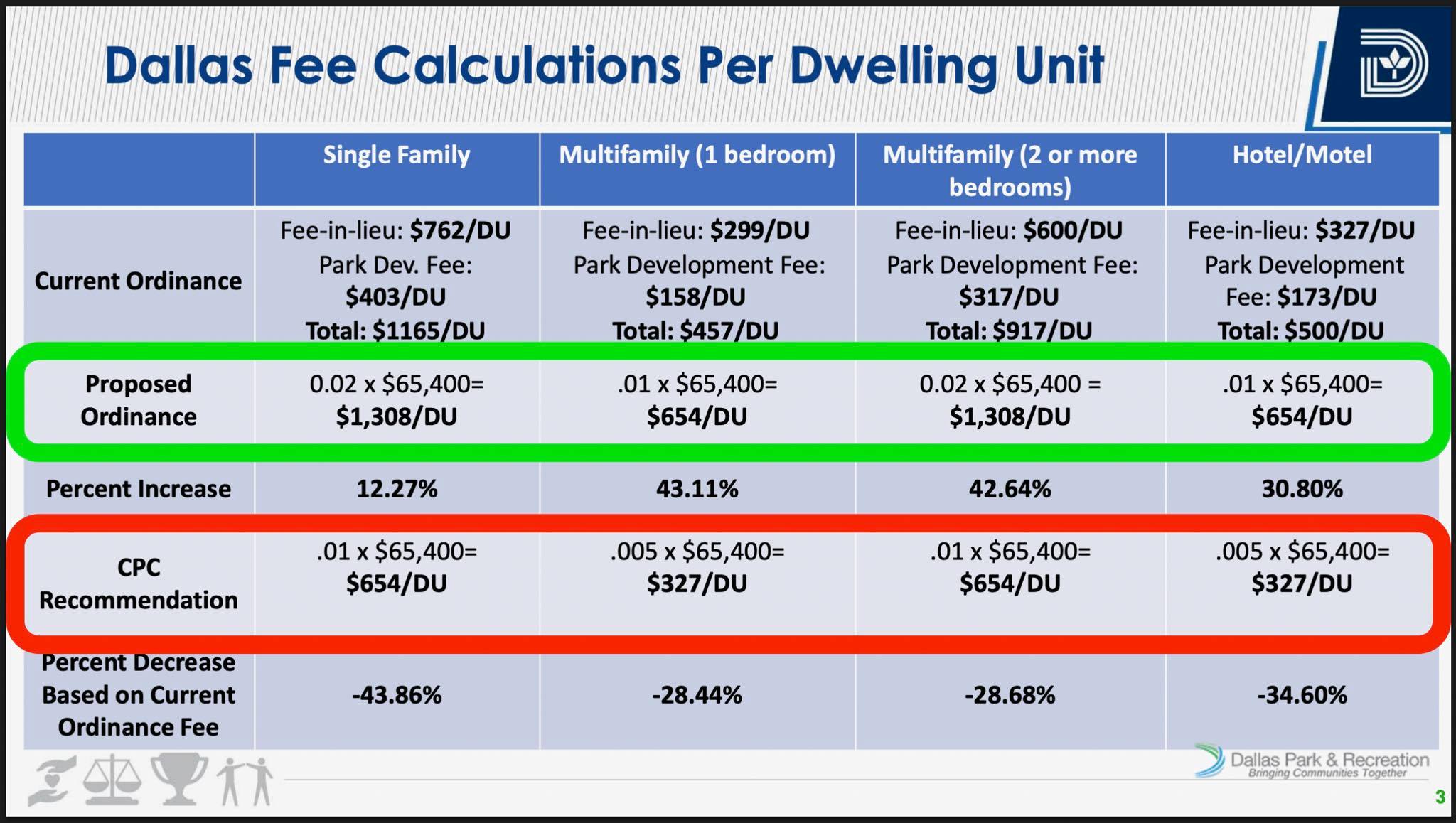
City staff worked to develop a fee schedule that abided by HB 1526, eventually landing on a flat fee formula that “allows the City to charge no more than 2% of the 5-year median family income average for Dallas. The 5-year median family income for Dallas is $65,400, so the maximum fee per dwelling unit Dallas can charge is $1,308.00.”
The fee schedule staff proposed (which was signed off on by the Zoning Ordinance Advisory Committee) was as follows:
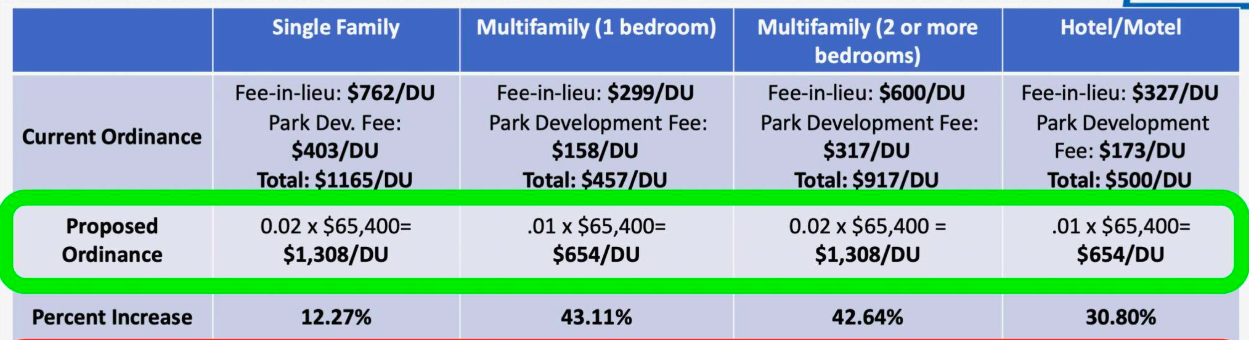
If implemented, staff’s proposed fee schedule would effectively increase how much developers would be required to pay in parkland dedication. Those funds are currently reserved for land acquisitions and improvements for parks in the park zones where the development is located. If those funds aren’t spent within 10 years of the fee payment, the money is refunded to the developer.
Commissioner Thinks Reduced Parks Fees Can Lead to Lower Rent
During CPC’s meeting on Feb. 13, District 1 Commissioner Christian Chernock proposed halving the fees on the proposed schedule, arguing that CPC was in a position to possibly alleviate housing costs by relieving developers of the effective fee increase.
“Today, what’s being asked of us is a 42% increase on an impact fee that’s going to increase the cost of construction that gets passed through to the renter and potentially buyer, but most likely a renter,” Chernock said.
As previously reported by CandysDirt.com, Dallas has a dearth of affordable rental units and single-family homes. Population growth and limited housing production have put considerable upward pressure on housing costs in the city, leaving some prospective renters and first-time homebuyers priced out of the market.
“At the end of the day, [the proposed fee schedule] moves the needle in the wrong direction on the backs of renters who are already squeezed to the limits, and we have an opportunity to do something about it right now,” Chernock said.
The commissioner’s motion to reduce the proposed parkland dedication fees passed.
Steep Cut to Parks Fees Prompts Call to Action
Members of the Dallas Park & Recreation Board were briefed on the amended proposed ordinance on Feb. 20.
Park & Recreation Assistant Director Ryan O’Connor told the board that the fee schedule passed by CDC would severely restrict the department’s ability to acquire land for new parks because insufficient fees would accumulate within the 10-year refund window.
“We will probably have to strongly consider including meaningful land acquisition dollars in future bond programs because we won’t really be able to rely on this funding mechanism,” he said.
Park & Recreation Director John D. Jenkins added that little money for parkland acquisition was put into the 2024 bond program because of the presumed parkland dedication fees.
Board members expressed their surprise and dismay over CPC’s decision to halve the fees, with many lamenting how the commission overrode the collaborative process between planning staff, park staff, ZOAC, and the development community.

District 9 Commissioner Maria Hasbany called CPC’s move “shocking.”
“We’ve seen so much progress through the mayor’s initiatives, you know, to have more green spaces in our city,” she said. “We’ve worked very hard on this small mechanism that will allow development to put some money into the very important process of maintaining, preserving, and creating more green space.”
Board members went on to discuss crafting a resolution in support of the original proposed ordinance with the fee increases. They also resolved to lobby their respective council members.
“I think like all board members, I can say this is appalling,” Board Chair Arun Agarwal said, calling the proposal a step back.
The next step for the proposed fee schedule is a hearing before the Parks, Trails, and Environment Committee. The Dallas City Council can overturn CPC’s amended proposed ordinance with a three-quarter vote, according to Park & Recreation Department staff.
6 Comments
Leave a Comment



It seems that some commissioners may not have fully understood the implications of their decision. I, myself, was not completely aware of the extensive process behind the proposal. I have conveyed my support for the original recommendation to my councilman and will strive to foster a more collaborative relationship with my park board member. I do believe the public access amendment is important as private parks minimize public benefit but the 50% cut across the board is too extensive and D3 has already given too much.
This is bizarre that so much media has been focused on this today both here and on Twitter. The City and the parks department has NEVER SPENT ONE CENT of the money collected by this program! Period! Not a single dollar from this program has ever been used to build a park! And our parks are doing just fine
If they need the money so badly, and don’t want this tax cut back, why don’t they spend the money that’s been collected from this program for over a decade that has just sat there collecting dust! It totals over $10 million to date. (Compared to $300M+ they just got from the taxpayer voted bond last year). This is not a truthful telling of the story.
Can we use it to shore up the police pension?
My fear with Prop S (or U, whichever) – is that you would have no choice but to do so! Then this money doesn’t really go to Parks at all
Not true! For example, The Park department used the Park Land Dedication money to purchase a 2 acre plot of land next to Bachman Lake for a much-needed parking lot for the new aquatic center and skate park and council district 6.
No.