
Dallas ‘Housing Needs Inventory’ Highlights 3 Primary Factors in the City’s Affordability Woes
Share News:

New data released Monday shows that Dallas has increased its net housing supply by just 5% since 2017. These modest gains coupled with rising home prices and a lack of “missing middle” housing are part of the familiar refrain for Dallas’ affordability woes. The key takeaway isn’t that Dallas is fumbling in the dark as homeownership and renting become farther out of reach; it’s what city leaders are going to do about it.
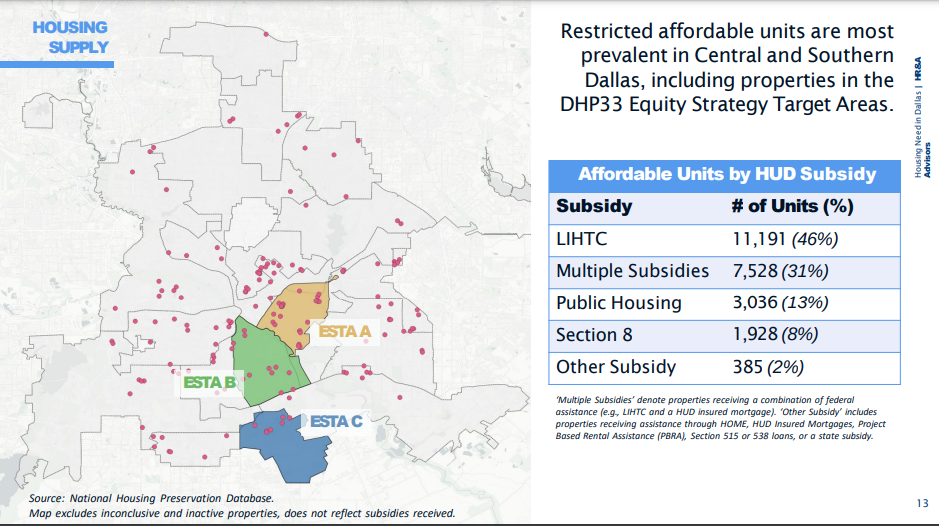
Representatives from HR&A Advisors, the Child Poverty Action Lab, and the Dallas Housing and Community Development Department presented a 33-page “housing needs assessment” Monday to the City Council’s Housing and Homelessness Solutions Committee.
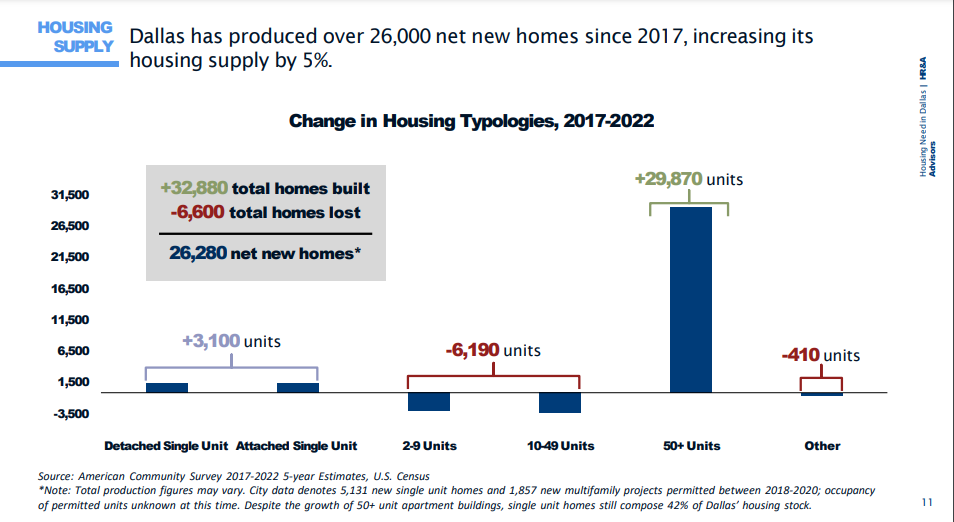
The report found that Dallas built over 26,000 net new homes since 2017. Seems like it should be more? Census figures show 32,880 new homes were built in Dallas, however, 6,600 homes were lost or torn down. The chart below shows what types of homes were gained and lost.
The Dallas City Council has expressed an interest in providing more homeownership opportunities to local residents; however the majority of Dallasites are renters, and the transition to homeownership is plagued with affordability barriers.
How Did We Get Here?
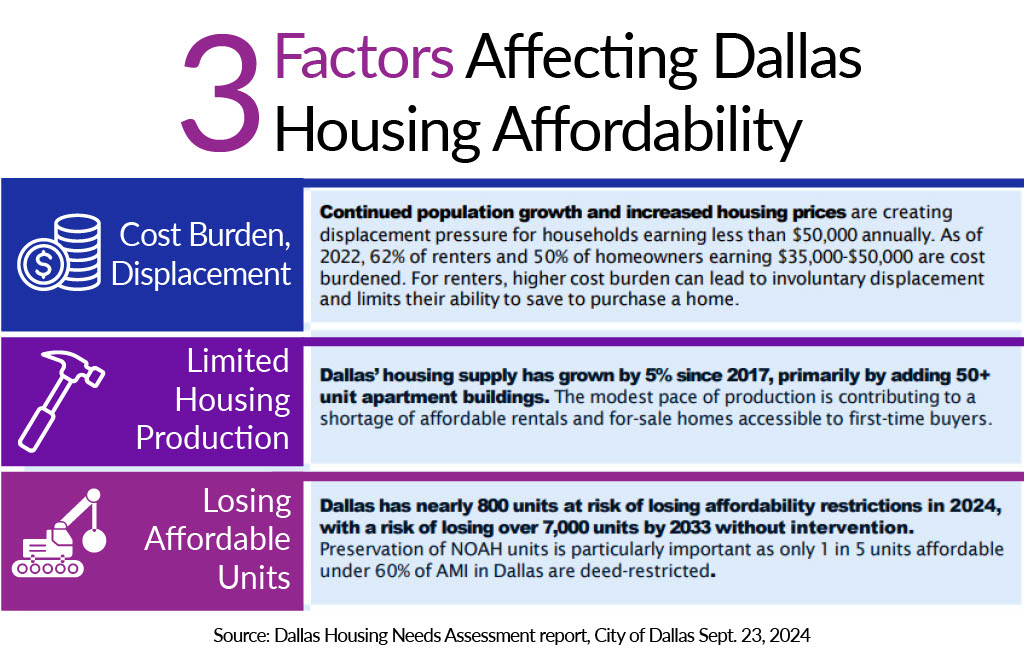
The report cited several familiar factors that are influencing Dallas’ housing affordability crisis:
A Need For ‘Something Visionary’
Housing Director Cynthia Ellickson reviewed the federal programs that the City administers. Such programs, said North Oak Cliff Councilman Chad West, are not a long-term strategy to promote homeownership.
“When is the city manager going to realize we cannot fix this housing crisis sitting in this horseshoe by ourselves?” he said. “We have got to welcome in outside help to do this, whether that is a development corporation or something else. It can’t be fixed by us sitting here passing federally funded programs … We need to do like an Invest Atlanta or something visionary, bringing in the private development community, public stakeholders, and our other public partners to help us do this.”
West also pressed city staff on when an implementation plan for Dallas Housing Policy 2033 would be rolled out. Assistant Director Thor Erickson said it could take a couple more months because they first wanted to see the data compiled by HR&A and CPAL.
“We don’t want to put something out that could contradict something else,” he said. “There’s a lot of conversations that have been happening to make sure that our work in the housing department to invest in the production and preservation of affordable homes could be really aligned with a data-driven process.”
West appeared anxious to move the process forward.
“At some point, we’ve got to come together and actually have an implementation plan and just start moving forward because what we’re doing now is shooting in the dark,” he said. “We’re passing [Public Facility Corporation] projects. We’re passing [Housing Finance Corporation] projects. We know we need it all but without working toward a North Star, I just don’t think it’s completely responsible. This whole policy implementation rollout, compared to the Economic Development Policy, is really going at a snail’s pace. I’m disappointed it’s taken so long.”
Housing Burdened Households
When the conversation turns to affordability, a sub-discussion often arises about living wages. People have difficulty living in Dallas — and 80% of large counties in the U.S. — because they don’t make enough money, according to a July ATTOM report cited by CBS News.
“Homeowners are typically advised to spend no more than 28% of their wages on housing, and anything above that level is considered unaffordable,” the report states. “But ATTOM found that the average homeowner, with a typical annual income of $72,358, pays $2,114 a month for housing — that means about 35% of their pay goes to housing costs.”
Far North Dallas Councilwoman Cara Mendelsohn noted that, according to the HR&A report presented Monday, the Area Median Income is lower in the City of Dallas than in Dallas County and Dallas County is lower than the DFW metro area.
“Do you think it’s incumbent upon Dallas to provide affordable housing to every single person here?” she asked the presenters.
‘We Have Affordable Housing’
Mendelsohn implied that there seems to be a fear that potential residents will have to go to a neighboring city to find affordable housing.

“I’m going to say, ‘No, come to District 12.’ We have affordable housing below 80% [AMI] available today less than a mile from my house,” she said. “It is literally mixed-income, good schools, transportation, jobs, [and] grocery stores, every single thing we talk about, available today.”
Some buyers could stay within the city limits but they may not be able to afford a home downtown, she added. The councilwoman has repeatedly pointed out that Dallas continues to invest in apartments for the 80% AMI and up “when we have a very clear, demonstrated need [in] the lower income bands.”
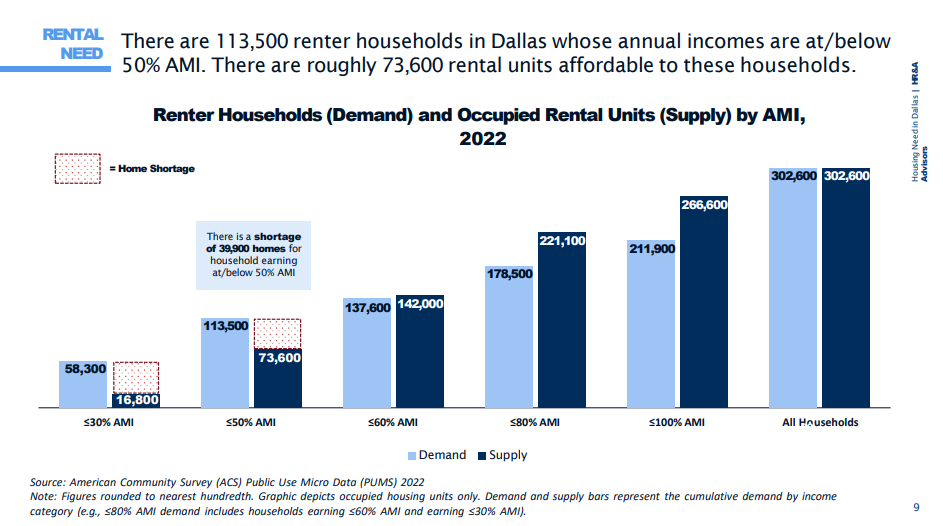
Ellickson said she believes the City’s limited resources should be focused on areas where gaps need to be filled: households at or below 50% AMI and homeownership.
Where Are People Moving?
Councilman Zarin Gracey asked for data specific to his southern Dallas district.

“What is the growth rate for District 3 so we can see where people are moving, so that can help us determine [if] these units really need to be going here or are they just putting them here because there’s an opportunity of land?” Gracey said. “It helps us determine what our needs are and how we can contribute.”
Erickson said staff would provide data broken down by district across the city.
“We really will look for your expertise on your districts to make sure what we’re presenting is accurate,” he said.

Preston Hollow Councilwoman Gay Donnell Willis said the report “speaks loudly to the need for economic mobility.”
“I’m so appreciative that we have our ISDs and community colleges that are helping with that, but the reality is what’s in the marketplace that could lead to homeownership,” she said. “This illustrates what a gap there is and how much you need to earn to even be able to get to that first step.”
Preserving Existing Affordable Housing
Councilman Jesse Moreno, who chairs the Housing and Homelessness Solutions Committee, said he wanted to ensure that the data being analyzed is consistent and accurate.

“My priority is preserving affordable housing that’s in stock today,” he said. “I have an apartment complex on Live Oak right now that’s about a 25- to 50-unit affordable apartment complex that’s being replaced by a 327-unit luxury apartment that is displacing individuals. We talk about homeownership and we talk about individuals who have lived in their homes for generations that are being displaced … and where do they end up moving? They end up moving to those same cities that we talked about earlier, into our suburbs. I want to make sure we stay committed to home ownership and affordability.”
1 Comment
Leave a Comment







Housing is like any other thing that folks must pay for. If you want a Mercedes, you cannot just complain to the City and expect it to appear in your driveway. Somewhere, people have become dependent on everybody else to give them what they believe is their right, apparently because they were born. If Dallas in the North is too expensive, then their remedy is to move to the South. If prices are too high in the East, then the West may be a better alternative. See, problem solved.