
Dallas Council Could Revisit Short-Term Rental Ordinance: ‘It’s Not Working’
Share News:

Short-term rentals are operating legally within Dallas neighborhoods while the matter is under legal injunction but the action approved by the City Council in June 2023 is punishing good operators and “isn’t working,” Councilman Chad West said during a Monday meeting of the Quality of Life, Arts, and Culture Committee.
Last year the CIty Council banned short-term rentals in single-family neighborhoods, providing a six-month deadline for operators to ensure they were in compliance or shut down. The Dallas Short Term Rental Alliance sued the city in October of last year, as expected, and in December was granted an injunction allowing STRs to legally operate in residential areas.
Dallas appealed the ruling in January, A non-jury trial was set for June 3 but didn’t happen, reportedly due to a backlog in the court docket. Then an appellate court hearing was set for Sept. 10, but that didn’t happen either. Some say the matter could be tied up in the legal system for years.
Dallas Deputy Chief of General Litigation Andrew Spaniol said Monday that oral arguments could be heard in October.
West pointed out that because STR properties are increasing and hotel tax revenues are decreasing, less money is going toward tourism and arts. Operators can’t be forced to register while the litigation is pending.
West said he voted against the ordinance last summer because he thought it was heavy-handed and his opinion hasn’t changed. Assistant City Attorney Casey Burgess confirmed that if the council wants to revisit the matter, they can file a five-signature memo to bring it back up for discussion.
“I understand we definitely need the ordinance,” West said. “They’re running rampant in my neighborhoods and we’ve got to get them under control, but this current ordinance that we passed punishes everybody, the good operators and the bad ones. It’s put several small business owners in my district out of business, including housekeepers and folks of that nature. That piece is never discussed. We just talk about the problems. We don’t talk about the good things that came along with this. Frankly … what we are doing is not working. The courts agree with that fact. As the STRs increase, our hotel occupancy tax goes down. It’s not working. We need to reconsider it.”
View the staff PowerPoint presentation on STRs or watch Monday’s Quality of Life Committee meeting.
STR Complaints
Director of Code Compliance Chris Christian said since the STR ban was approved over a year ago, about 160 nuisance complaints have been lodged against properties, with the most occurring in District 14 (downtown, uptown, and portions of East Dallas), District 2 (Deep Ellum, Old East Dallas, and the Medical District), and North Oak Cliff. The data does not include 911 public safety calls.
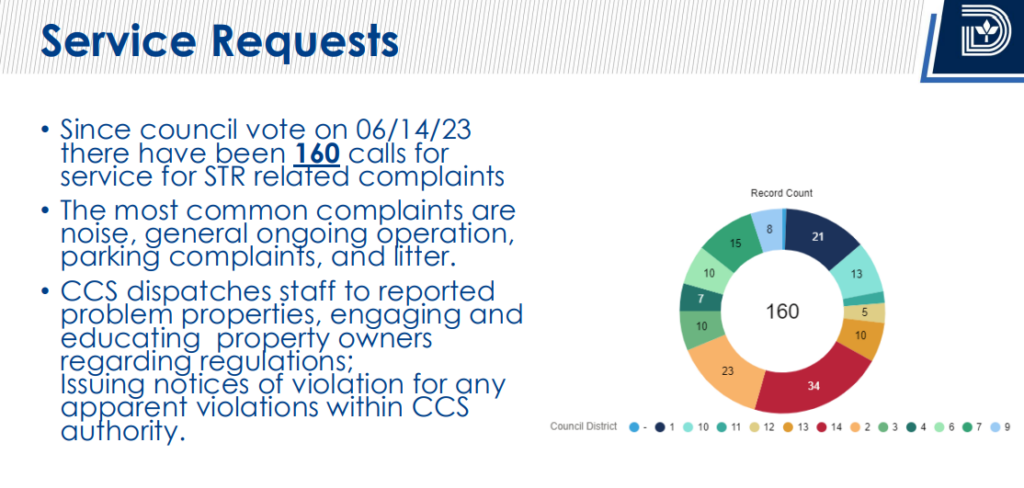
“Because of the ongoing legal injunction, enforcement of short-term rental ordinances is currently on hold,” Christian said. “This has prevented Code Compliance from legally registering any properties for operation during this time.”
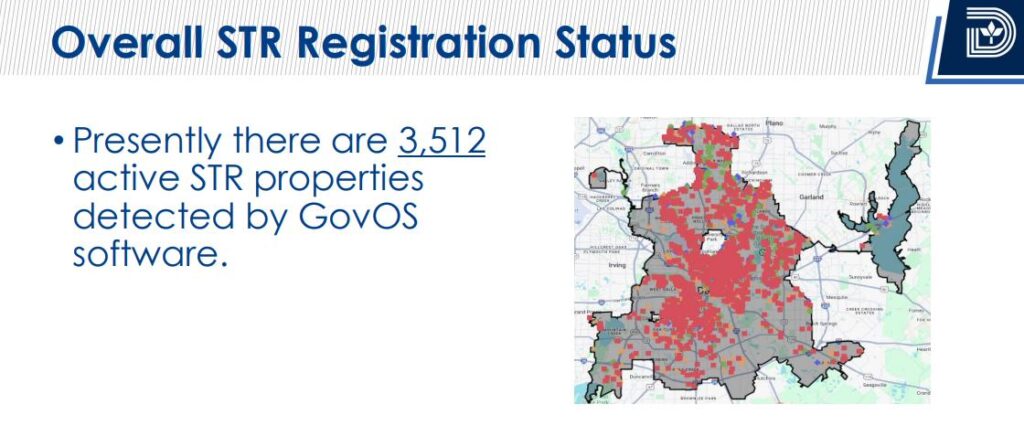
About 3,512 active STRs exist in Dallas. Operators are required to collect a 9% hotel occupancy tax from guests.
From June 2023 to July 2024, STR operators have contributed about $3.9 million in HOT. That figure was about $3.8 million for Fiscal Year 2023.
“One of the key challenges is ensuring that all potential STR owners respond to the city controller’s request to register and remit their taxes,” Christian said.
Councilwoman Gay Donnell Willis represents the Preston Hollow area where some STRs are operating illegally under improper land use.
“The number of potential STRs that are not registered is growing,” she said. “We’ve got to pay attention to that.”
Council Feedback
Councilwoman Jaynie Schultz pointed out that if the City prevails in the lawsuit, a significant amount of revenue will go away because the STRs operating now within residential areas and paying HOT will be deemed illegal and shut down.
Councilwoman Paula Blackmon asked about expenses related to STRs and noted that the City has been in a “holding pattern” for over a year while the matter is in litigation.
Christian said an initial $1.3 million was invested to stand up the Code Compliance STR enforcement team. The annual cost to maintain the program is about $650,000.
Deputy Mayor Pro Tem Adam Bazaldua said it appears that Dallas is “in a worse place than where we were before.”
“I know that litigation has hamstrung us to enforcement,” he said.
Christian explained that Code Compliance can’t currently enforce codes under Chapter 42B, which would allow his staff to address nuisances in neighborhoods late at night and cite both the property owner and the person causing the nuisance.
The number of nuisance calls — 160 out of 3,500 properties — is minuscule, Bazaldua said, adding that he supports regulation rather than a blanket approach that punishes everyone.
“I’m curious to see if there are repeat offenders,” he said. “If we were doing regulation, it would allow us to revoke permits for those who were repeat offenders. I’d like to see where the city would be able to cease operation and get rid of the actual problems that exist and not impact the other 3,300 units that are registered.”
The councilman added that the data is eye-opening to the fact that Dallas is not doing enough.
“The reality is, even if we do prevail in the lawsuit, what we currently have on the books is not providing the relief that is going to be necessary,” he said. “It’s not only going to disproportionately impact those who are good actors in the industry, it’s also going to make it very hard for our city resources to actually address the issue. I think it’s going to make y’all spin your wheels for thousands of properties out there that are going to be pushed into the black market.”






This is District 1 Council Member Chad West’s second round of attack on single family neighborhoods after being the instigator of the infamous 5-signature memo re: “gentle” density and ForwardDallas 2.0. I used to support him but I don’t plan to next May when the election comes.
Councilmembers West & Bazaldua’s push to revisit the STR ordinance seems very premature. It’s “not working” because it’s been tied up in court & hasn’t been given a *chance* to work. Hopefully, the hearing appealing the injunction will take place in October. Council needs to let the court case play out.
If Dallas prevails in its appeal, Bazaldua’s concerns about the impact enforcement will have on city resources are completely unfounded. As written, the Dallas STR ordinance allows the city to go after platforms for collecting booking fees on STRs w/o permits. This type of platform accountability forces the platforms to remove listings w/o permits. Other cities with similar ordinances have been able to achieve high compliance rates w/o placing an undue burden on city resources. https://dpo.st/3HbCAAp
Despite the temporary injunction, data from Inside Airbnb shows the # of STRs in Dallas is currently 4912, down from over 5600 at the time the ordinance was passed, so the mere act of passing the ordinance seems to have encouraged STR investors to go elsewhere. https://insideairbnb.com/dallas/