
Why Glenn Kelman’s Exit Marks a Turning Point for Redfin
Share News:


Redfin’s longtime CEO Glenn Kelman is stepping down — and on its face, that’s not the kind of executive shuffle that would necessarily rise to the top of CandysDirt.com’s news stack. But context matters.

When Rocket Mortgage announced last year that it was acquiring Redfin, the most revealing part of the deal wasn’t the price tag or the integration strategy. It was the unusually candid blog post written by Redfin CEO Glenn Kelman himself — a piece that read less like corporate boilerplate and more like a founder explaining, in plain language, why the independent Redfin era was coming to an end.
Kelman’s departure comes six months after Redfin completed its $1.75 billion acquisition to Rocket Companies. His last day is Friday.
Kelman had led Redfin since 2005, when the company was just three people in an apartment, shaping it into one of the most recognizable — and disruptive — brands in residential real estate. Under his watch, Redfin pushed salaried agents, tech-forward transactions, listing refunds, and a brokerage model that frequently made traditional agents bristle, even as consumers flocked to the platform.

Which is why his resignation now lands differently than a routine CEO exit.
In a note posted on LinkedIn titled “Unemployed, In Greenland,” Kelman said he’ll look for something outside of real estate for his next opportunity.
“I gave it my all!” he wrote.
“Redfin and Rocket are the future. And America has never needed that more. We’re the only real estate company to take full responsibility for our customers, from click to keys,” he continued.

Kelman isn’t just leaving a job. He’s exiting the company at the precise moment Redfin is being folded into Rocket’s broader vision of a fully integrated homebuying ecosystem — search, brokerage, mortgage, and title under one corporate roof. Some may call that consolidation, but his departure signals the end of the founder-led chapter and the beginning of Redfin’s next life as a Rocket subsidiary, with all the strategic shifts that it implies.
For local Redfin agents and competing brokerages, this matters. Leadership changes at this level bring inevitable questions about whether changes in fee structure, technology priorities, and agent relationships may follow. Redfin’s incoming interim CEO Varun Krishna addressed those concerns in an email to staff, obtained by GeekWire, while also sharing his thoughts about Kelman’s leadership and friendship on LinkedIn.
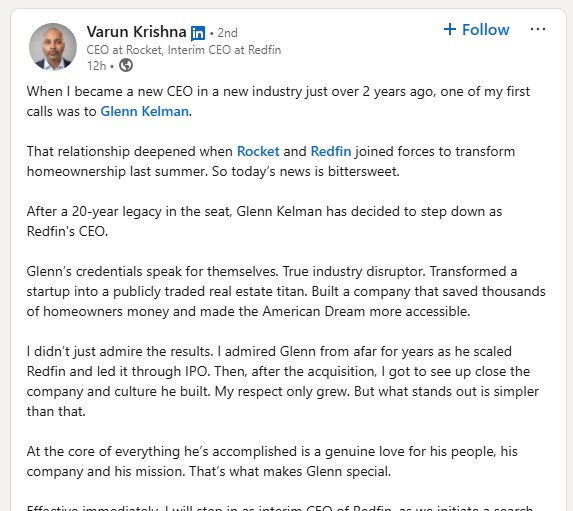
“We are betting big on Redfin’s future,” he wrote in the staff memo. “More investment in brand, hiring, traffic growth, and innovation. We will aggressively play to win, with the full strength of Rocket behind this team.”
Krishna added: “Redfin is on the precipice of one of the most exciting transformations in its history, and we’re leaning into it.”
It also marks the loss of one of the real estate industry’s more distinctive executive voices. Kelman was unusually willing to publicly critique industry practices, MLS policies, and even his own company’s missteps. That kind of transparency is rare in a business that often prefers talking points over plain talk.
And as the real estate industry continues to consolidate, the move toward one-stop-shop platforms raises a familiar question: who benefits most from that convenience?