City Hall Roundup: Runoffs, High-Speed Rail, Police Academy
Share News:

Two more new faces will be joining council members at the horseshoe in Dallas City Hall after runoff elections were held on Saturday.
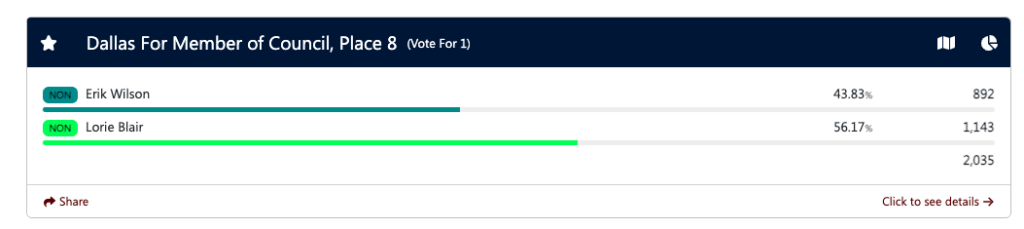
As of 10 p.m. last night, District 8 candidate Lorie Blair and District 11 candidate Bill Roth were leading their respective races by significant margins.
Blair was clocking about 56.2% of the vote compared to the roughly 43.8% earned by Realtor Erik Wilson, setting her up to assume termed-out Council Member Tennell Atkins’ seat.
Issues like inequities in city development and the need for more affordable housing featured heavily in the race, with many neighborhoods in the southernmost city council district in Dallas suffering neglect from the kind of private investment driving economic growth in other parts of the city.
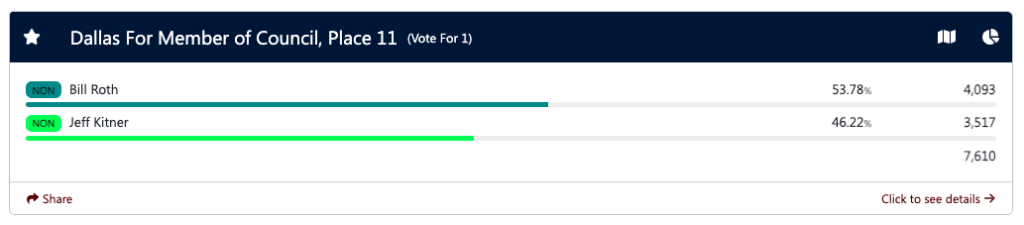
Roth was leading Jeff Kitner 53.8% in what could be considered a slight to incumbents, even though there was no incumbent in the race. Multiple council members, including at least Jaynie Schultz and Paula Blackmon, appeared at polling locations over the course of the runoff to lend Kitner their support. Meanwhile, Council Member Cara Mendelsohn supported Roth.
The District 11 race was animated by community uproar over the controversial Pepper Square development, which critics claim was just another example of city officials running roughshod over resident opposition.
High-Speed Rail Study Drops
On Monday, the Economic Development Committee discussed a city-commissioned report on the potential economic impact of the proposed high-speed rail between Dallas and Houston. The report claims Dallas could see an additional $3.5 billion in annual GDP and 20,000 jobs between 2029 and 2050 if the project goes forward.
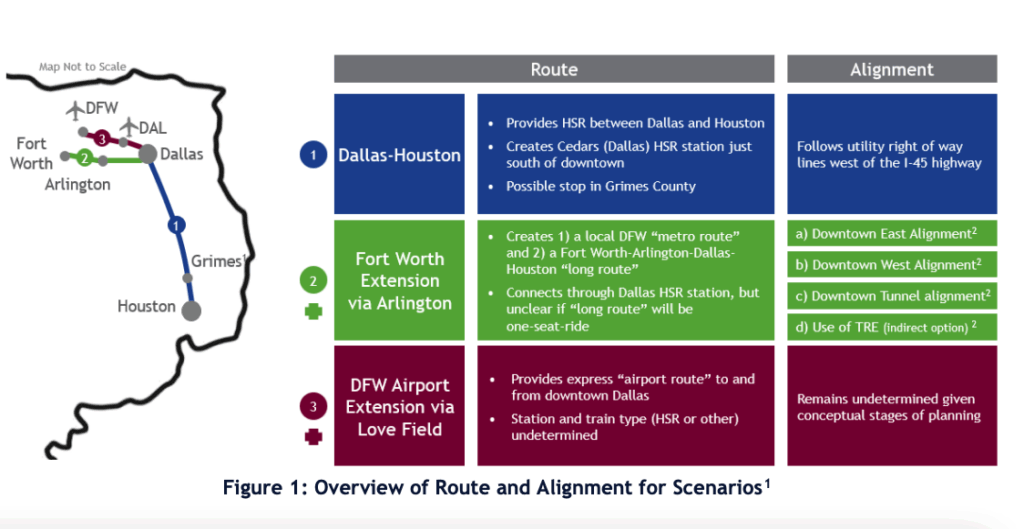
Economic projections assume the high-speed rail yields around 4.3 million riders annually. There are three possible routes at play, the longest of which could extend to Fort Worth.
Federal financial support of roughly $64 million was rescinded by the Trump administration in April, with officials arguing that private investment should be taking the lead on advancing the project. The U.S. Department of Transportation determined the high-speed rail could cost as much as $40 billion.
“The Texas Central Railway project was proposed as a private venture. If the private sector believes this project is feasible, they should carry the pre-construction work forward, rather than relying on Amtrak and the American taxpayer to bail them out,” Transportation Secretary Sean Duffy said at the time, according to The Texas Tribune.
Council members on the committee, while encouraged by the projected economic impact, were wary of the project’s viability in the absence of considerable taxpayer dollars supporting it.
“It would be a first in world history that a transit system was fully supported just on private funding,” said Council Member Paul Ridley (District 14), per The Dallas Morning News.
The economic impact report commissioned by City Hall includes a section on the implications for Dallas real estate at the station site and along the railway line:
“The HSR station would increase property values and development in the surrounding area in three ways. First, HSR would simplify travel and make properties within walking distance of the station more desirable for both residential and commercial use. Second, passenger traffic would generate spending and activity that further real estate premiums and investment, with more expected impact on retail and hotel properties than office or residential properties. Third, the station and new development around it, offering desirable amenities and attractions, may create a positive feedback loop, including foot traffic key to the long-term success of transit-oriented development.
“The railway line may impose some negative externalities, including noise and vibration during construction and operation, impairments that diminish views and light, and disruption when land parcels are divided or require demolition. Although construction-related impacts are temporary, they may lower surrounding property values until the project is completed.”
New Police Training Facility Set to Cost More and Start Construction Later
Officials at City Hall are grappling with significant cost increases and schedule setbacks for the planned replacement of Dallas’ outdated police training campus.
First approved by voters in May 2024 in a bond election, the facility originally had a budget of about $140 million. That figure has now swelled to approximately $275 million, according to a staff presentation the city council received on Wednesday.
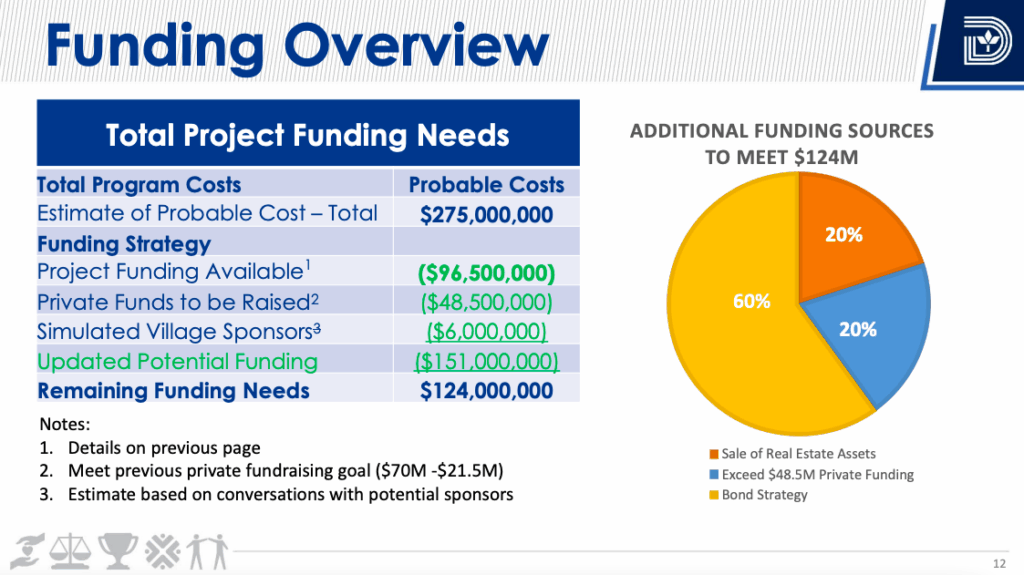
The proposed development includes a 20-acre Law Enforcement Training Center on the UNT Dallas Campus (estimated at $185 million) and a 60-acre public safety facility with vehicle-pursuit tracks and a shooting range (around $90 million).
Council members will consider the beefed-up expenditure at their June 11 meeting at City Hall. The presentation notes, however, that on top of being more expensive, the project is also behind schedule.
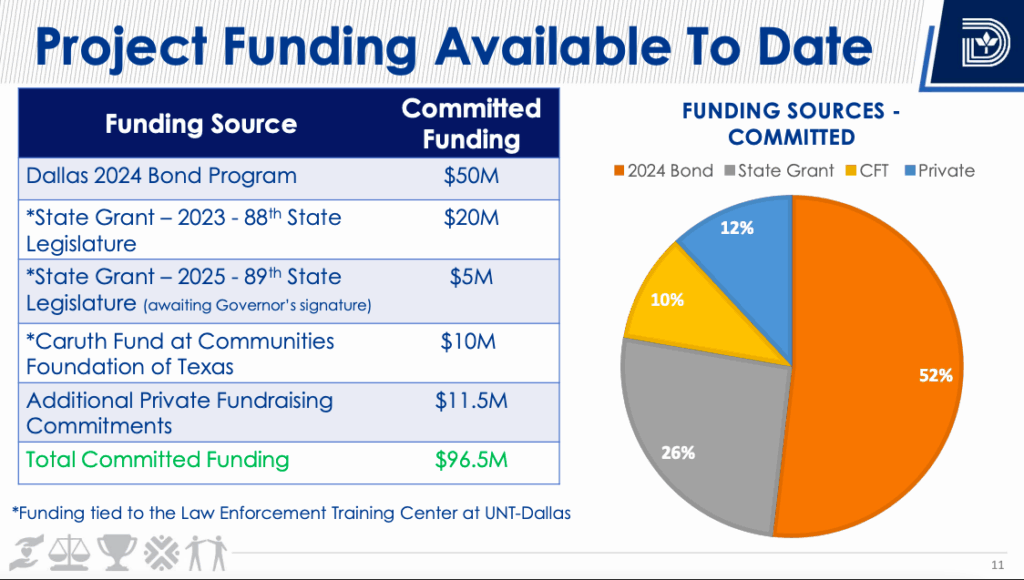
The city has already secured $96.5 million through existing allocations, $25 million from the state, and $21.5 million in private commitments — putting the project short around $124 million.