
Billionaire Andy Beal Withdraws Zoning Request for Highland Park’s Tallest Residential Feature
Share News:


By the looks of it, billionaire Andy Beal has withdrawn his request to build the tallest residential architectural feature in Highland Park, days before it was set to go before the Town Council on Feb. 4. The request had cleared the zoning board with a 3-2 vote after Beal’s representatives appeared before the board Jan. 23. Beal withdrew the request on Thursday.
You may recall that Beal attempted to remodel and expand an architecturally significant Beaux Arts mansion located at Preston Road and Armstrong Parkway. Following months of work, the Rose Lloyd/Edwin Cox mansion was ultimately demolished.

But let’s dig in because we know you want the dirt. I went to the zoning meeting last Thursday. I’ve never attended such a civilized hearing of any kind. There were no t-shirts showcasing opinions and no raised voices, just cheerful greetings, and hugs all around the room. I half expected to see wait staff coming by with cocktails. Don’t get me wrong, there was certainly passion displayed, but it was ever so polite. I’m glad I arrived early because, by the time proceedings began, it was such a packed house that staff had to bring in additional chairs.
65-Foot Features
Beal’s legal team submitted an application to amend the zoning ordinance that allows architectural features in the “A” zoning district to reach a height of 65 feet. Right now, the ordinance allows for a height of 45 feet, with an additional 10′ for architectural features like a spire, cupola, or turret.
The “A” zoning district is only a few homes. There are six properties zoned as such and only four meet the 5-acre minimum. So, if I understand it properly, the proposed ordinance, had it been adopted, would have only affected four properties.
Let’s break this down further. You may need a calculator and a large adult beverage.
There was a lot of discussion about percentages and a few alarming observations. One zoning board member theorized that Beal’s ask could allow a 12,000-square-foot feature atop the house, though, the actual request was for 3,000 square feet.
Considering the mass of the home, it did not seem unrealistic, but the very pointed question asked was, “Why was an extra 10 feet necessary?” Seriously, if you are one of the best architects in the world, and of course, you know the ordinance at the outset of the project, why not mind the rules?
Ordinance or Variance?
As neighbor David Toomey remarked, “Why create an ordinance for a specific property? It should not be about a specific property but what is right for the community.”
Another member asked why an ordinance would need to be rewritten instead of simply creating a variance for one property.
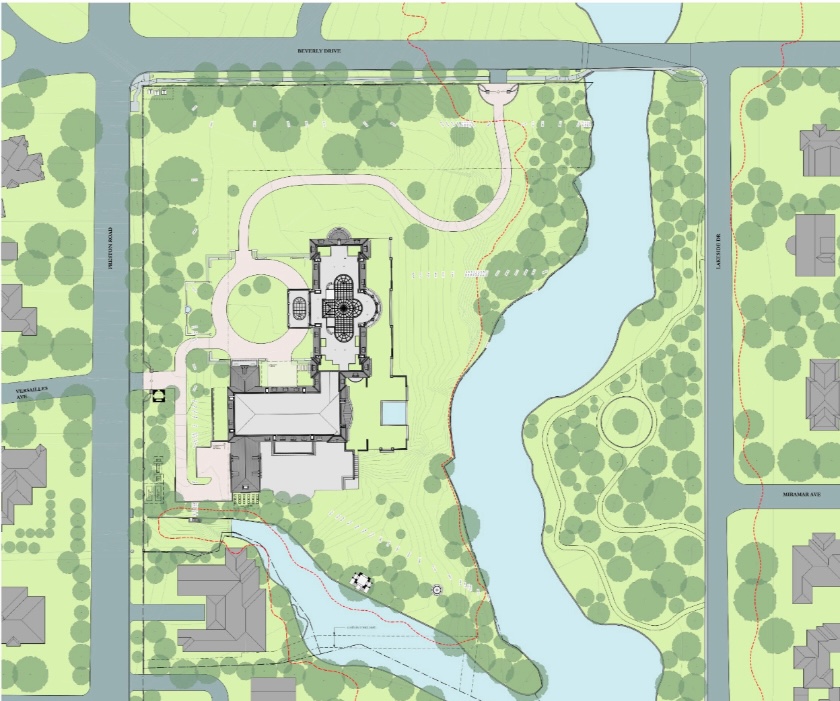
There were additional worries over the privacy of neighboring properties, glare from the structure, and potential floodlight issues.
Larry Good spoke on behalf of Preservation Park Cities and reminded the board that the current height permissions are the most generous in any single-family residential district in the region.
“Even with trees, the 65-foot scale is not compatible with properties on Lakeside. Zoning changes would set a precedent on Armstrong Parkways along Lakeside and other locations in Highland Park.”

Architectural Integrity
Beal’s team was prepared with an impressive presentation, and his esteemed New York (and Texas-registered) architect Peter Pennoyer, who is regarded as one of the world’s finest classical architects, was in attendance.

Allaying privacy concerns, Beal’s representatives offered drone shots to show that no neighbor would have their privacy compromised. The architect Pennoyer spoke before the board, assuring members and those in attendance that Beal was willing to not only invest in a beautiful home but also in moving the existing monumental trees around.
And the question of why the estate would need an extra ten feet? Representatives said without it, the architecture would be compromised. If disbelief were a color, most in the audience would have been wearing it.
“I would say that as it relates to the architecture of the home, we worked with the architect, and the team worked diligently to stay within the 55 feet, and it compromised the architecture, the mansard roof, and the ceiling heights to accomplish what the owner wants from a design perspective, Beal’s representative Moshe Itzhakov said. “We are not claiming any kind of hardship.”
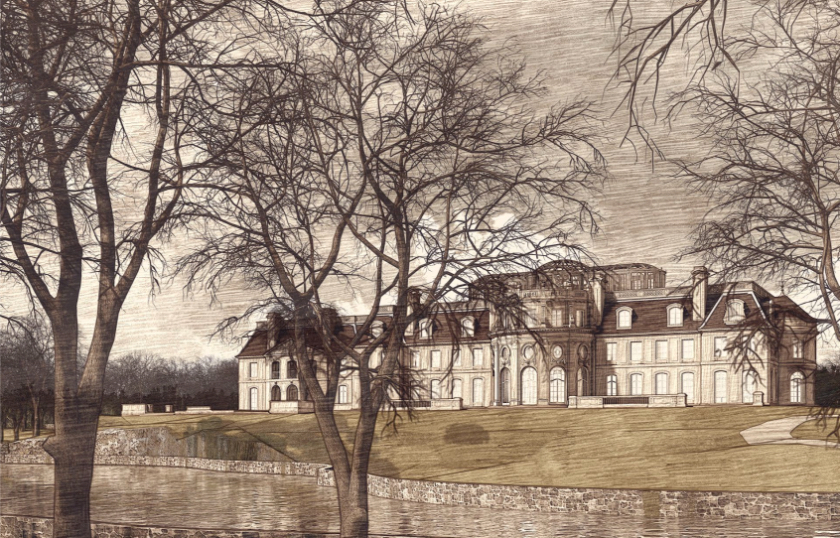
“We are trying to do the right thing,” Pennoyer added. “It will look like architecture from the Beaux Arts era. To have someone willing to invest in these details is an extraordinary opportunity.
“My goal is to design a house no one will ever take down.”
“I understand the site’s fraught history, but our intention is to create something extraordinary,” Pennoyer said.
I guess they decided “extraordinary” didn’t need another 10 feet after all.






This will be interesting to watch unfold, especially with the Cooleys’ assemblage of the three nearby properties.
He’ll now leave the lot empty, hold on to it, and then sell it to someone else. He’s done that before.
Sigh. The renderings look like a French styled office building. An institutional feel. He could have maybe kept the facade of the original and built a big glass house behind.
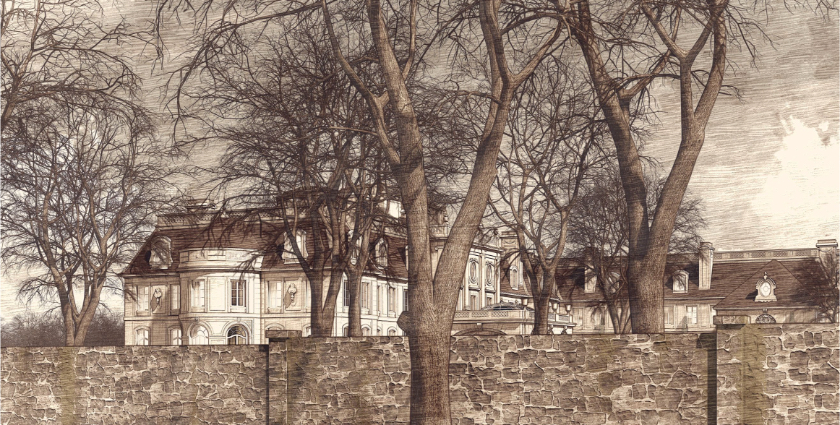
To avoid unnecessary confusion/alarm, the rendering at the top of this post is not what he proposed.
Instead, it was presented to show how it would look if he adhered to the MINIMUM setback from Preston. He asserted that he compromised by agreeing to a significantly deeper setback in return for the extra height. (But he conceded it was in his own best interest to set back much farther than the allowed minimum.)
Yes, renderings are simply that, a mere idea of what is proposed. Still nice to see what he had in mind but in the end he may build a big glass box or he may just sell the property. It’s kind of his modus operandi.
Do you think they suspected it wouldn’t pass with town council and just decided to modify their architecture? At this point I’m wondering where Beal even lives. With his trophy properties he seems to purchase, tear down or partially renovate, and then sell soon after. Perhaps he just wants a livable place ASAP on one of these trophy lots he’s purchased over the years. As I understand it, he’s been after this one for a while.
No, Brandon, I think it would have passed. It was a very civilized meeting and intelligent questions were asked and answered. He has one of the best architects in the world working on the house so, of course it could be modified but if it is not actualy going to cause a realistic problem, I honestly think it would have passed.Who knows what is really going on? I’m pretty sure he has a livable place right now lol. Understanding the “why” of people demolishing historic properties is complicated because all we can do is speculate when they won’t or can’t be interviewed. From what I understand the house was in a pretty deplorable condition. Have you ever started a house project and had one issue lead to another, then another, and before you know it you are in way over your expected experience? I know I have. I think that must have been the case here. Even billionaires have their “this is enough” breaking point. I’d be happy to let him tell his side but I don’t think he particulary cares what the rest of us think. The historic properties he has purchased and demolished were never protected by their owners and they could have been. So the loss is truly on the shoulders of the owners that sold to him. They could have been deed restricted. The drawings for what he has planned look like he’s building something quite beautiful…if it gets built.
This man is certainly an enigma…lol. Hope something beautiful is built soon.