
Strong Towns Founder: Regulations, Incentives, Cultural Expectations Are Undermining Urban Renewal Efforts
Share News:


Strong Towns founder Charles Marohn has some ideas for how cities can “escape the housing trap” and become more prosperous. He pitched his suggestions for Dallas — including code reform, creating a network of small-scale incremental developers, and localizing housing finance — at a gathering in Oak Cliff last week.
“When we ask people, ‘Are we in a housing crisis?’ the answer we get across the board is yes,” Marohn said. “We follow that question up with, ‘What needs to happen to housing prices in order to alleviate this crisis situation?’ Half the people say they need to go up and half the people say they need to go down … We are having, in a sense, two different conversations about housing.”
One of the conversations is about housing as shelter. In that conversation, Marohn said, housing is unaffordable and unattainable.
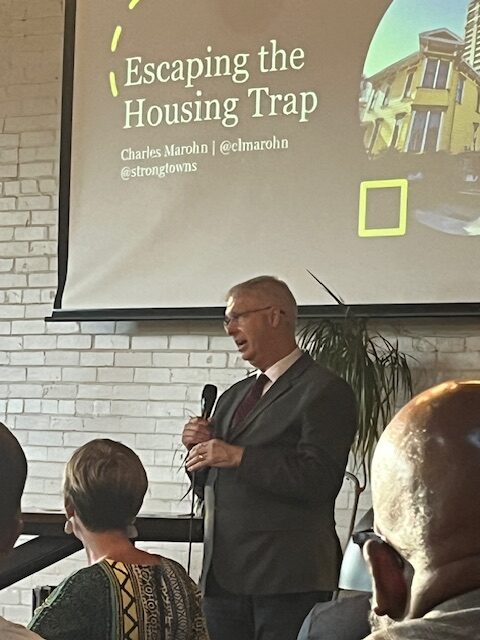
“In order to alleviate those problems, housing prices need to come down,” he said. “The other conversation is about housing as a financial product, the idea that housing and its derivative products … sit not only at the heart of our financial system but are really a vehicle in which we create and build wealth broadly through our economy. This is the housing trap. This is where we find ourselves today as Americans.”
The Oct. 3 gathering at Wax Space was hosted by the Dallas Housing Coalition, Habitat for Humanity, Verdunity, and developer Monte Anderson’s Options Real Estate. In case you missed it, watch the livestream here.
What is Strong Towns?
Strong Towns is a Minnesota-based podcast centered around land use planning and how cities can solve the housing crisis through density and the restructuring of suburbia.
Its founder, Marohn, is the author of Escaping the Housing Trap: The Strong Towns Response to the Housing Crisis.
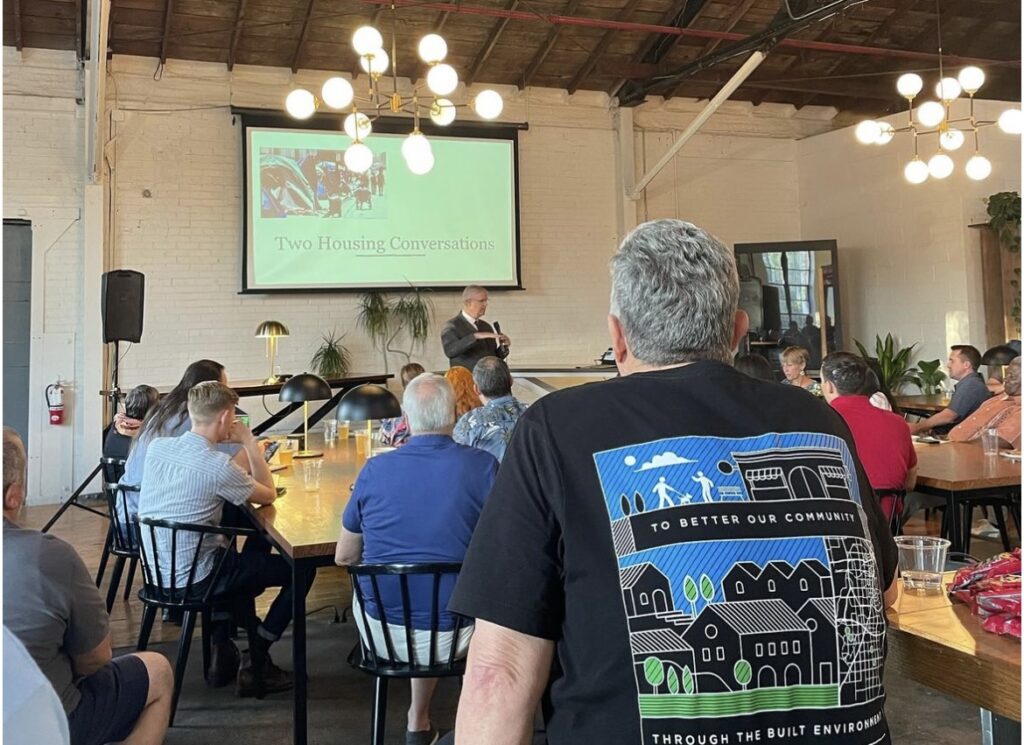
At last week’s event, the speaker explained that when he talks about the housing trap to city leaders, they respond with a feeling of helplessness.
“The problem seems so massive, so overwhelming, and the things that we’re doing seem so ineffective in comparison,” he said. “How do we, even in a city the size of Dallas, deal with this massive problem? This feeling of helplessness is pernicious and we need to get rid of it.”
How Housing is Financed
Marohn’s presentation last week featured a history lesson on mortgage financing prior to the Great Depression.
“Local banks were literally taking your money and lending it to someone else,” he said. “They were not only going to have to be accountable to all the people in the community, but if people locally lost faith in the bank, they were going to pull their money out and the bank was going to fail. This was an extremely risk-averse undertaking.”

At that time, a typical home loan required a 50% down payment, and the bank would lend the other half on an interest-only loan financed over a short period of time.
“At the end of that window, the balloon payment would come due and ostensibly the bank would be in a position to renegotiate with you … a new three-to-five-year loan,” Marohn said. “This provided the bank with the ability to get out of bad investments. If there was a change in inflation or a change in interest rates and the bank had to adjust their portfolio they were not stuck paying bad rates for a long period of time. This provided protection for the local bank and provided a way for people to access reasonable amounts of capital from their neighbors.”
During the Great Depression, home prices went down and people didn’t have a lot of money. When people couldn’t come up with the cash to cover their loans, the banks foreclosed on their homes and sold them at even lower rates.
“People were being forced out of their homes, banks were forced into foreclosing, and housing prices continued to drop,” Marohn said.
The New Deal
President Franklin D. Roosevelt’s New Deal offered an opportunity for the federal government to purchase loans so people weren’t kicked out of their homes. The government would turn around to the property owner and refinance the home over eight or 10 years. The government also suggested that lenders offer more manageable down payment rates of 25% to 40%, Marohn said.
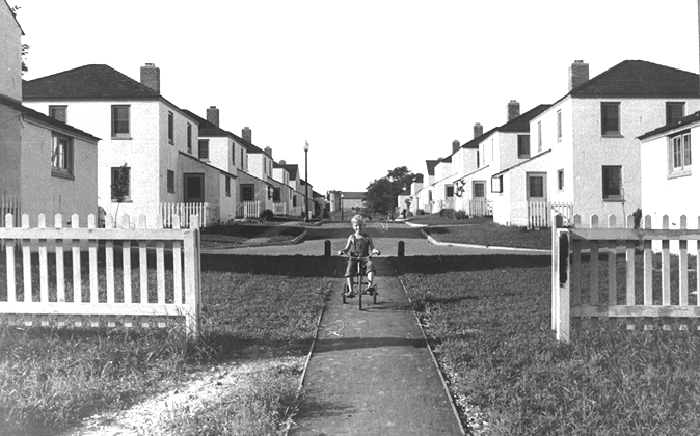
At the end of World War II, there was fear among economists that the U.S. would go back into the Great Depression. That didn’t happen; instead, a post-war boom kicked off and lasted two decades. The capacity dedicated to fighting a global war was repurposed into building a new version of America, Marohn said.
“We took all of that industrial might, we took all of that capital … that we had created and we turned it into making our cities grow very quickly as a way to create jobs and economic development,” he said. “We funded highways, sewer systems, and water systems. We took the tools we had used to stop a deflationary spiral and we repurposed them in order to expand housing and make it more attainable.”
Making it easier for people to borrow money to stay in their homes was the moral thing to do at the time, Marohn said, but it is not the answer today.
“The idea today of making it easier for more people to borrow more money to ultimately pay more for housing is not the way we get out of this trap,” he said. “In fact, that is the trap.”
Housing as a Financial Product
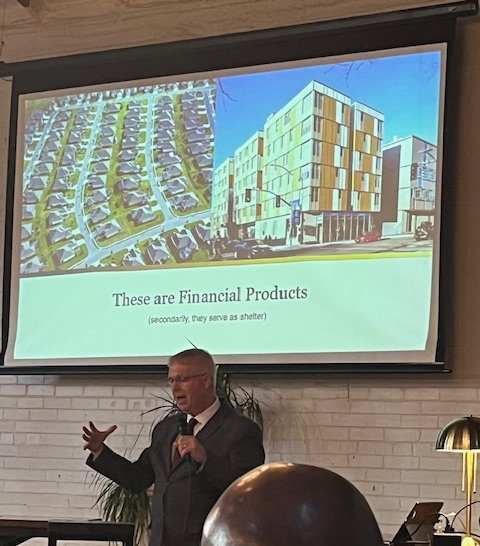
A single-family home is a “fantastic financial product,” Marohn said.
“It is also shelter for millions of Americans, but its primary purpose in today’s economy is as a financial product,” he said. “It is a great financial product because it can be comingled — bundled — with all kinds of other similar products in our economy.”
Strong Towns focuses on what it can do at the local level, a philosophy that appeared to appeal to the audience at last week’s event, which included City Plan Commission Chairman Tony Shidid and Commissioner Christian Chernock.
Most single-family homes are occupied by one or two people who find themselves “house rich and cash poor,” Marohn explained. An elderly widow in such a position may struggle to maintain the yard or shovel the snow. Their options are to sell the house or get a reverse mortgage, which isn’t appealing.
“Would it be allowed for someone in this situation to take one of their extra bedrooms and make it into an apartment they could rent?” Marohn asked. “What if we allowed them — and I know this is going to sound insane — to put in a kitchenette and an exterior door and rent that room out? It’s not that hard to do, yet our zoning ordinances don’t allow that. Our building code would make it difficult.”
Instead of making it impossible for homeowners to maximize their space, code reform is needed to allow for backyard cottages, starter homes, and other diverse options, he said.
“When we eliminate this starter rung of the ladder, we make it impossible for broad swaths of our population to fully participate in our society,” he said.
Strong Towns suggests code reform, building an ecosystem of small-scale incremental developers, and localizing housing finance. The formula creates a competitive market so everyone can afford to get into a home.
“At Strong Towns, we have a saying,” Marohn said. “No neighborhood should be exempt from change, and no neighborhood should experience radical change.”