
Is Your Driveway The Problem? Zoning Committee Wants More Input on Impervious Surfaces
Share News:


The Dallas Zoning Ordinance Advisory Committee continued conversations last week about changing the city’s development code to limit surfaces that impede the natural infiltration of stormwater into the ground. Following a robust two-hour discussion, ZOAC members said they wanted more feedback from developers and other municipalities.
In addition to hearing from industry stakeholders, the zoning committee asked for more information about performance standards, slope impact, requirements for parkway streets, “ribbon” driveways, and the impact of warehouses and industrial properties.
“I’d like to find a way to adopt much of this,” said ZOAC chair Tip Housewright. “I just think we need to understand any unintended consequences and sort out some of the details that we’ve got questions about.”
Senior Planner Lori Levy said limiting impervious coverage aligns with city policies that call for the reduction of flooding and the heat island impact that is exacerbated by impervious surfaces.
“Citywide, whenever we get a hard rain, we see these issues of flooding and, again, the flooding concerns are exacerbated by these impervious surfaces because the stormwater runs off,” Levy said. “It doesn’t have a chance to infiltrate into the ground, into the soil. We’re experiencing hotter days than we have in many years. That is due to a lot of our dark, impervious surfaces.”
ZOAC, a subcommittee of the City Plan Commission, is also considering incentivizing sustainable solutions for pervious surfaces.
Other pending code amendments under review include proposals related to parking, accessory dwelling units, concrete or asphalt batching plants, and commercial vehicles.
Want to deep-dive in the weeds of the proposed code amendment? Watch the May 14 ZOAC meeting here and view staff presentations here and here.
Concerns Raised by Developers
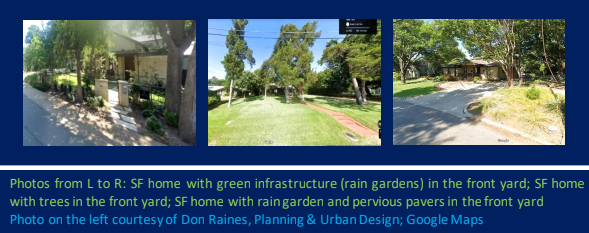
Impervious coverage, according to the City of Dallas, is any surface that prevents or substantially impedes the natural infiltration of stormwater into the ground, and includes, but is not limited to hardscape surfaces such as asphalt, concrete, wood, crushed granite, pavers, synthetic turf, compacted soil or rock, and similar surfaces. Linear borders such as landscape barriers, retaining walls, and fences are excluded in these calculations.
ZOAC members spent a portion of the May 14 meeting reviewing an email from David Spence, owner of Bishop Arts property company Good Space.
Spence said his company has 25 years of experience with maintenance and installation of permeable improved surfaces and has incorporated compacted-aggregate parking patios because of “green concerns” such as retaining rainfall onsite “rather than piping it to the Trinity River, as well as to avoid triggering landscaping ordinance regulations, which invariably reduce off-street parking.”

“We have lobbied the last four directors of Public Works to get approval for gravel parking lots,” Spence wrote in his email. “So, in some ways, we’re fans of the practice. However, because we maintain compacted-aggregate parking lots ourselves, we know the headache of keeping them safe and presentable.”
A gently sloped lot like that of Encina restaurant on West Davis Street lends itself to decomposed granite, Spence added.
“Otherwise, the granite washes into the street and into the storm sewer system,” he said. “As an example, see the parking lot of Sylvan 30. Even aggregate of larger diameter, like one-inch crushed limestone, is subject to washing away in heavy rain. Any aggregate develops potholes and rivulets that make for treacherous footing, and therefore are a litigation risk. Don’t be fooled by engineers or landscape architects that the plastic buried-matrix systems hold gravel in place; the plastic disintegrates under vehicular traffic.”
Levy acknowledged the maintenance concerns and said materials have to be approved by engineers, and natural solutions are welcome.
“They offer many more benefits,” she said. “There are a range of options available.”
Next Steps for ZOAC Decision on Impervious Surfaces
If an ordinance is approved by the City Council, it would apply to new development and residential redevelopment when the cumulative area of impervious coverage is increased more than 200 square feet, Levy explained.
The ordinance applies to nonresidential redevelopment when the cumulative area of impervious coverage is increased by more than 2,000 square feet.

City officials said they reached out to industry stakeholders with The Real Estate Council and Dallas Builders Association but hadn’t received much feedback.
ZOAC commissioner Ryan Behring questioned the timing of the impervious surface code change because a proposal to reduce parking minimums for new development is also under review.
“It’s pretty clear that the biggest culprit to impervious surfaces is parking areas,” Behring said.
CPC has been inundated with reviewing the ForwardDallas comprehensive land use plan so it probably won’t be presented with any new code amendments until the fall, said Chief Planner Sarah May.
“We’re taking everything in order, so it will be parking, then private game clubs, and if this moves out of ZOAC, it would go after that,” she said. “I don’t want to put this before parking because it’s backward to say you have to provide a lot of parking but we’re going to limit your impervious surfaces.”






If we are worried about too much impervious parking then why in the world have we put down mile after mile of concrete for a bicycle and jogging path all around and through Dallas?
Can you imagine a gravel parking lot at Home Depot?
Unfortunately our heaving North Texas black soil is not conducive for gravel as a concrete substitute
We need to reach out to the Dallas Builders Association. I wish we had done impervious on our drive: tends to not show cracks.