Dallas City Council Sides With Convention Center Timeline Over Oak Cliff Concerns
Share News:

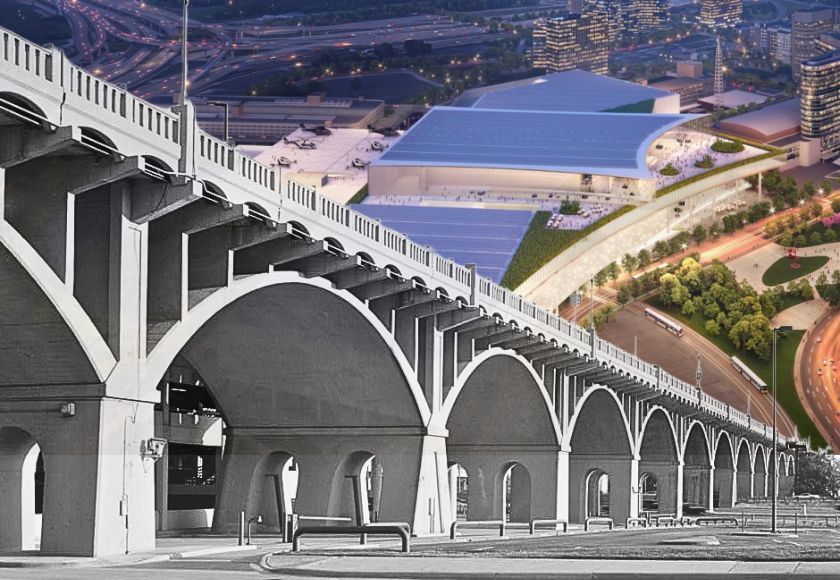
The Dallas City Council voted Wednesday to keep the Kay Bailey Hutchison Convention Center redevelopment on its current path Wednesday, rejecting calls to redesign the project to preserve existing vehicular traffic between Oak Cliff and downtown on the viaducts.
Council members also voted to bring on an independent transportation consultant to support delivery of all traffic-related components of the convention center redevelopment.
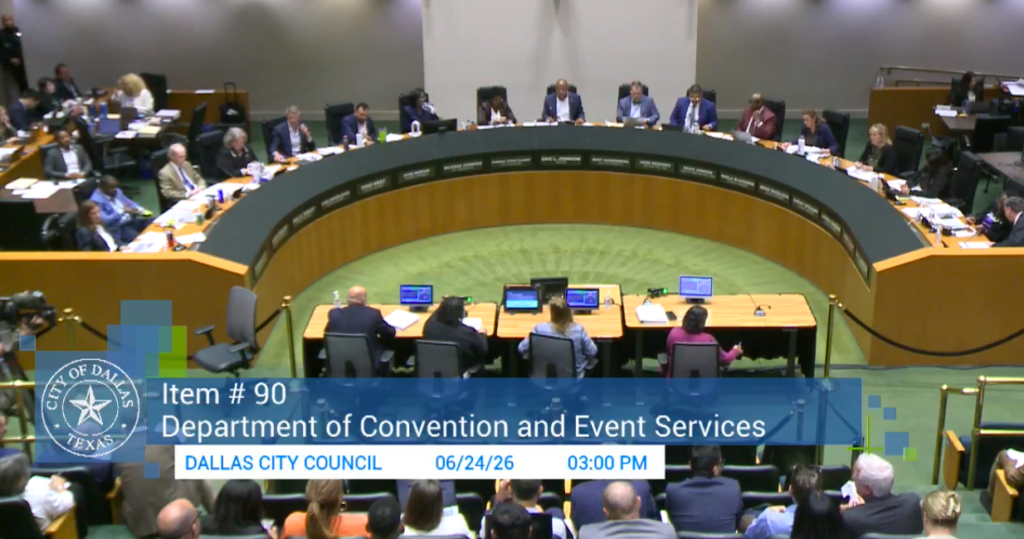
The votes followed a discussion over how staff managed the fallout from the current convention center design, which requires the removal of a section of the Jefferson Viaduct just north of the Union Pacific Railroad.
The debate began in May, when the Transportation & Infrastructure Committee recommended raising the building to its previous design to prevent interference with Jefferson. Officials were responding to fierce pushback from Oak Cliff residents and business owners who argued that proposed changes to the vehicular traffic patterns would decrease the neighborhood’s existing ease of access to the city center.
At that committee meeting, which drew a number of council members who weren’t even on the committee, there was pretty widespread skepticism (if not outright hostility) to the notion of limiting the connectivity facilitated by the two viaducts. On Wednesday, a few council members were singing a different tune.
Council Members Zarin Gracey (District 3), Maxie Johnson (District 4), and Lorie Blair (District 8) argued that staff’s latest reconfiguration of viaduct traffic did not cut off downtown access from southern Dallas, and that any further delays to the convention center timeline would result in unacceptable economic impacts like revenue and job losses.
“It doesn’t matter whether the convention center is raised or it’s lowered,” Blair said. “You will still have access via the viaducts in order to get in and out of downtown. The only challenge that we will have is during construction.”
Construction of the new convention center is expected to last until at least 2029, with an anticipated opening sometime in 2030. Staff assert that redesigning the project would push opening even further out.
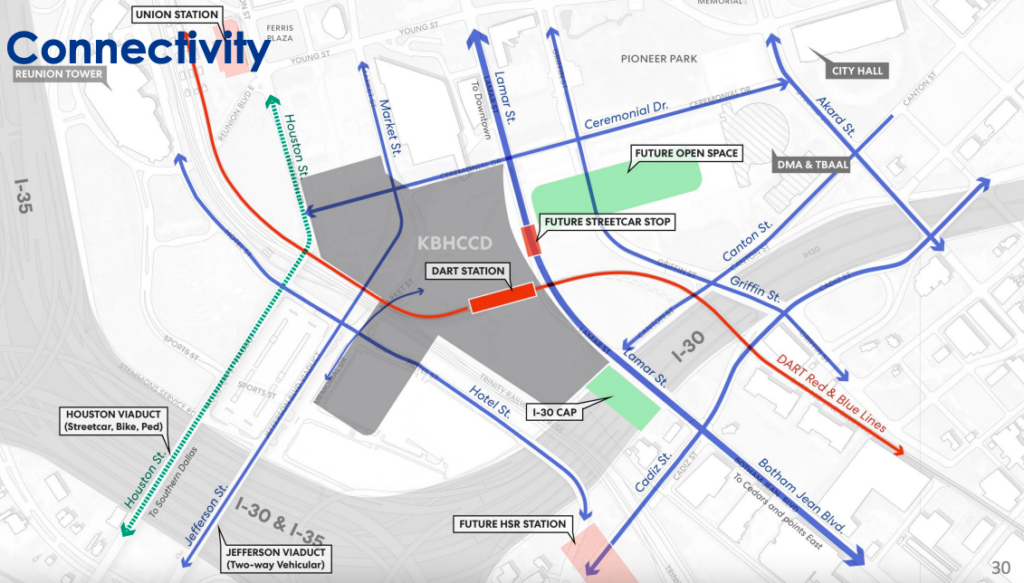
During construction, three lanes of northbound Jefferson traffic would be funneled onto Houston Street, which would be reduced to just one lane in each direction from the Sports Street parking garage to Young Street. However, staff proposed adding a ramp from Jefferson directly to the convention center’s mobility hub and Hotel Street to ease congestion. Upon completion, though, a new flyover would connect Jefferson and Houston north of the parking garage.
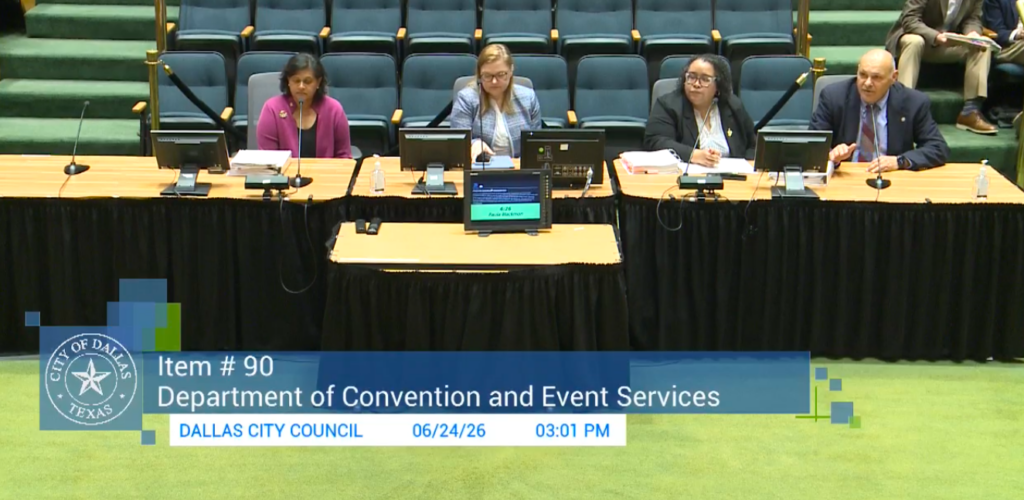
Some council members said misinformation about the viaduct situation has fueled confusion over whether the viaducts would be demolished. Heightened tensions among residents and officials were on display during the meeting, with supporters of preserving viaduct traffic patterns repeatedly shaking their heads at remarks by staff and council members
Council Member Kathy Stewart (District 10) said, “One of our local [news] stations said we’re taking down both viaducts.”
While the two viaducts are not under threat of physical destruction (except for the northern section of Jefferson that flows directly onto Market Street), staff said they intend to follow through with the Oak Farms Transportation Corridor Study, which calls for taking all cars off of the Houston Viaduct and reserving that route for public transit, bicycles, and pedestrians. Jefferson would then be converted into a two-way road with four lanes of traffic.
“I understand that the construction may lead to temporary delays, and that is understandable, but we have to find a better long-term solution,” said Council Member Chad West (District 1).
West joined viaduct advocates recently to raise awareness among commuters using the bridges to get in and out of downtown.
“At a time when downtown is struggling, we shouldn’t be cutting off access, we should be improving it to Oak Cliff,” West said. “While I understand and share the concerns that some of my colleagues have about delays to the convention center, if we rush this and get this wrong, we are making a decision that cannot be undone and will impact Oak Cliff for decades.”
Staff insisted that their proposals would ultimately maintain the same number of car lanes between Oak Cliff and downtown, counting the new ramp leading to the convention center. Funding has yet to be allocated to pay for the reconfiguration, and the final permanent traffic plan will have to go through a Thoroughfare Amendment process with opportunities for public input.
A purported lack of public input was another throughline animating Wednesday’s discussion. Some council members criticized the city’s public engagement process, describing the approach as a failure of departments working in “silos” rather than coordinating transportation planning, convention center design, and community outreach.

Others were more pointed in their assessment.
“We’ve asked staff to come back with better ideas. The only thing I’ve seen happen is the same ideas be brought forward in an intense lobbying effort of council members to flip them to agree, to just let it go forward,” said Council Member Cara Mendelsohn (District 12).
“And repeatedly, especially over the last year or two, this council has been asked to make a very important decision, not just about this issue, about many issues, and the question is, do you go with the business and developers or do you go with what’s best for the residents?” she added.
Brett Shipp, who was active in the campaign to maintain existing viaduct traffic patterns, said he and others were encouraged by the hiring of an outside consultant and also glad further delays wouldn’t be added to the convention center timeline.
“We didn’t want to see anything negative or bad happen to the convention center,” he said. “We don’t want delays. What we want is equity, and we want responsible representation and justice for the people of southern Dallas who were being denied a voice in a very important process.”
The decision followed public comment from several dozen speakers, including Shipp, who were each only allowed one minute to address the city council — a move officials have been implementing lately on hot-button issues that draw significant civic participation.
Speakers were largely split between people with interests in hospitality and tourism urging officials to keep the current design for the sake of the industry and Oak Cliff residents and business owners asserting that lowering the convention center would undermine historic transportation connections that have linked Oak Cliff to downtown for generations.
“Should a city that just lost its signature downtown retailer, its signature downtown employer, and both of its downtown sports teams, while cities across our region spend hundreds of millions of dollars to draw people into their downtowns, turn around and make it more difficult for its own residents to reach our core?” said Bishop Arts Neighborhood Association president William Joy. “Should a project be delayed a year, or should communities suffer for decades?”
A number of residents said the city was asking Dallas neighborhoods south of downtown to bear the burden of a cost-saving redesign with serious implications for commuters and businesses that rely on that connectivity.
Economic considerations for stakeholders in hospitality appeared to prevail, though, following reports by staff about the potential fallout of adding up to a year to the project timeline if the building was raised back to its previously planned height.
“When the convention center closed, our industry understood what was coming,” said Traci Mayer, executive director of the Hotel Association of North Texas. “We expected loss of business. We expected room night cuts and shift cuts, and we took that on willingly because we believed in the plan and we believed in the timeline. What our workers cannot absorb is more delay. The recommendation before you will set the project back. And another year of reduced hours and uncertainty will have a direct negative impact on our workforce.”
Council Members Laura Cadena (District 6), Adam Bazaldua (District 7), Bill Roth (District 11), and Paul Ridley (District 14) joined Mendelsohn and West in voting against the motion to deny raising the convention center design to preserve Jefferson connectivity to Market Street. In the end, the motion passed in a 9-6 vote.
UPDATE: This article was updated at 2:58 p.m. on June 25, 2026, to clarify the motion that was made and adopted by a majority of the Dallas City Council.