
Dallas Leaders Are Divided Over Whether the City Has a Housing Crisis — and What to Do About It
Share News:

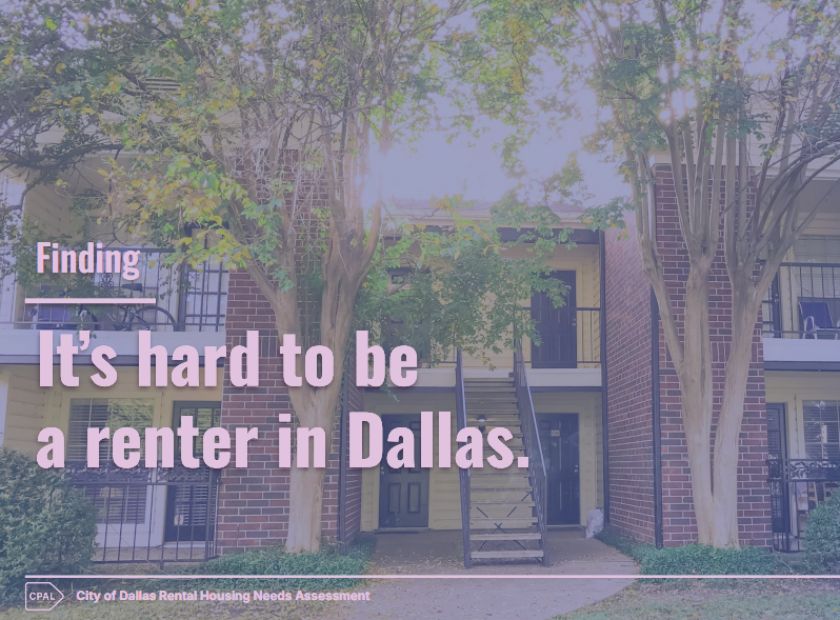
City leaders are divided over whether Dallas is really facing a housing affordability crisis — and if so, what should officials be doing about it?
That question surfaced Wednesday as council members were briefed on the state of housing in Dallas and a new strategic plan aimed at making housing more attainable across the city.
But the conversation at City Hall made one thing clear: Dallas leaders may not even agree on what the housing problem actually is — whether the city is underbuilt, over-subsidizing development, or simply building the wrong kind of housing.
Workforce Housing Gaps Apparent
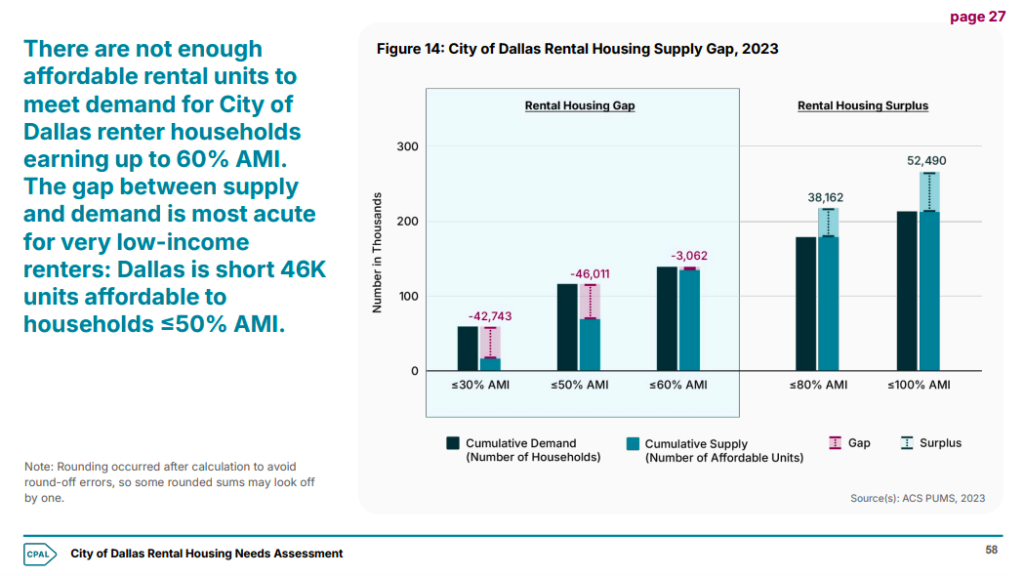
Staff and housing advocates pointed to significant gaps between supply and affordability, particularly for lower-income households, as rapid population growth over the past decade outpaced housing production and pushed costs higher.
Data indicates that Dallas is especially underbuilt in certain categories. The city has an estimated shortage of about 46,000 units for households earning at or below 50% of the area median income, roughly $52,000 for a family of four.
While Dallas has added substantial multifamily inventory in recent years, much of that development has skewed toward market-rate or luxury units, leaving a gap in what is commonly referred to as workforce housing — rent that’s affordable for teachers, police and firemen, and service workers.
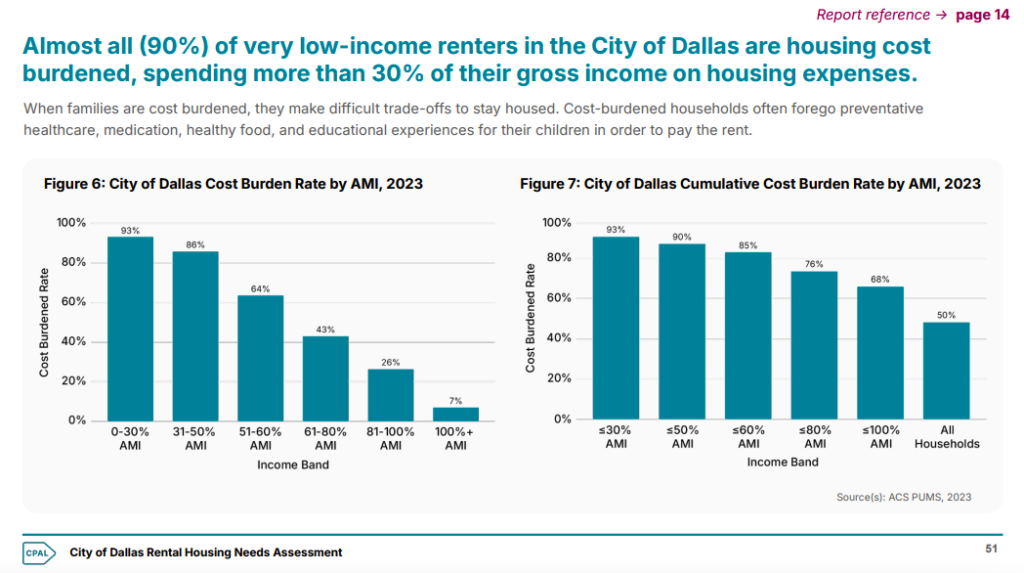
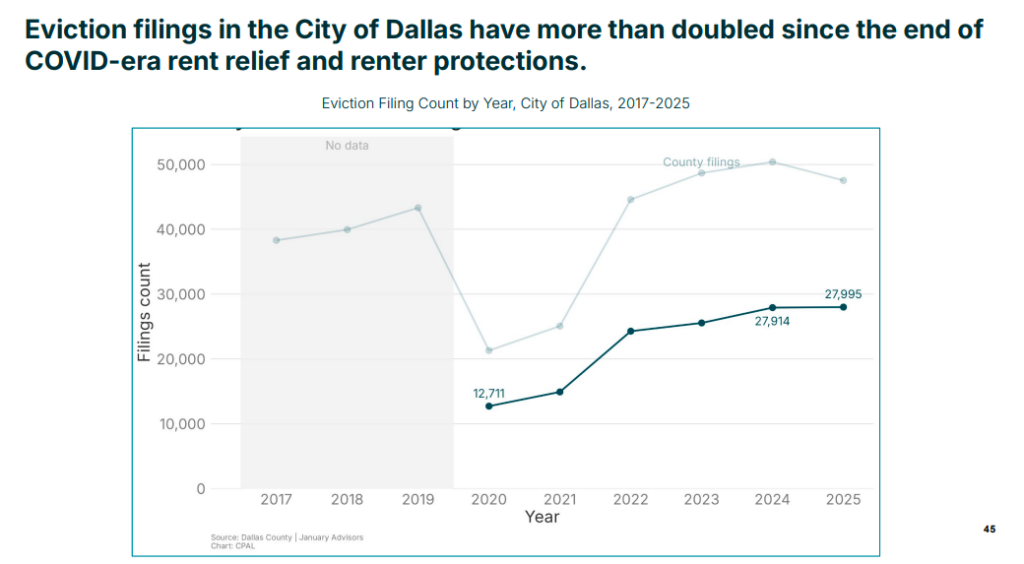
The average Dallas renter spends 39% of their income on housing, according to CPAL’s data. Households earning 0-30% AMI, however, spend roughly 78% of their income on housing. Evictions have also rebounded since the end of COVID-era protections, more than doubling between 2020 and 2025.
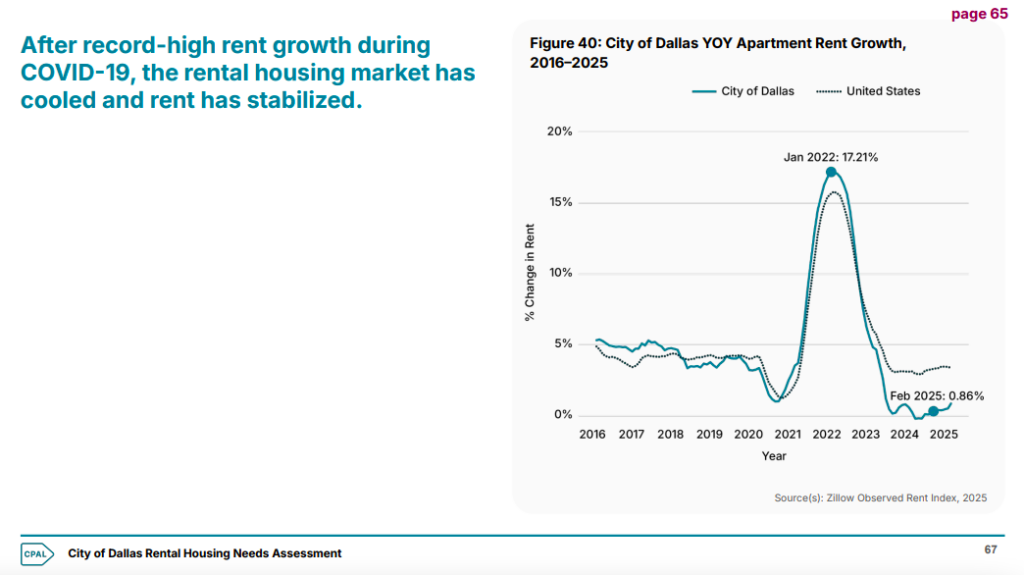

And while rents have stabilized recently due to a wave of new multifamily construction, many of those units are still priced out of reach for lower-income renters.
“We actually see a small gap up to 60% AMI, which caught our attention because in last year’s report we forecasted there will be rental housing supply gaps up to 100% AMI by 2035,” said Ashley Flores, senior director at the Child Poverty Action Lab, speaking with CandysDirt.com. “So when we saw for the first time a gap up to 60%, it sort of signaled that we were tracking along with that forecast, meaning we’re seeing rental gaps start to affect households with income higher than 50% AMI.”
On the single-family home front, production is also lagging behind. Compared to most of the other bigger cities in the D-FW and some across the Sun Belt, Dallas has failed to see a meaningful uptick in permits pulled for single-family construction.
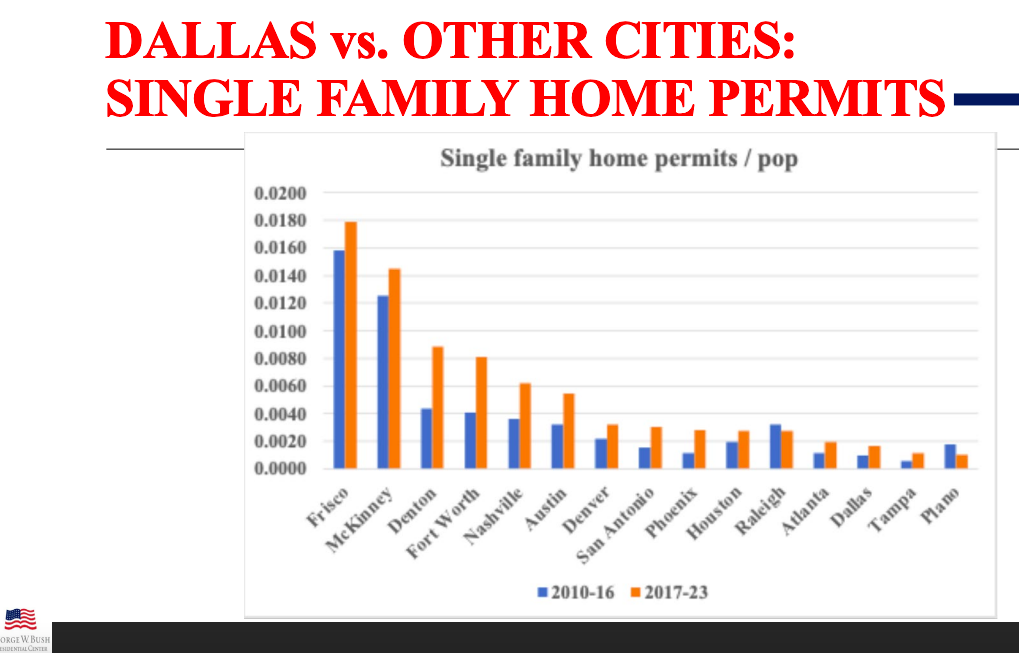

“We’re still a lot better than San Francisco and LA, but relative to the other places that have seen demand growth, we have underperformed pretty dramatically relative even to our neighbors in Fort Worth,” said economist Cullum Clark, director of the George W. Bush Institute-SMU Economic Growth Initiative.
The home price surges seen over the past several years could also be catching up to the city and surrounding areas, discouraging further growth. Clark said net domestic in-migration into the D-FW is down around 80% relative to the highs reached just a few years ago. Dallas County, in particular, has an accelerating net outflow of residents.
“We have lost a lot of our housing cost advantage relative to places elsewhere in the country,” he said.
But not everyone at City Hall agrees that Dallas is facing a housing crisis.
Some Council Members Question ‘Crisis’ Narrative
Pointing to multifamily vacancy rates of over 8% citywide as Dallas proper’s population stagnates, Council Member Cara Mendelsohn (District 12) questioned whether tax abatements are being used effectively.
“That’s terrible fiscal policy, and it’s terrible housing policy,” she said, arguing that tax incentives should be used for residents with the most need rather than used to subsidize mixed-income developments that include a split of affordable and market-rate units.
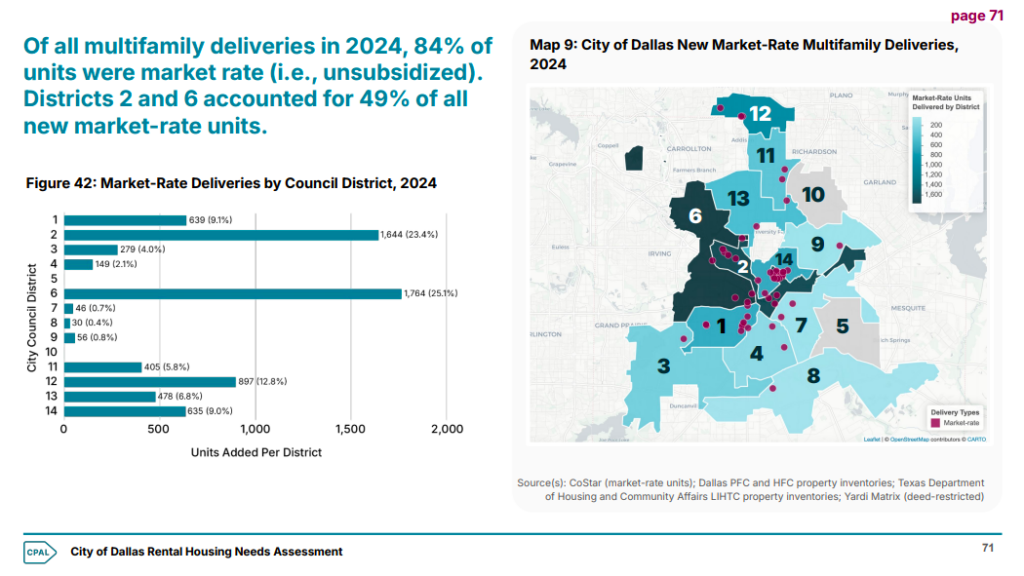
Some council members raised concerns about focusing too heavily on multifamily development while not doing enough to encourage single-family-home development and attainable homeownership.
Mendelsohn argued the city should be trying to balance single-family production, adding that homeownership rates are actually higher in the southern sector than in the north.
Council Member Maxie Johnson (District 4) asked staff what’s being done to encourage the production of attainable homes for the “missing middle,” such as teachers and police officers who hope to buy a home, throwing out the $200,000 range as a hypothetical.
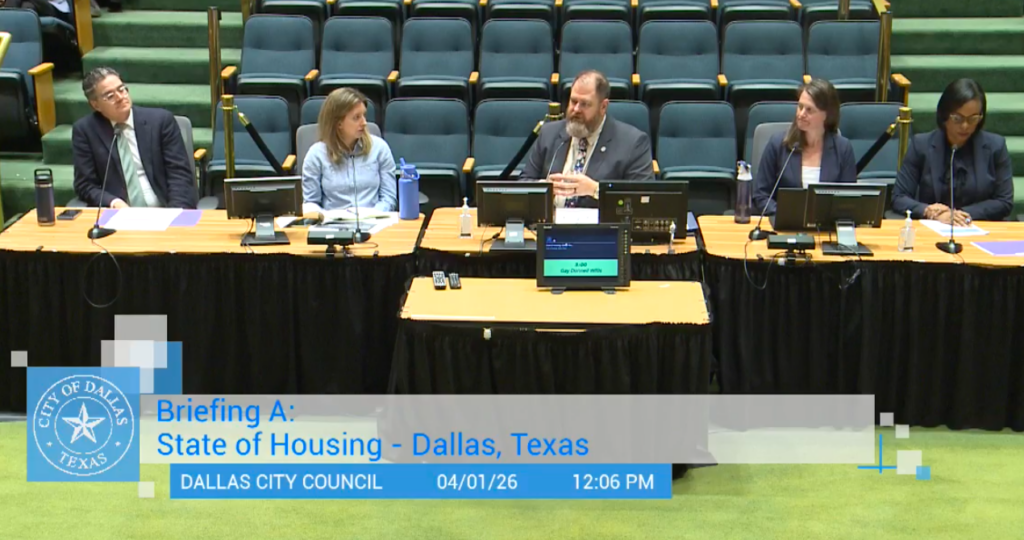
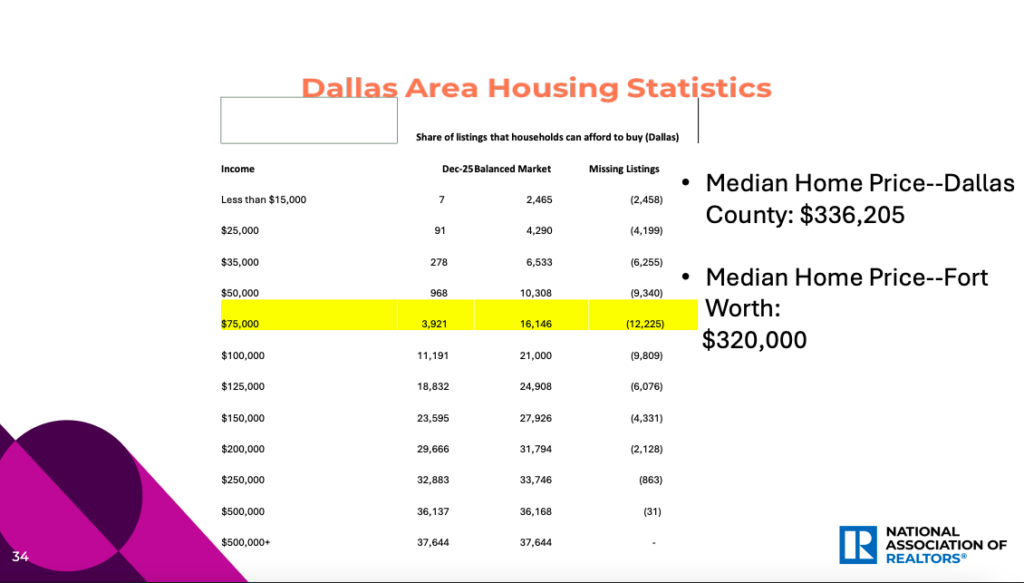
“It costs about $270,000-300,000 to build a 1,300-square-foot home,” said Thor Erickson, director of the city’s Housing & Community Empowerment Department. “That price point is affordable to an 80% AMI buyer… so home ownership becomes out of reality for so many of our Dallasites and just people across the nation right now due to housing costs, rising valuation of housing, and incomes remaining stagnant.”
Multiple council members expressed support for the construction of more subsidized multifamily construction and rehabs, even arguing against adding any additional thresholds to Dallas Housing Finance Corporation and Dallas Public Facility Corporation rules (we’ll get into this in a separate article), which have supported many tax abatement deals.
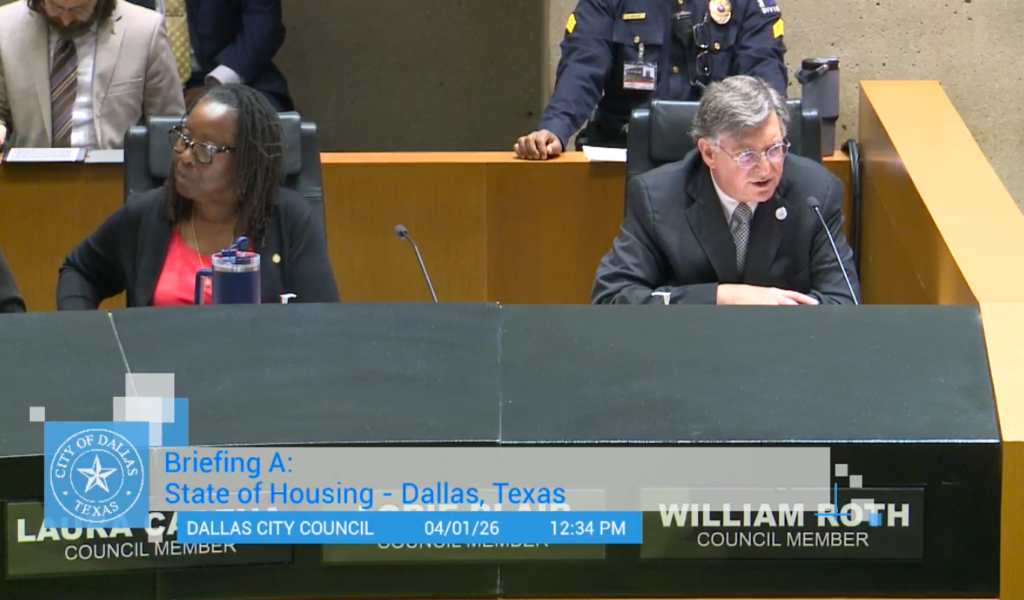
Council Member Bill Roth (District 11) cited residents’ concerns about dense multifamily developments, suggesting that staff should be more sensitive to the stability and feelings of such communities.
“If there’s not good communication with the neighborhoods, if the neighborhoods aren’t considered significantly in these solution-based proposals for all these items that we’re talking about, then those solutions are not going to be viable,” he said.
The City’s New Plan: ‘Dallas Is Home’
The proposed “Dallas Is Home” framework comes after the city’s previous housing plan — Dallas Housing Policy 2033 — was sunsetted due to federal guidelines prohibiting funding tied to racial equity initiatives, forcing the city to develop a new strategy to address housing and homelessness.
The new strategy calls for stepping up housing production and preservation efforts citywide, identifying and targeting area-specific priorities.
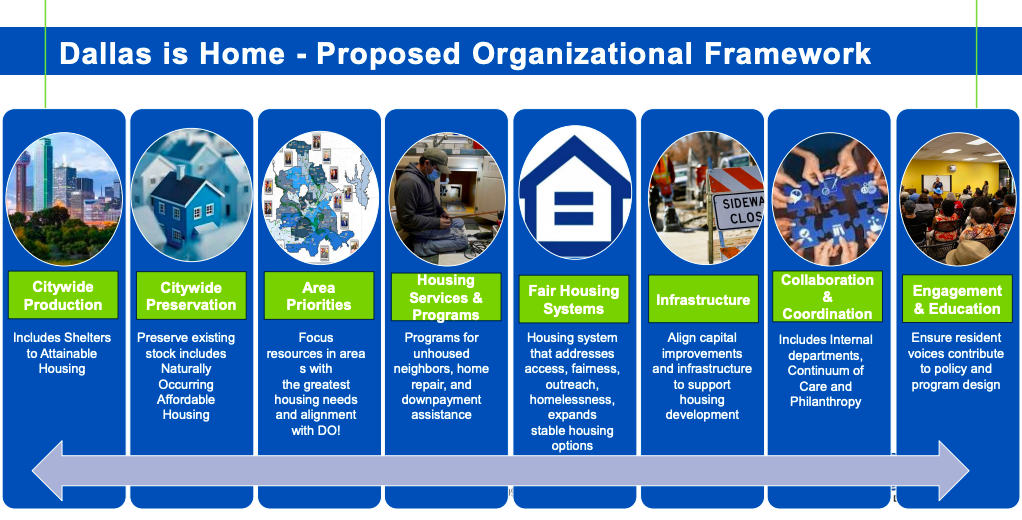
The plan aims to improve coordination across multiple city departments and programs to streamline housing development and meet the city’s needs.
“We’re looking at things like parking reform, streamlined permitting, housing development incentives, and the infrastructure needed to allow for new housing developments — there’s lots of collaborative work that all needs to come together,” Erickson said.
Specifically, the proposed strategy calls for more shelters and attainable housing, continued investment in home repair and down payment assistance programs, stronger partnerships with private and philanthropic groups, and better community engagement so housing policy is both coordinated and responsive to resident needs.
The “Dallas Is Home” framework is still in draft form and will continue to be refined as council members debate policy priorities, funding tools, and development incentives.
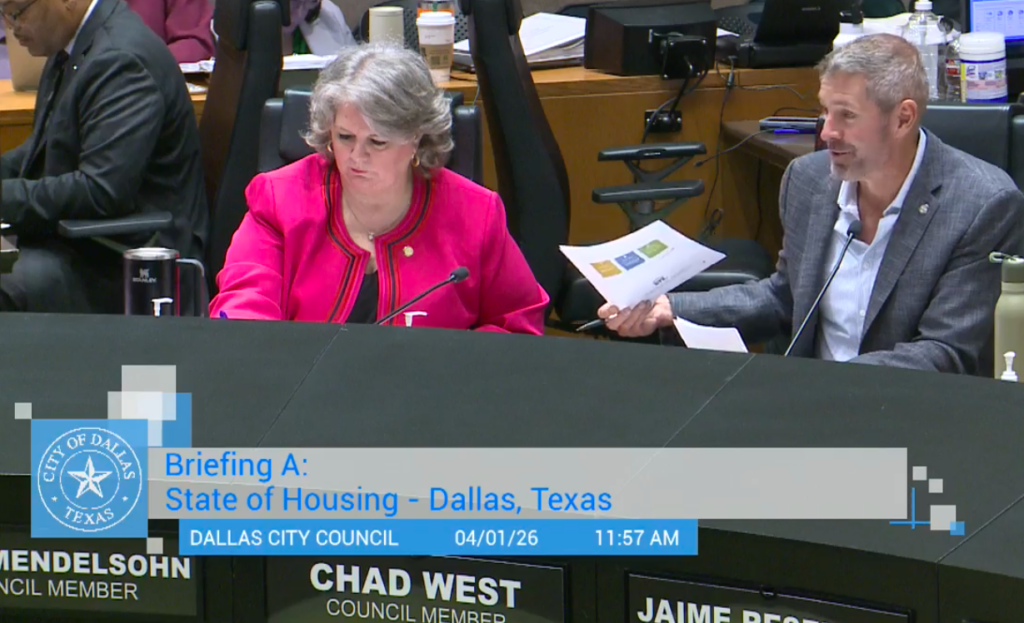
“We hear it in our community survey, national polls, and when I talk to my neighbors at the grocery store: affordability is a huge issue,” Council Member Chad West (District 1) said, later quoting Mayor Eric Johnson’s testimony to the U.S. Senate last year.
“Government itself is not an effective housing developer, but what government can do is step aside, cut the red tape, and encourage the private sector to build more homes faster,” West said. “I think that dovetails well into us not adding additional hurdles into this [HFC and PFC] process.”
After Action
After the council briefing, housing advocates said the debate at City Hall reflects a larger conversation about housing choice and affordability across Dallas.
“We want to get closer to a 50/50 homeownership goal, but it doesn’t necessarily do us any good if people don’t have housing choice and housing access, so I was a little discouraged by some of the commentary towards renters, saying that they destabilize communities when 60% of Dallas is renting right now, and of those renters, 50% are housing-cost burdened,” said Dallas Housing Coalition executive director Bryan Tony, speaking with CandysDirt.com after the council briefing.
“We shouldn’t be forcing people to live in shared housing or intergenerational housing just because they don’t have a choice,” he added. “That’s not the thriving Dallas that I think of personally or our members envision.”
During public comments earlier in the day, Tony called on officials to invest more in “hard subsidies” like grants, forgivable loans, and bond funding for housing, as well as tools like HFC and PFC tax exemptions and more regulatory relief for builders.
Whether Dallas faces a housing shortage, an affordability problem, or a mismatch between the two may still be up for debate. But before Dallas can solve its housing problem, city leaders may first have to agree on what the problem actually is.
2 Comments
Leave a Comment




City duties:
Trash pick up
Clean water
Police service /law enforcement
Safe neighborhoods
The city is not a housing developer or property manager.
Beautifully said.