
City Hall Roundup: Zoning Committee Recommends Standards For Impermeable Lot Coverage
Share News:


A subcommittee of the Dallas Plan Commission determined Tuesday that a development code change is warranted to reduce the heat island effect and improve drainage on residential and commercial properties.
The matter is complicated and not a particularly sexy topic for cocktail parties, but it’s important, city leaders say. It also comes at a time when several Zoning Ordinance Advisory Committee members are pushing to eliminate parking minimums for new construction, an issue that could further complicate new requirements on impervious surfaces.
Senior Planner Lori Levy outlined staff’s proposed amendments at Tuesday’s two-hour ZOAC meeting.
“We want it to be achievable and impactful, and we think it is,” Levy said. “That’s why we went through so many iterations.”
The matter is expected to go before the City Plan Commission and Dallas City Council following the adoption of the ForwardDallas comprehensive land use plan and other code amendments that were already in the queue.
“I am generally against unnecessary regulation of development, but stormwater management is truly one of those issues involving negative externalities,” ZOAC member Nathaniel Barrett said.

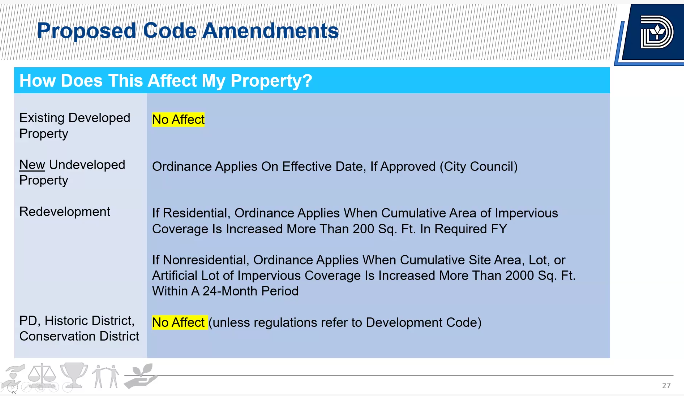
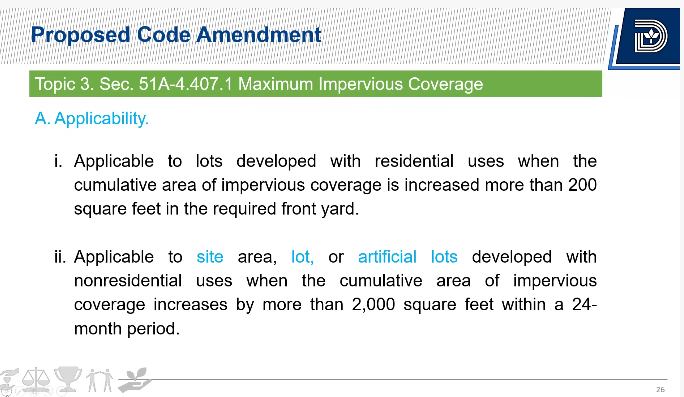
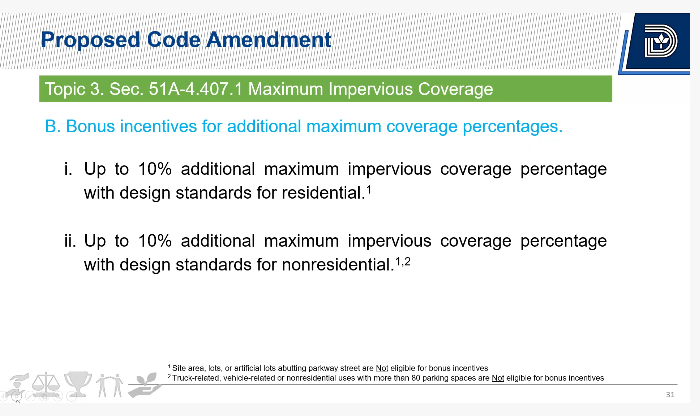
Limiting Impervious Coverage
In simple terms, the proposed code amendment would limit impervious coverage for both residential and non-residential development in an effort to reduce the environmental impacts of stormwater runoff, such as flooding and the heat island effect.
Impervious cover is any type of human-made surface that doesn’t absorb rainfall, including rooftops, patios, paved and unpaved driveways, sidewalks, roadways, and paved and unpaved parking lots.

“These impervious surfaces cause flash flooding caused by the lack of infiltration of rainwater that goes into the soil, causing damage to streets, businesses, and homes,” Levy said. “We have pollutants from stormwater runoff that run into our already-vulnerable rivers and watersheds. We have water quality degradation that’s caused by stormwater runoff, and flooding events of our rivers, streams, and critical watersheds. That water has nowhere to go, basically, if it can’t infiltrate into the ground.”
The recommended change calls for applying a maximum impervious coverage to residential front yards, establishing a lower base maximum percentage without design standards, and offering incentives for green infrastructure such as rain gardens, permeable pavement, and bioswales.
ZOAC Feedback
The standards apply to the entire lot including its structures, not just the driveway or parking lot, Barrett clarified during Tuesday’s meeting.

“The residential side seems very achievable to me — ribbon driveways and things like that,” he said. “We already see these kinds of standards in Austin. I know what they look like and I can see how we would get there. I’m not a fan of the non-residential side. It needs to be paired with some kind of regulatory relief.”
The feasibility hinges heavily on what CPC and City Council decide about parking requirements, he added.
“It’s going to be very hard suddenly when we are requiring parking lots with impermeable coverage and then we are saying at the same time you can’t have it,” he said. “The other side of that is when we prevent people from using more of their lots in those zones that allow for 100% lot coverage, that risks pushing development further out, which has a bigger stormwater and heat island effect overall than if we had simply allowed 100% lot coverage for the structures.”
The vote to move the code change to CPC included a caveat that impermeable surfaces should not be less than the maximum lot coverage permitted under the zoning district. That means if a non-residential builder wants to construct a building with 100% lot coverage, they can do so. Committee member Lorie Blair asked that language about truck parking be clarified.
“I think all the other things can be worked out by the time it gets to CPC,” Barrett said.
ZOAC member Ryan Behring expressed concern that smaller properties could be disproportionately impacted. Business owners have said pervious surfaces could be challenging to maintain.
ZOAC member Mark Rieves said he agrees with the residential standards.
“In 32 years I’ve lived in Dallas, I’ve never seen anyone tear down a structure and build a smaller structure,” he said. “They’ve always built basically to the max … To require them to give back a little bit, they’re maximizing profits … so that makes total sense on the residential side.”
Heat Island Issues
The scorching heat is absorbed by dark surfaces, Levy explained.
The City of Dallas announced in a July 5 press release that it would be collecting data to map areas where people are most at risk during extreme heat.
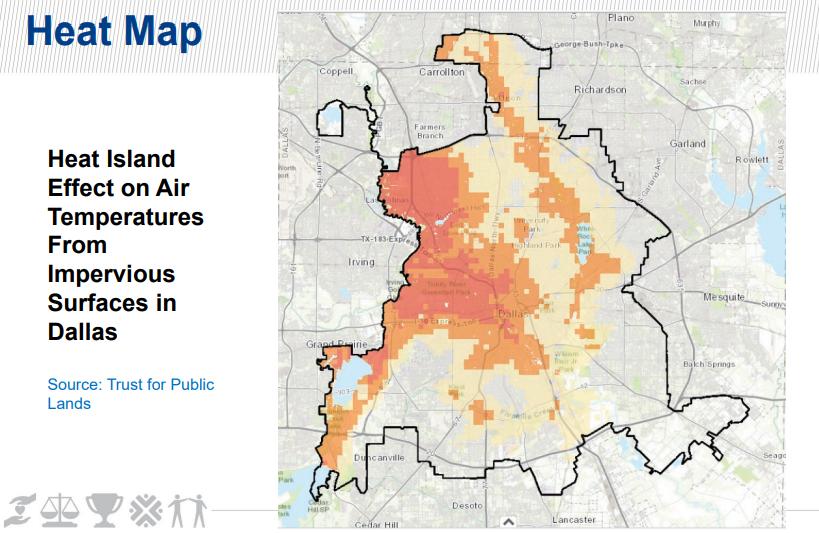
Last summer, city officials mapped 100 square miles of the city and will cover the remaining 245 square miles of Dallas on Aug. 10.
“Summer 2023 was Earth’s hottest on record, and communities across the globe felt this heat, impacting health, infrastructure, agriculture, and more,” the press release states. “Using specially designed sensors mounted on moving vehicles, community volunteers will drive prescribed routes to record ambient temperatures and humidity during three specific times during the day.”
The study area includes Kiest Park, Mountain Creek, Pleasant Grove, Buckner Terrace, Bahama Beach Waterpark, Lakewood, Casa View, North Dallas, Far North Dallas, Cypress Waters, and Northwest Dallas.



Stormwater runoff has been a concern for many years. While serving on the long sunsetted Dallas Environmental Health Commission, we advocated that the city adopt iSWM, Integrated Stormwater Management, that San Antonio had already put in place by 2005. Unfortunately there was no agreement between the developers and the city to fully implement this program which would have addressed the increasingly dangerous flooding issues that Dallas was already experiencing at that time. But the North Texas Council of Governments adopted it.
https://iswm.nctcog.org/
Perhaps a revisit is in order. It isn’t going to get any better until we do.