
City Hall Roundup: Dallas Sanitation Looks to Improve Safety, Efficiency By Limiting Alley Trash Pick-Up
Share News:


Solid waste collection is one of the top 10 deadliest jobs in the U.S., and Dallas officials are looking at ways to reduce hazards in neighborhood alleys, a department director told the City Council earlier this month.
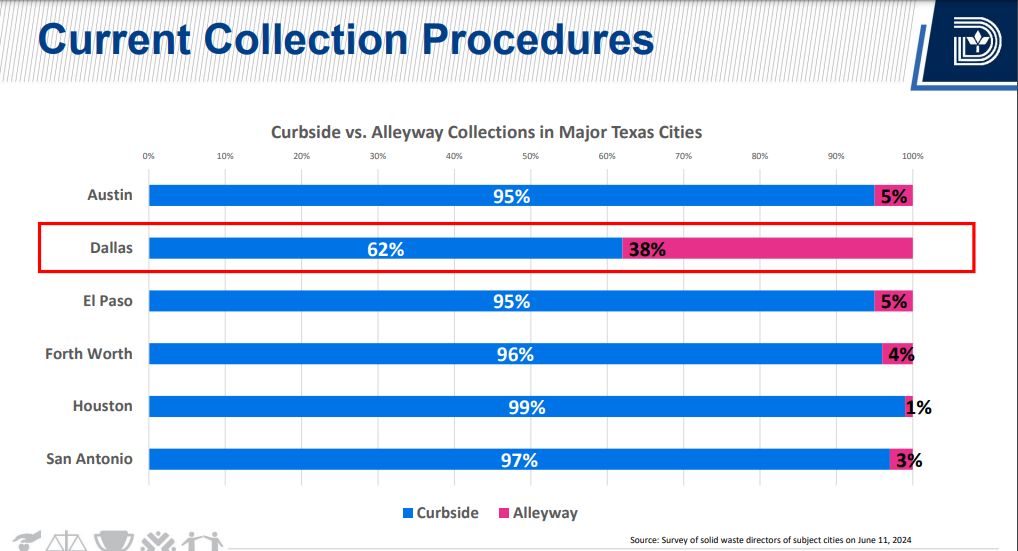
Director of Sanitation Cliff Gillespie said alley collection is provided to about 38 percent of customers, and the pick-up areas are not designed for today’s solid waste management needs.
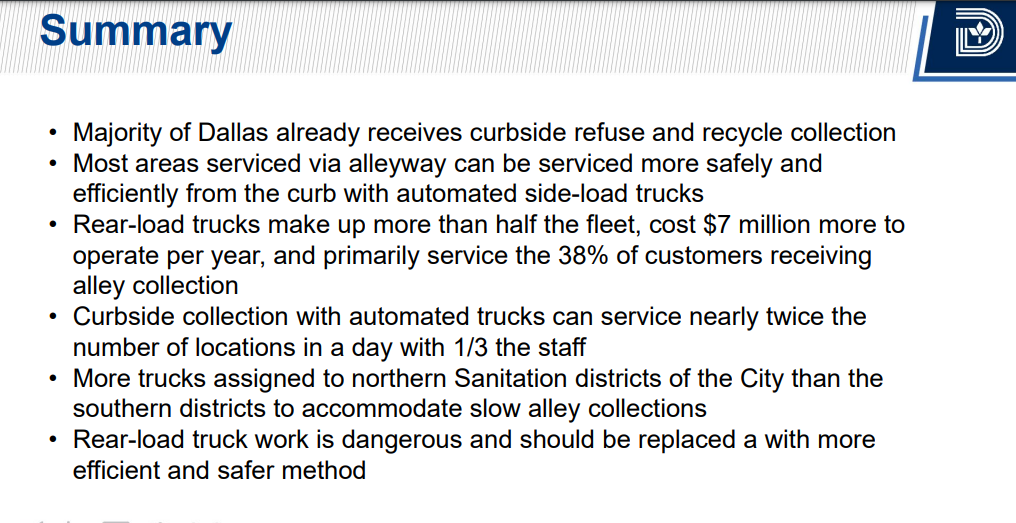
“Crews face daily risks from extreme weather, overhead utility lines, utility poles, gas meters, and unpredictable alley conditions,” he said. “These conditions have also caused fires, resulting in total losses of trucks, injuries to personnel, and near-misses for electrocution.”
Refuse and recycling collections are provided weekly to approximately 258,000 Dallas customer locations. Staff is proposing to transition alleyway service to curbside on a case-by-case basis and use automated service in some areas, Gillespie said.
View the June 18 presentation or watch the discussion from the City Council briefing.
Sanitation is Among Top 10 Deadliest Jobs in U.S.
Gillespie shared a video at the June 18 council briefing, advising that it may be “hard to watch.” While the Sanitation Department wants to explore opportunities to improve reliability, sustainability, and equity of service delivery, they’re concerned about hazardous conditions for the workers.
Several council members expressed concern about those who have relied on alley pick-up and were not anticipating a change. Physically disabled customers can enroll in the Helping Hands program at no cost to receive assistance where carts are retrieved from a predetermined location, Gillespie said.
Alleys vary in width — generally about 8 to 10 feet — and some are gravel or unimproved. Solid waste collection work consistently ranks among the top 10 deadliest jobs in the U.S., according to the U.S. Bureau of Labor Statistics.
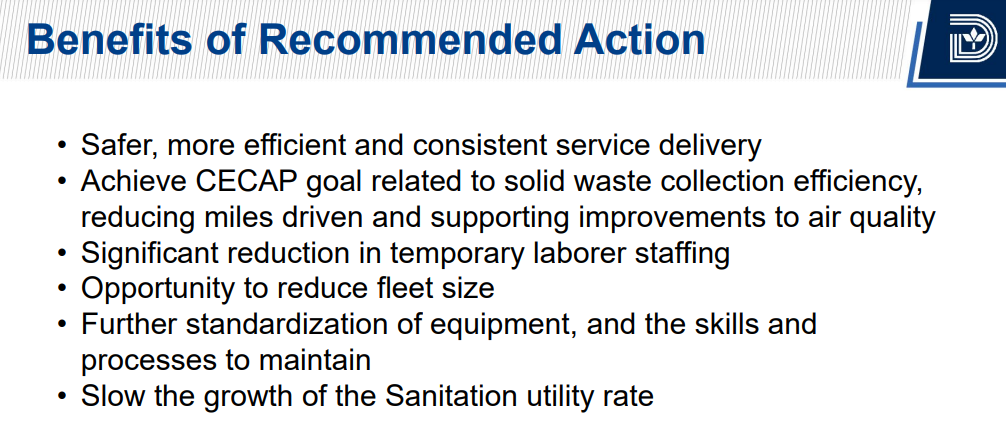
“This statistic underscores the hazards that temporary workers face daily, further highlighting the unsustainable nature of our reliance on this labor model,” Gillespie said. “There are many jobs on that [top 10] list that are required, that are necessary, but this is not one of them. This service can be performed much more safely, efficiently, and environmentally sound from the curb. We can’t continue to operate the way we have been. Something has to change.”
Council Expresses Concern About Residents’ Ability to Comply
Council Member Gay Donnell Willis pointed out that some residents do not have a front driveway and would have to roll multiple trash cans through their yards or homes.
In addition to the Helping Hands program, free to those with physical disabilities, the service also is provided for a monthly fee to those who are not disabled, Gillespie said.
Councilman Jaime Resendez said his parents live in a District 5 neighborhood with alley pick-up.
“Right now they can easily push their carts down the driveway into the alley and it gets picked up,” he said. “Is there something you or I could tell them to make them feel comfortable with this change or is it a ‘tough luck, figure it out’ type of thing?”
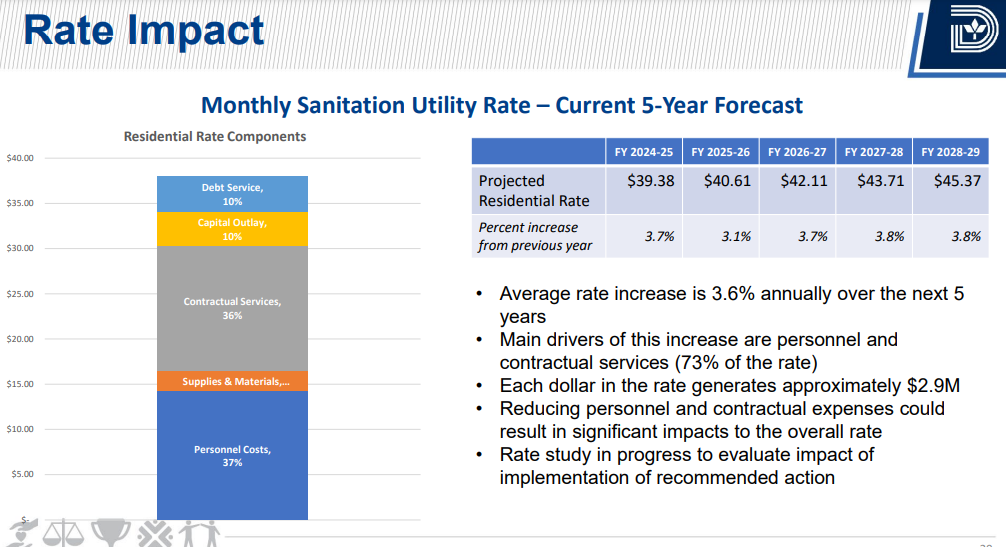
Gillespie said he empathizes with those who have grown accustomed to alley pick-up but suggested there are services to help them and it also will help control rates that have steadily increased.

Sanitation is an enterprise fund, meaning operations are funded by service charges. If Dallas moves to automated trucks and more curbside pick-up, a cost savings will be passed on to some ratepayers.
Putting large trucks through narrow alleys damages the trucks and risks injuries, so there’s a cost-benefit to using automated trucks and transitioning alley pick-up to curbside, Gillespie said.
Council Member Cara Mendelsohn said she is “not all in” and asked for information on whether residents could hire a private company to pick up their sanitation. Currently, the City of Dallas is the only sanitation service provider for single-family neighborhoods.
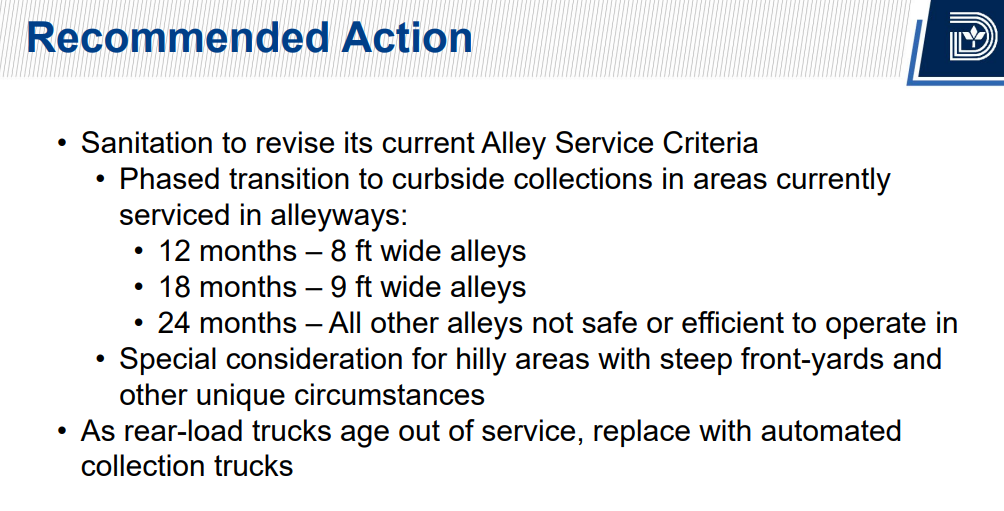
If the council responds favorably to staff’s recommended changes, those with 8-foot-wide alleys could see studies beginning in January on where sanitation service should change, with the transition occurring about a year later, Gillespie said.
2 Comments
Leave a Comment







I am 84 years old and my wife is 85. I am disabled and she has Alzheimer’s . We can not get the trash cans to he front. Please do not eliminate alley pick up.
Thanks you
Ray Sins
4918. Weeburn drive
Dallas. 75229
Clifton Gillespie has only one goal. And that is to eliminate alley service. His figure of 38% is not accurate. That is only the number of allies he has left to convert. He has already very underhandedly converted 62% of alleys to curbside. The City is guilty of destroying alleys we have had services in for 60 years. They purchased trucks which are too big and the trucks destroy the edges of the concrete, create ruts and holes. The city does no maintenance.
This is a huge disservice to the residents of Dallas, Texas .