
Are You Barking up the Wrong Tree About Storm Damage?
Share News:


The hottest topic on Neighborhood Nextdoor for the past few weeks has been storm damage to trees, how to prevent it, and who is responsible. We all know Nextdoor can be a mob-like atmosphere, but one totally patient and calm voice rang out. It was Leslie Halleck of Halleck Horticulture, so we asked her to set us all straight.
By Leslie F. Halleck
Certified Professional Horticulturist, ASHS
After a week with no power, I ventured out to survey the extensive post-storm damage to trees around my East Dallas neighborhood and surrounding areas. What I found was an all too familiar feeling of futility. We’ve been here before, and we’ll be here again. Sooner and more frequently, I suspect, due to the urban heat island effect and continued loss of tree canopy.

As I spoke with arborist contacts around town, we agreed much of the storm damage to trees (and thus downed power lines) could have been avoided with good preventative tree care. The same goes for many of the large, uprooted, and downed trees.
Trees that are never pruned, pruned improperly, or over-pruned by unqualified landscape crews (this is a big problem in Dallas) are all significantly more susceptible to storm damage. Trees with undiagnosed disease and decay can be a silent, expensive catastrophe waiting to happen.
Prevent Storm Damage With Proper Pruning
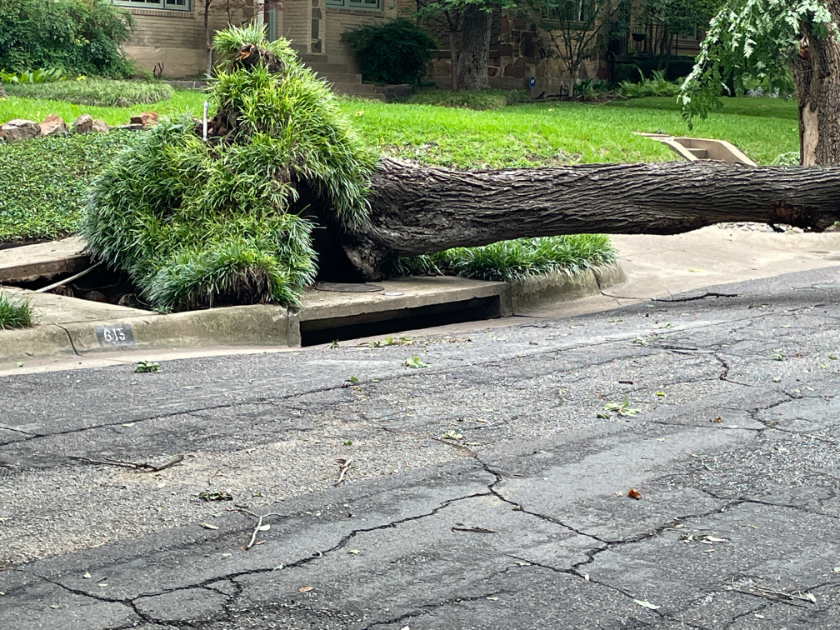
The consequences of storm damage to trees or poor maintenance can take years to manifest. Most damage and potential hazards go unnoticed by the untrained eye. Drought stress, cold damage, construction damage, pests or diseases, bad pruning, and the like are often not noticeable right away, or at all, unless you know what to look for. Deadwood that dropped may not seem important, but it could mean there is existing disease and decay lurking undetected. This is why professional tree inspections every couple of years are a worthy investment in your property value and our valuable urban canopy.
Obviously, not every tree is going to go undamaged or uprooted when directly subjected to 80 mph winds or a tornado, even if they’ve been well cared for. Many of the large trees that are uprooted and downed may have been lifted right out of the ground in the direct path of the storm, their canopies acting as a sort of sail in such winds. When soil is saturated with heavy rainfall, the tree’s root system can’t adequately anchor the tree, and up and over it goes.
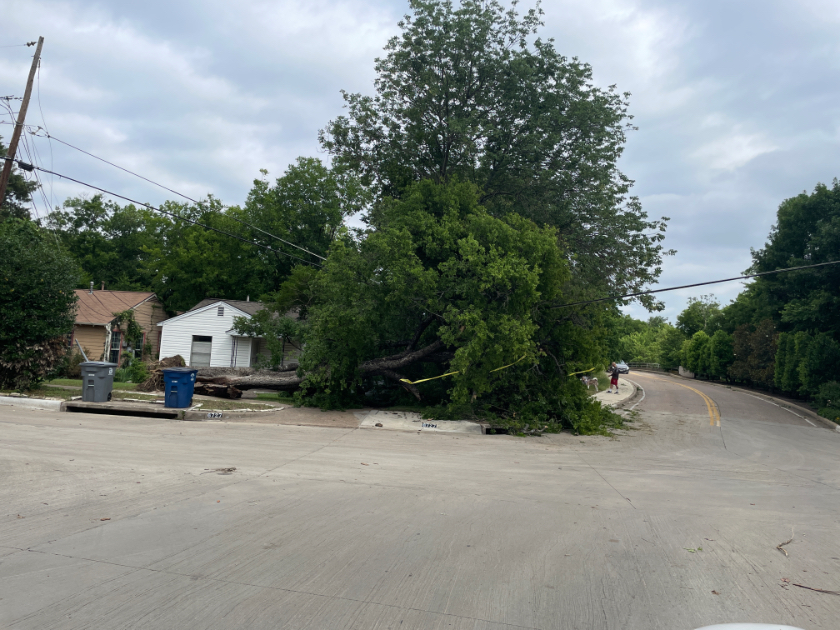
That said, many such uprooted trees were already structurally unsound at the root zone because of surrounding hardscapes such as concrete, pavement, sidewalks, buildings, and driveways. Much of a tree’s feeder roots are in the upper layers of soil. When you physically box in a tree with hardscape, you limit its ability to take up oxygen, water, and nutrients at the root zone, weakening it. When construction is performed around large established trees, and any digging or improper trenching is performed to install such hardscape, you may be literally cutting off half or more of the tree’s root system. The result is often an unstable tree – and possibly a significant hazard – that appears “fine” until it uproots in the next intense storm.

Like me, you may still be surrounded by head-high piles of tree debris lining your neighborhood streets. The city is working hard to chop away at the post-storm tree damage, but it’s going to take a while to clean up the mess. Understandably so. The reality is the trees on our property (as well as the trimmings) are our responsibility, not the city’s. As property owners, we’re also responsible for maintaining trees and vegetation to code on adjacent parkways and to the center of adjacent alleys (even though those trees and plants become city property if you plant there). Before you say, “It’s not my property or responsibility,” you should familiarize yourself with the city code and tree ordinance.
Obstructions Alley/Sidewalk/Street
City of Dallas
Obstructions (Section 18-14)
The occupant or owner is responsible for keeping the street, alley, sidewalk and public grounds clear of obstructions. This includes the trimming of trees, shrubbery and vines which may obstruct any vehicle traveling through an alley, or which may obstruct a sidewalk or street or other public grounds.
If you care about your trees and our urban environment, hire qualified professionals and companies owned by people with both robust educational credentials (degrees and expert professional certification) and experience.
But professional tree care is too expensive!
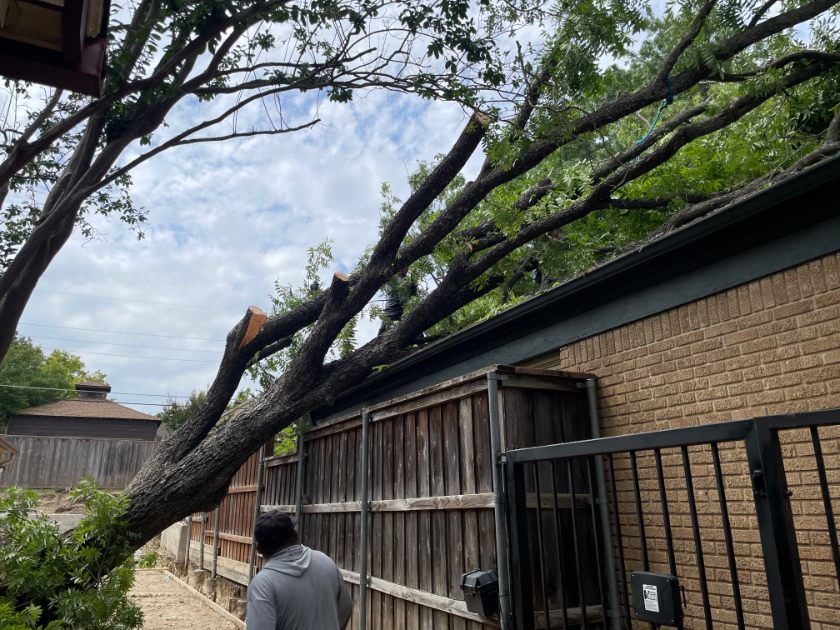
Sorry, but the landscape crews running around with chainsaws and ladders hustling your tree care business are, for the most part, hurting your trees, not helping them. The guys who mow your lawn may be adept with power tools and be easy to work with. That doesn’t make them tree or plant experts. They’ll cost you, and all of us, more in the long run.

Leslie Halleck is a certified professional horticulturist. For more information on preventing storm damage to your trees and properly maintaining them, check out Halleck Horticultural.






Whomever the city has cutting trees aren’t much better. The way they leave trees all chopped up at an any-which-way angle is horrendous. Seems this has only been in the last 10-15 yrs. They must use the same guys then.
Hi Laura, As an industry insider, what I can tell you is that the contractors who have to prune around power lines or for easement clearance have to prune according to clearance needs NOT the structure of the tree. Sometimes there is no way to clear power lines without chopping off half a tree’s canopy. Unfortunately trees planted where they shouldn’t be (under or next to power lines) or alleys, etc. – or trees on residential properties that were never selectively pruned by the homeowner so they didn’t grow to close or into power lines, don’t get pruning that may be best for the tree- they just have to get “chopped” for proper clearance. So mostly, this is not the fault of the city or the electricity/Oncor contractors, it’s simply a plant placement/growth issue. It’s often not pretty, but often simply necessary.