
Dallas Eviction Rates Are Skyrocketing, But is There a Solution in Sight?
Share News:


Dallas evictions are at an all-time high, and to add insult to injury, the City of Dallas says landlords are now retaliating against renters who report code violations.
Nearly 40,000 eviction cases were filed in Dallas County Justice of the Peace courts last year, meaning about 10 percent of renters were removed from their homes. Some of the evictions are done illegally, but often the tenants don’t have the resources to hire an attorney or miss work to appear in court, says Mark Melton, founder of the Dallas Eviction Advocacy Center.
Last year, the DEAC won 85 percent of the cases it tried pro bono in court — so there’s value in just showing up.
Founded in 2020 during the COVID-19 pandemic, the DEAC now has 16 employees and has helped more than 15,000 families navigate eviction.
“The reality is we live in an era of complete noncompliance when it comes to landlords trying to evict tenants,” Melton said in a recent Dallas Housing Coalition webinar. “Part of our thesis is if we are in these courts representing these tenants, at scale, the landlords will necessarily learn the rules and start to follow them.”
Joshua Fechter of the Texas Tribune reported in February that amid high rents, eviction filings in major Texas cities were soaring above pre-pandemic levels. Legal aid groups and housing advocates said there weren’t enough lawyers to keep up with the high volume of eviction filings.
Most eviction cases are filed due to nonpayment of rent, according to an eviction observation project conducted by Dallas-based Child Poverty Action Lab.
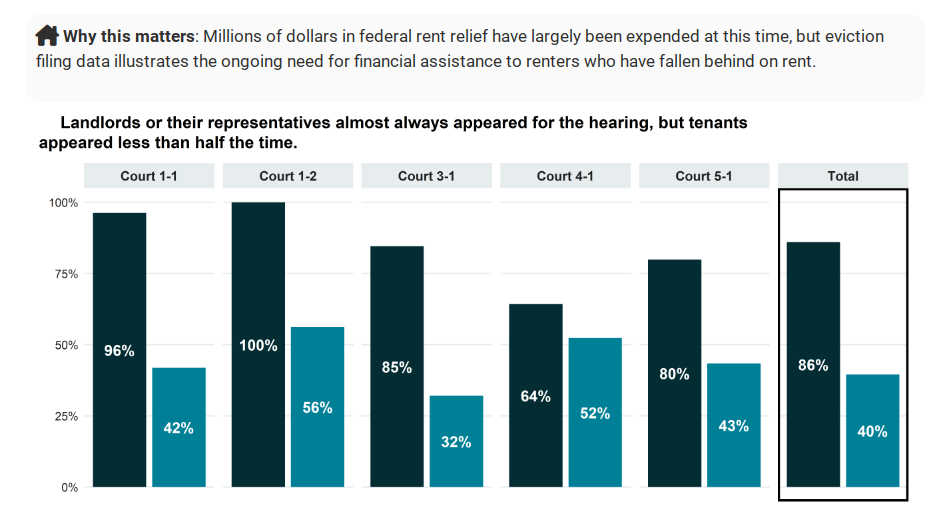
Vouchers and rental assistance programs provided during the COVID-19 pandemic are drying up, leaving hundreds of employed Dallas residents in a situation where they could be facing homelessness. Seventy percent of the people getting evicted are single moms and their kids, Melton said.
“The most common reason we see for evictions is something like, ‘My kid got sick and I had to take three days off work and I get paid by the hour … so I couldn’t make rent,’” Melton said. “That’s why people are getting evicted. It’s not because they’re lazy. It’s because the system does not provide the right support to keep people from it.”
Landlord Retaliation
Dallas Assistant City Manager Jon Fortune issued a memorandum in mid-February notifying Dallas City Council members of an issue with landlord retaliation related to tenant 311 complaints about code violations.

“State law and the city code prohibit landlords from retaliating against tenants who complain to the city regarding the condition of their leased property,” Fortune wrote in his memo. “Specifically, landlords are prohibited from reducing services and/or amenities or attempting eviction.”
Subsequently, the City created a 311 dashboard so residents can report retaliation attempts in addition to code violations. Tenants may also file written complaints with the City Attorney’s Office.
“We are tracking landlord retaliation complaints separately from complaints regarding violations of the minimum property standards through a new service request,” the memo states. “This separate service request will allow residents to follow the progress of their specific concerns; assist city staff in pursuing investigations and related enforcement; and accurately reflect the data associated with landlord retaliation.”
A September 2023 Dallas Morning News report identified the northeast Dallas neighborhood of Vickery Meadow as the area where landlord retaliation was most commonly reported.
Affordable Housing Options After Eviction
At the start of the pandemic when DEAC was launched, it was fairly common to find housing for an evicted tenant at a rental rate of about $1,000 per month, Melton said.

“Those units are almost impossible to find now,” he said. “We’ve seen upwards of 40 percent in rent inflation at the lower end of the market … People’s income didn’t go up by 40 percent. Poverty is becoming more pervasive as a result.”
A 2023 Child Poverty Action Lab report shows a deficit of about 33,000 affordable rental units in Dallas. It’s been pointed out, however, that new housing projects are under construction and becoming available almost constantly. The problem is they’re not affordable.
In response to the “whole affordable housing crisis narrative,” Melton said it’s true there are plenty of units for people to live in, but that doesn’t tell the whole story.
“The people at the bottom end of the market that are living in poverty or near poverty, they can’t afford to live in any of the units that are available in Dallas,” he said. “They can only afford to live in a subset of those units at the very low end of the market. Basically what we have is an oversupply of luxury Class A apartments and we have an undersupply of cheaper, more affordable units across the city and the county.”
Addressing Mass Evictions And Homelessness
Is a solution in sight?
Melton said the number of eviction cases his DEAC team wins dropped from 97 percent in 2021 to 85 percent in 2023, and that shows landlords are following the law and filing their cases properly.
They are still, however, filing a lot of cases. Like most big cities in the U.S., Dallas has a homeless problem as a direct result of the mass evictions.
The solution, Melton says, is to make intelligent investments to stabilize people. It’s a lot more expensive to provide homeless shelters and mental health services, he explained.
A study conducted by The Perryman Group showed that Melton’s DEAC contributed $182 million to the economy and a savings to taxpayers of $40.6 million.
“If you get evicted, it’s really hard to keep a job,” Melton said. “We’re losing economic activity when people go into shelters. On the cost side, the government is spending a lot of money on shelters and on healthcare costs, which go up dramatically for low-income and especially homeless people. We also have criminal justice costs because crime and poverty are correlated. When people become homeless and desperate, they commit more crimes.”
Investing in people would not only solve “the bleeding heart argument” of doing the right thing, it would save taxpayers hundreds of millions of dollars, Melton said.
“It’s just common sense to do it, but we’ve got to show people that it’s true.”