
Here’s a Special Fort Worth Friday, the Vienna Holiday Edition
Share News:


Editor’s Note: When Eric Prokesh calls you from a 16th-century villa in Italy to talk architecture, you answer — even at midnight. This week, he’s off the Fort Worth path again, with a nod to timeless European design. Let’s call this the beautiful crypt edition.
Kaisergruft: A Beautiful Burial, or the Dynastic History Hiding in Plain Sight

What relevance does this crypt have to the 21st century? Well, the assassination of a Habsburg Archduke, ironically interred elsewhere, ignited World Wars I and II. Who knows how much farther along we all might be had he dodged that assassin’s bullet.
This crypt houses only the bodies of the Habsburgs. Their entrails are housed in a special vault below St. Stephen’s and their hearts are encased in silver chalices in the Augustiner Church — all part of the burial ceremony. The tombs here at the Imperial Crypt range from the extravagant Rococo of Maria Theresa‘s bed, shared with her husband Francis of Loraine — who, though unfaithful, managed to give her twelve surviving children (four died). This sarcophagus is the largest and reflects the apex of Austria’s power. Vienna Gloriosa. The conspicuously stark, unadorned, copper casket of her son Josef II, one of Europe’s enlightened despots, in front of his parents’ monument, reflects a dramatic shift in values.
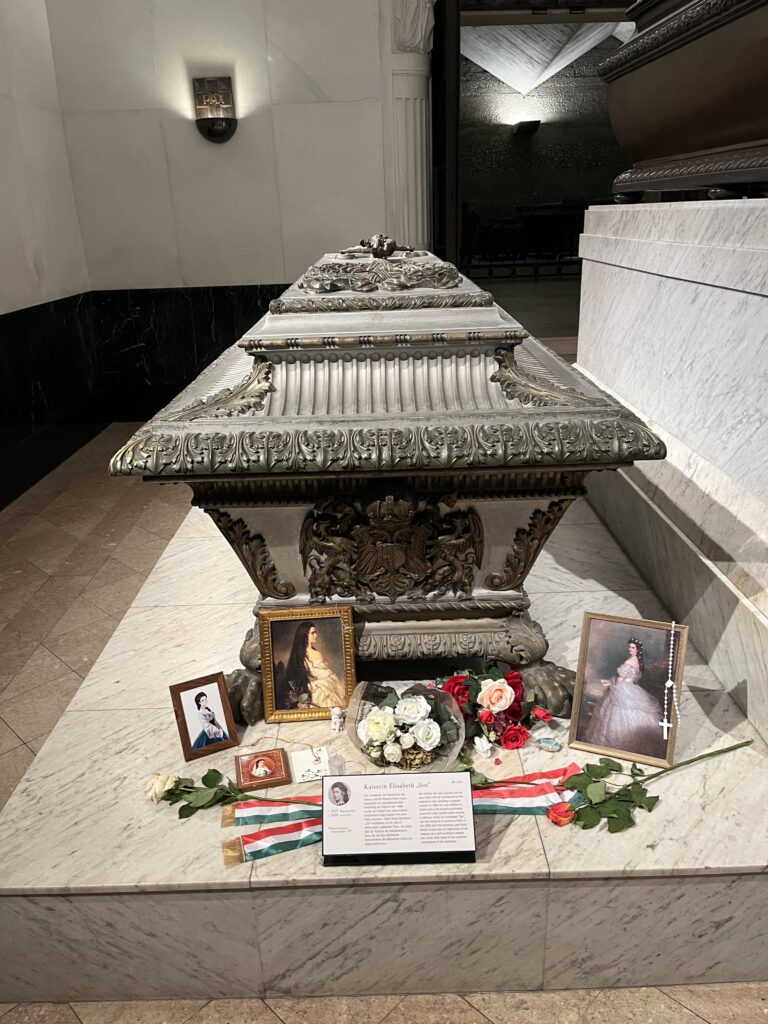
Most compelling is the pitiful story of Franz Josef who survived his wife Elizabeth, assassinated in Switzerland, interred at his left, his son Rudolf who killed himself and his mistress at his hunting lodge in Mayerling at right, and his brother Maximillian, executed in Mexico whose sarcophagus is in the preceding room. Hapless Habsburg, Maximillian’s execution by firing squad was a naively misguided, romantic gesture of self-sacrifice. Juarez would have preferred his escape, which he was given every opportunity of making.
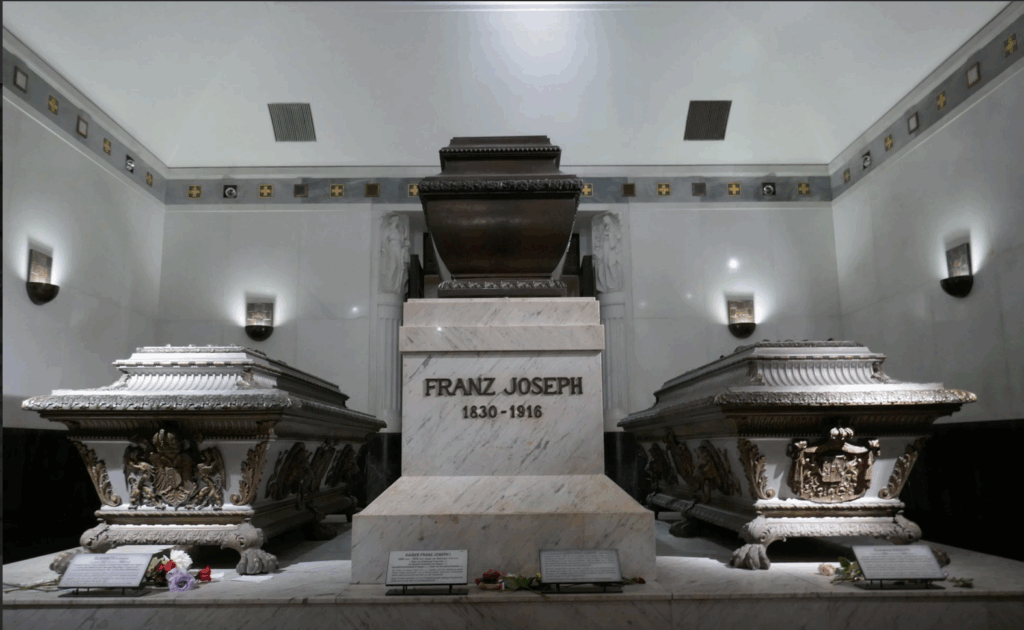
His nephew, Franz Ferdinand, assassinated in Sarajevo, chose not to be entombed here because his morganatic wife, though a countess, was considered a commoner and therefore ineligible for Habsburg burial. Rudolf‘s interment in the consecrated tomb was a very sticky matter, for suicide was then a mortal sin (the murder of his mistress was then not publicly known) and he would not have been permitted a Catholic burial. It required the intervention of the pope and a declaration, probably accurate, that Rudolf was of “unsound mind“ i.e, insane.
The earliest monuments date from the 17th Century. With the exception of Josef II and some of the more modern sarcophagi, they are mostly made of bronze and require intensive intervention to stave off the almost irreversible symptoms of “bronze disease.” Some of the monuments are in of themselves impressive works of art, meant to endure for eternity, but sadly just as prey to the forces of decay as their mortal occupants.
You can read more about the Imperial Crypt here.
Zu Viel Sisi! Too Much Sisi!
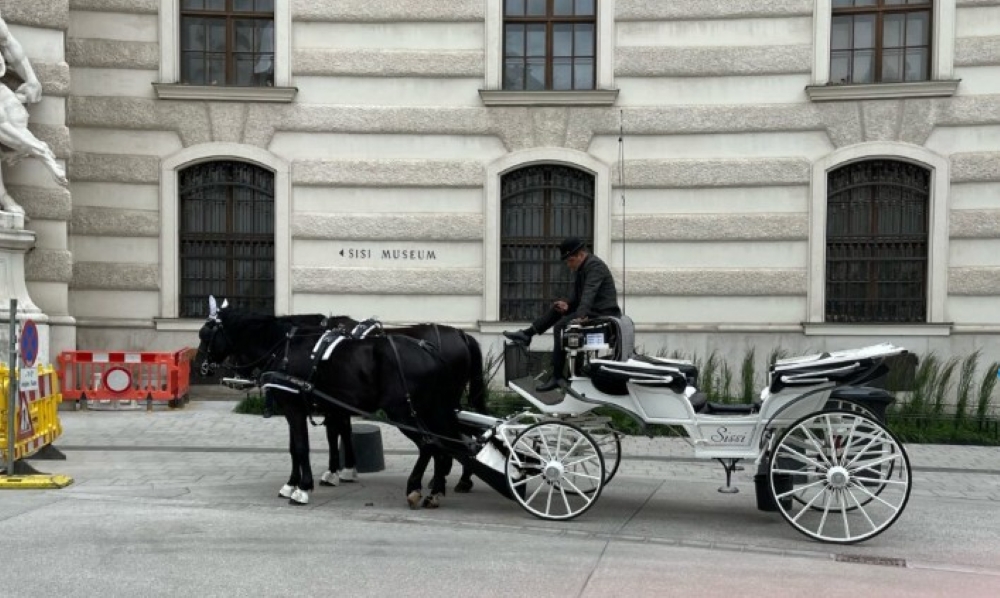
The imperial state apartments have been given a rebranding, no doubt with the intention of popularizing a historic venue. An objet de culte in her own time, the Empress Elizabeth, aka Sisi, continues to fascinate today.
Born into the semi-wild Bavarian Wittelsbach family (her first cousin was mad Ludwig) her life in many ways parallels that of Diana, the late Princess of Wales. She married as a teenager a much older man —in this case, it was a love match, but she struggled to find a meaningful role in the strict, conservative Habsburg court.

Obsessed with her appearance, she set up calisthenic apparatus in these apartments. Eventually, her frustrations resulted in a signed semi-official treaty with her powerful mother-in-law, Sophie, giving her greater freedom and control over her children’s education.
Eventually she became a wanderer pursuing her equestrian passion and retreating often to he villa in Corfu. At the age of 53 she was fatally stabbed while boarding a ferry in Geneva by an Italian anarchist.
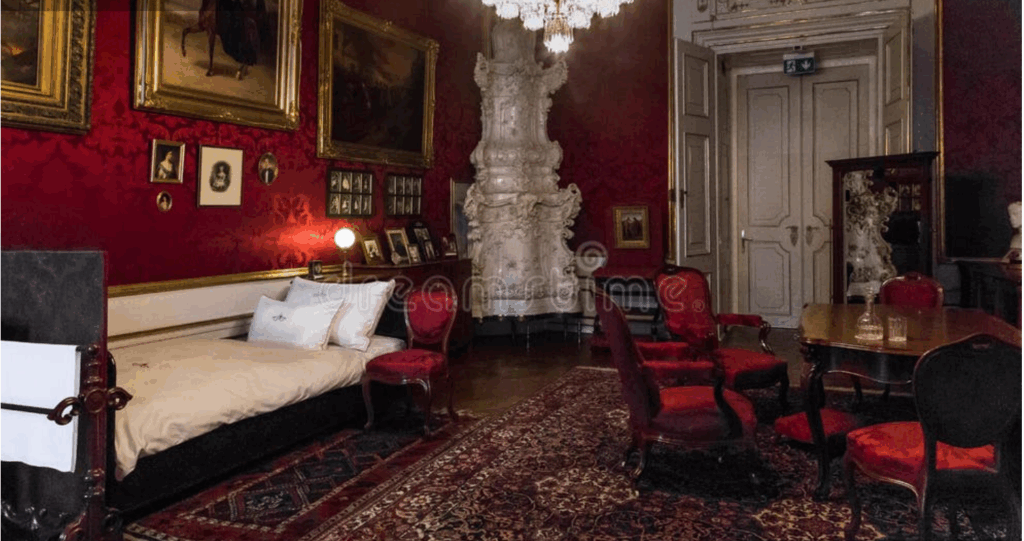
All fascinating stuff. But the disposition of the suite of state apartments has been interrupted by half a dozen dark display rooms with photographs, letters, articles of clothing, and Sisi memorabilia of minor consequence, with the result that one would be forgiven for concluding that Elizabeth was the sole occupant of these rooms.
The web page for the Hoffburg Palace has an overtitle “Feeling Sisi’s aura as a living experience,” which strikes me as a Californication dumb-down of history. Some of the displays, like the Empress’s private rail car, are not without interest, but it’s all rather too much and I wonder why these new additions couldn’t have been shifted to separate rooms in the 1,800-room palace, presenting an opportunity to hawk an additional ticketed attraction.
Read more about the Sisi Museum here.
Public Works Worthy of Notice
I’m always surprised when historians and other observers speak of decadence when describing fin de siecle Vienna, no doubt provoked by the open sexuality of Gustav Klimt, Egon Schiele, and the literature of Aurthur Schnitzler, in their way signs of a new openness and vitality.
One could make a list of the great minds at work in this city circa 1900-Freud, the afore mentioned artists, composers Gustav Mahler and Alban Berg, revolutionary modern designers Josef Hoffmann and Adolf Loos, and the Vienna School of Economics to be brief, and one is astonished at the explosive dynamic energy in play in pre-war Vienna.
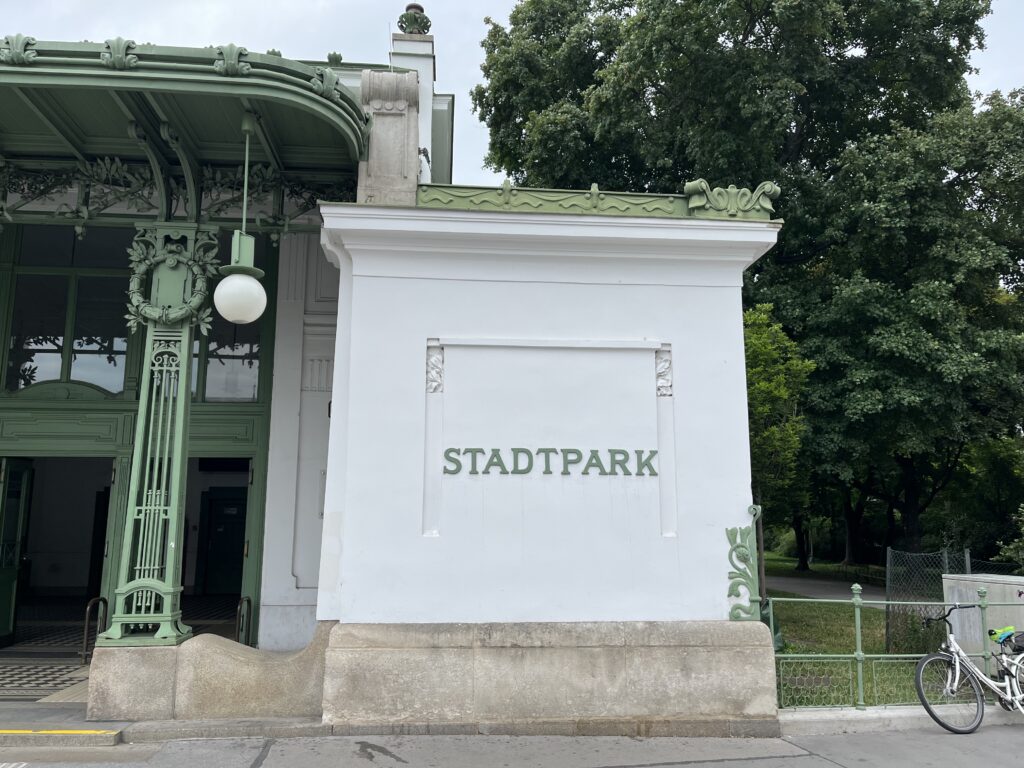
A central figure in the “new city” was architect Otto Wagner. Along with the many private commissions, including Villas and Commercial Buildings, are Wagner’s abundant Civic projects, including Bridges and numerous Metro Stations. Steps from our hotel is Stadt Park Station, one of many that shaped Vienna’s early 20th-century urban landscape. Wagner appears to have been given a free hand in his public commissions to deploy his inventive and innovative designs and has more than any single person put his imprimatur on one of Europe’s loveliest cities.
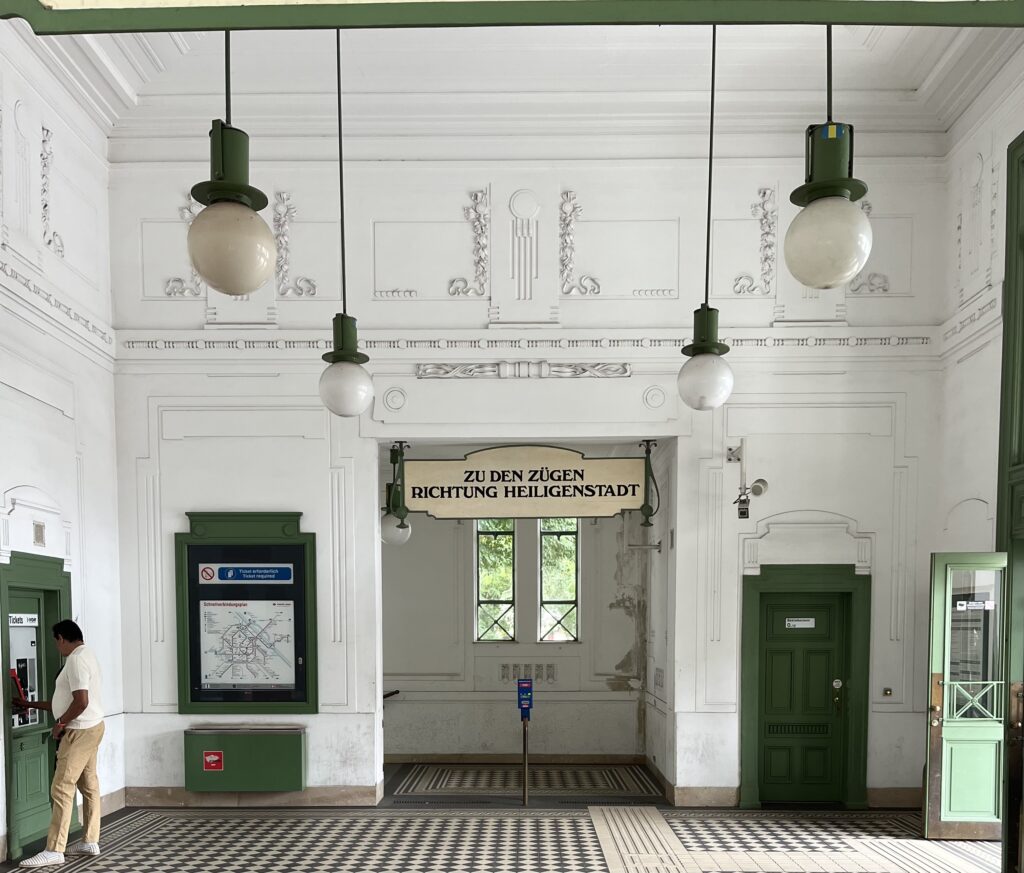
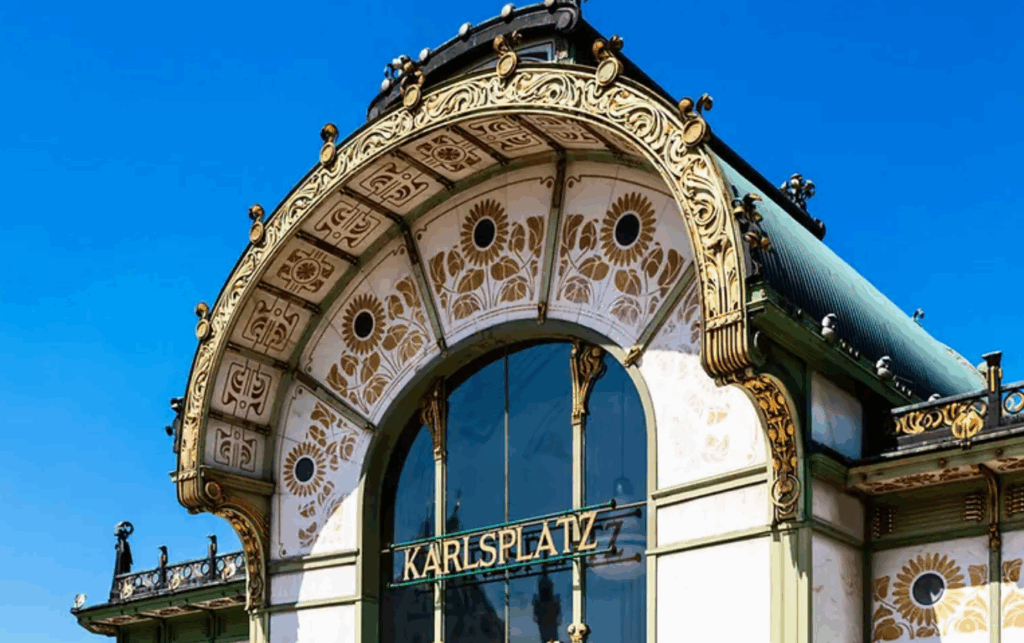
Unlike many early 20th century modernists Wagner doesn’t so much eschew ornament as invent a new modern vocabulary of ornament. Structural elements like bolts, mullions and piers become part of the decorative fabric much as functional gothic buttresses supporting cathedrals.
Read more about the Otto Wagner Pavilion.
Finally, a Torte That Says a Mouthful
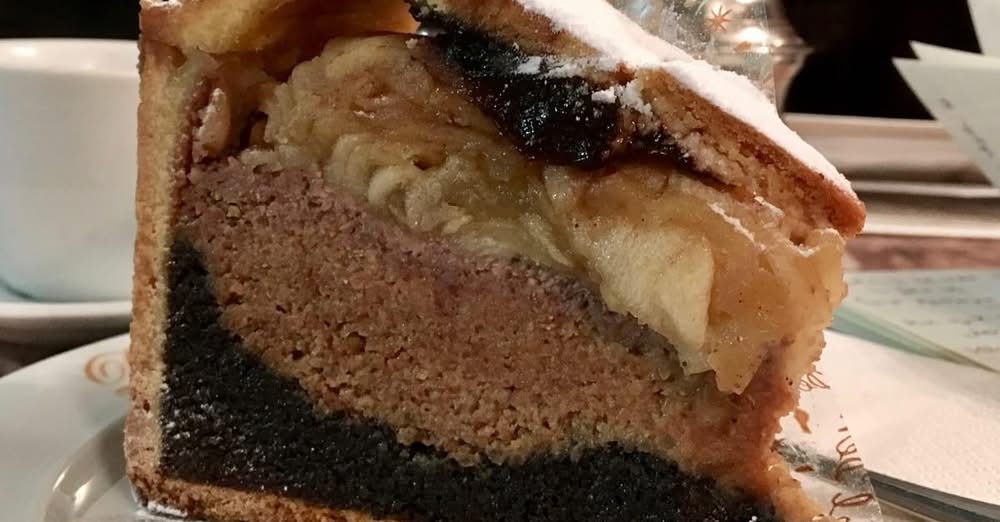
My favorite dessert in the world, and I’ve only ever had it here in Vienna. I always called it Wächer Torte, but could never find one article or mention of it on the internet. I’ve waited 25 long years to indulge, so I headed straight for Demel, Vienna’s celebrated konditerei or pastry shop as my first stop in the city.
Annoyingly Demel, where I consume this confection, doesn’t list all of their pastries on their menu or website. Riffling through all of the little bits of paper that one accumulates daily, while traveling, I found this morning, the receipt from Demel. The mystery cake is in fact Fächertorte,“Fan Cake” — a cake with Jewish Hungarian roots called “Flódni” in Hungary.
It consists of a short crust with layers of poppy seed, honeyed walnuts, thinly sliced apples and a special plum paste called powidl. Actually that most Austrian pastry, Apple Strudel, likely came from Hungary. The Knödel or dumplings probably have Czech-Lands origins. And Wiener schnitzel is essentially Vitello Milanese.
Land in the right cafe and you can delight in tasting dishes bearing the stamp of the far-flung influences of this once imperial capital.
Read more about that fan cake here.
Eric Prokesh is an award-winning interior designer whose work has graced magazine covers and has appeared in books and HGTV.


Concerning fachertorte, Demel in Vienna rivals Gerbeaud in Budapest, and there is a similar competition among the Jewish bakers of the two capital cities. Fachertorte is enjoyed during the Jewish holiday of Purim, during which Queen Esther, who included poppy seeds in her vegetarian diet within the palace, is recognized. Concerning Franz Josef, on August 1, 1914 Germany declared war on Russia, which as you stated led to World War II, and furthermore the Holocaust. August 1, 1914 synchronized with Tisha b’Av, the 9th of the Jewish month of Av, an annual Jewish fasting day. Tisha b’Av commemorates the date on which we were ordered to wander in the desert for forty years, the date on which the First and Second Temples were destroyed, and the date on which the Jewish population was expelled from England in 1290, and 202 years later from Spain. Eric, please enjoy the Continent and teach us more about European architecture and design.
Well the original domino, No? Austria declared war on Serbia, in retaliation, Russia on Austria who cashed the blank check from Germany. The unsettled business and grievances of WWI led after a twenty year “truce” to WWII. I still feel it here to this day. Quite literally to this day. Today in Karlskirche the recessional at mass was a little Austrian hymn by Haydn which I think is illegal in Germany. It was reworded as Deuctchland, Deutchland, Über Alles…In Austrian history there was a singularly horrible program in Vienna in the 15th Century of which you are no doubt aware.